




High Noon in the Philippines
What is wrong with the Philippines? Plenty, I guess, but nonetheless I may have to reserve the answer towards the epilogue of this piece.
To begin with, like the rest of the world where an administrative and civil elite exists to advise the government on matters of economics, politics, reform and defence, that institution alas, is virtually non-existent in the Philippines.
And even supposing it did, just where is it now or for that matter during all those times when the country careened from crisis to crisis over the last 20 years?
If it gives a sensation it is back to the same old rigmarole in the Philippines - well it indeed, is?
What is wrong with the Philippines? Plenty, I guess, but nonetheless I may have to reserve the answer towards the epilogue of this piece.
To begin with, like the rest of the world where an administrative and civil elite exists to advise the government on matters of economics, politics, reform and defence, that institution alas, is virtually non-existent in the Philippines.
And even supposing it did, just where is it now or for that matter during all those times when the country careened from crisis to crisis over the last 20 years?
If it gives a sensation it is back to the same old rigmarole in the Philippines - well it indeed, is?
With corruption and cronyism ceaselessly double-teaming to claim one leader after another, the story of the Philippines, as usual is a familiar one.
Or if one is looking for a metaphor, it is 'movie' time all over again in the Philippines!
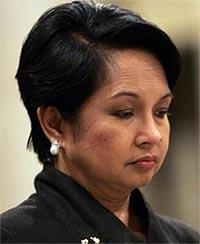 And like all previous movies this one too, is shot in Manila albeit with a different cast. It stars, its current sitting president, Gloria Macapagal Arroyo the scion of the famous family of former president, Macapagal, who for all intents and purposes could be feeling a tad inglorious about the controversies swirling around her midst.
And how her political fortunes plays out, may rightly or wrongly, hinge now on the scenes in the streets of Manila, which over the last three months has been dramatised by loud calls for her to resign following allegations that she rigged the last presidential election.
Catapulted to power in 2001, before impeachment hearings against her predecessor Joseph Estrada could even be completed, Arroyo is no stranger to controversy. Her actions four years ago, was not only unpopular but the sense of deja vu she herself maybe feeling, cannot be understated by the desperate attempts she made urging Congress to sign defective impeachment documents.
By such an urging, she was probably attempting to escape the gauntlet, the prospect an impeachment may bring.
Tenuous times
That she is morally corrosive cannot be said enough, by the open acknowledgment she herself made of corruption in her administration. In compounding matters further, she has even done a Marcos double, i. e. use funds meant for land reforms for her own political survival.
So therefore, depending on what the momentum of the street protests are, these are indeed tenuous times for the Philippines.
And with any other movie that reaches for a climax, it would only materialise once the clergy of the Roman Catholic enters the fray, or the possibility thereof.
Along with the military, both these institutions hold the key levers of power in the Philippine society. And, if Arroyo's cares to remember, the combination of the two was just what proved pivotal in the downfall of Marcos.
So, this is turning out to be a re-run of an old movie, and as always the president is directing it.
And if there is a name for this movie, it better be High Noon.
How much of a sensation that was, cannot be more keenly felt than to talk about the so-called 'reprieve' she won in her country's legislature, when the bid to impeach was defeated.
That's only because, Arroyo's opponents failed to muster the majority of votes needed in the House of Representatives, to proceed with hearings against her.
With just 51votes in the 236-seat chamber, it simply lacked the ammunition to assassinate her presidency. Nonetheless, the opposition plans to take the fight to the nation's Supreme Court promising, as otherwise to paralyse the nation if that should come to pass.
So, where does all this leave the Philippines - at a stalemate, off course. That however, will be too soon a rush into judgement.
What Arroyo can count on, unlike the episodes with Marcos and Estrada, is the distinct lack of an alternative leader whose moral fibre can be equated as vastly dissimilar from hers at its best.
So, with time on her side, she is therefore safe and secure.
And with the economy registering some 4.8 percent growth even during political uncertainties though much of the revenue comes from Filipinos remitting payments to the tune of US$3.5billion annually she does seems to be doing what she was elected for; i.e. improving the livelihood of her peoples.
Destined to fall
In the final analysis, if ever Arroyo needs a comparison, nothing is more apt than her father, the late president Macapagal. Under his watch, the economy not only strengthened but also the promised reforms, were actually carried out.
 So, if movies are all about happy endings, that does not seem to be what it is now with the script Arroyo has. Illegitimate as was her rise to power in 2001, she seems destined to fall by the very sword she wielded against former president Joseph Estrada.
If what goes around does come around, that indeed seems to be just what is happening with streets protests and court applications.
It is now Arroyo's turn to bear the brunt of people power that unique feature of Filipino democracy that originally starred former president Ferdinand Marcos - now resting quietly in a glass case.
JAYA PRAKASH lectures in journalism at Beacon School of Technology (www.beacon.edu.sg)


