




AP: Another episode in a political soap opera
The latest episode in the unfolding melodrama of the minister and the AP she approved has reached another climax this week. The usually invisible and ineffectual parliament has provided the stage this time for hounding the minister, for failing to answer questions on the issue in the august House in person.
Those untutored in the finer points of Malaysian democracy at work would have gotten the mistaken impression that the Malaysian Parliament has finally come of age, playing its role as the highest political forum of the land, and bearing heavily upon a prominent member of the administration to give an account of her decision.
Alas, not many things are what they seem in this country. The latest episode in this political soap opera smacks of the kind of intrigue that must have been the daily fare in the palace courtesan politics in days long gone.
The latest episode in the unfolding melodrama of the minister and the AP she approved has reached another climax this week. The usually invisible and ineffectual parliament has provided the stage this time for hounding the minister, for failing to answer questions on the issue in the august House in person.
Those untutored in the finer points of Malaysian democracy at work would have gotten the mistaken impression that the Malaysian Parliament has finally come of age, playing its role as the highest political forum of the land, and bearing heavily upon a prominent member of the administration to give an account of her decision.
Alas, not many things are what they seem in this country. The latest episode in this political soap opera smacks of the kind of intrigue that must have been the daily fare in the palace courtesan politics in days long gone.
Let us recapitulate briefly the genealogy of events thus far.
The first salvo in the whole affair was fired, not by the opposition, but by a former prime minister who also happens to be a former mentor and boss of the current minister in charge of the portfolio over the AP issue.
There are no rules on how a retired PM should behave of course. Former US presidents Bill Clinton and Jimmy Carter tend to play a non-partisan statesmanlike role, and they seem to bend backward in not criticising or supporting the current administration in Washington, at least not too urgently. But we do live in a different country, and that is that.
If the minister had been a member of MCA or the MIC, the controversy would probably have taken another course. In this instance, the AP minister is a leading light in Umno, the head of their powerful Wanita wing, and a long serving member of the cabinet.
Given the uncertainty and the unseen but volatile undercurrents of realignment of power within Umno in the post-Mahathir era, it is not surprising that the issue has become an instrument of intra-party intrigue in the recent Umno general assembly.
Restoring face
You would hope that the Umno delegates would demand fair-play, justice, and transparency in government, and that a meaningful debate on the weaknesses of the NEP would have resulted. Instead, the lady minister concerned was accused of bad etiquette in her abrasive rejoinder to her former boss, and an apology was demanded for the sake of restoring face to this very distinguished personage.
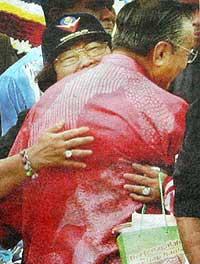 By now, we are familiar with the public display of what should have been private emotions, the tearful lament for a lost relationship on the part of the allegedly guilty party, and the cold shoulder given by the other protagonist. Even a good natured hug in public was ridiculed. The cut and thrust of the daggers may have taken the more civilised form of symbolic gestures, but the violence and cruelty remain none the less. This is palace politics at its best, the stuff of which Malay legends are made.
Nevertheless, the issue is a real one, and refuses to go away quietly, partly due to a press that has smelled blood and profit. It is logical that the current sitting of the Budget Session of Parliament should become the next act in a play the concluding chapter of which is yet unpredictable.
The Opposition Leader has played his role well, a role with which he is familiar. His point is legitimate of course. For many decades past, the ruling coalition has always treated the Parliament like a department under the Prime Minister's Office. To call it a rubber stamp is very often an insult to that useful office equipment.
The oral question and answer session at the beginning of daily sitting is one of the most important institutions in Westminster-styled parliamentary democracies all over the world. In the UK, in the House of Commons, the career of an MP or a government minister may be made or broken based upon his performance during this part of the parliament proceeding. I vaguely remember reading somewhere that the British prime minister goes to Parliament to answer oral questions directed at him at least once a week.
In Malaysia, the moribund state of our parliamentary democracy is evident from the fact that the prime minister and his cabinet colleagues with the possible exception of Samy Vellu -seldom answer oral questions in the House. One of the deputy ministers or an inconsequential parliamentary secretary is usually sent to do the job.
Now a deputy minister or a parliamentary secretary is not a member of the cabinet. They do not attend the cabinet meeting which is held every Wednesday. They do not carry the legitimacy, the authority and the knowledge of a full minister. Often, it is a matter of political skills and ability. The performance of some of these second echelon government front benchers is nothing less than mediocre.
Naturally, opposition members and government backbenchers are dissatisfied. After all, many do want to do a good job in this the most important function of their office. They raise queries about the absence of the minister, and are often told that the minister is attending another meeting elsewhere, or that he is travelling abroad.
Resort to conventions
The implication is clear: Parliament is not important to the cabinet members, when in fact, in a healthy democracy, answering to the rakyat by facing their elected representatives is one of the most important obligations of a minister!
The Opposition Leader is right on another count. In a parliamentary democracy, the Parliament operates by virtue of provisions under the Federal Constitutions as well as the House Standing Orders. Where these are silent on certain matters, Parliament has to resort to conventions.
 In this instance, the Opposition Leader probably has in mind the principle of "ministerial responsibility", the idea that a minister is finally accountable for all matters within the jurisdiction of his ministry. It is a gentlemanly understanding that, within the context of the controversial AP issue, the minister ought to be in Parliament to answer all pertinent questions in person. The buck stops there, or so it ought to.
The minister can, if she pleases, invoke another parliamentary convention in her defence. All members of the government including deputy ministers and and parliamentary secretaries - do work on the principle of collective responsibility and collective leadership.
There is no room for dissent against a cabinet decision, unless the member is prepared to resign from his position. By virtue of the same principle, not only can a deputy minister and a parliamentary secretary within the minister's own ministry, but any government member from any other ministry can reply to oral questions in Parliament. It is a matter of preparation, working out the reply with the help of senior ministry officials.
And this is the weird part. The cabinet has made a decision directing the minister in charge of international trade and industry to be present in Parliament to answer all queries on the AP controversy. The decision was announced by the DPM and widely publicised in the press.
The strange decision is tantamount to a proclamation that the cabinet has suspended its principle of collective leadership and collective responsibility, and that the minister concerned would have to clean up her own mess without explicit or tacit support from the cabinet, as if the entire cabinet wishes to distance itself from the whole hornet's nest.
This sort of directive cannot be construed in any other way except that it is a disguised vote of no confidence in the minister. She probably sensed the humiliation and the pressure. It is no coincidence that she begins to mumble about how she is not indispensable, and that she would resign if asked to do so by the PM. The demand of honour would have compelled her to resign on her own accord, without being asked.
Missed opportunity
The PM's ambiguous silence on the entire AP fiasco is pregnant with implications of course. The forces of courtesan politics are obviously at work, and your reading between the lines is as good as mine.
 Unfortunately, the focus of media attention has been directed to the drama of personality conflicts, between the minister and her former mentor, and between her and the Opposition Leader.
The loss can only be measured in terms of the cost of missed opportunity. In an ideal world, or at least in a healthier parliamentary democracy, media and parliamentary debates could have been directed towards the crucial issue of the weaknesses of the NEP, both in principle and in implementation, including a review of the many failures to help those bumiputeras truly in need of government assistance in their effort to benefit from the nation's industrialisation process.
Then again, the debate could have been turned on what actually is the heart of the matter: the National Car Policy. The National Car Project is the leftover from a previous administration. After two decades or so, hindsight should at least alert policy makers to the wisdom and the folly of this nationalistic project which has cost so much to so many Malaysians with little feasible economic return so far. With the uncertainty of a globalised world, especially in the automobile industry, should it not be a time for honest soul searching and rational reappraisal?
Unfortunately, by portraying the AP controversy as a melodrama involving only the rich and the powerful, the real issues that affect national interest and the economic well-being of the people have been conveniently swept under the parliament's thick carpet. The demand for transparency on the issuance of AP has finally turned out to be a farce, a sandiwara , and no more.


