




Vacancy: Caring govt needed
When it comes to paying for transportation, Malaysians have been suffering for a long time. And the suffering is not getting any better as the country inches closer to her 2020 vision. As a matter of fact, it is getting worse.
When it comes to paying for transportation, Malaysians have been suffering for a long time. And the suffering is not getting any better as the country inches closer to her 2020 vision. As a matter of fact, it is getting worse.
The recent big jump in fuel prices is just one in a long list of examples.
First, let me bring up the issue of road tax. Not only is the tax high compared to most countries, but Malaysia has an ancient system that requires car owners to pay based on the engine size the bigger the engine the more you pay.
It is a system which goes beyond logic. Do cars with bigger engines take more space on the road or erode the road faster? No! This system is ridiculous and unfair.
I've traveled to and lived in many countries, and in all those countries, perhaps with the exception of Singapore, drivers pay lower road tax and the system does not discriminate in regards to engine size.
 For example, here in Qatar the tax we pay for a car is 65QR or about RM65 per year, whether one owns a Daihatsu Sirion (similar to Perodua Kelisa) or an ubiquitous Toyota Land Cruiser (with a 4.5 or 4.8 litre engine).
The road tax system in Malaysia is even more ridiculous for motorcycles where the owner of a small moped-type cycle pays no or little tax whereas those with 500cc engines pay at least RM400 per year (more than the road tax for a Kancil!).
Considering the fact that Malaysian roads are congested and the petrol price so high (another issue which I will touch below), it makes sense to encourage more people to ride bikes than drive cars. Furthermore, bigger bikes are a lot safer than the mopeds.
Made-in-Malaysia cars
Second, the price of cars in Malaysia is high compared to most other countries. Malaysians have sacrificed a lot just because some politicians have big egos (read: to have made-in-Malaysia cars).
With the advent of Proton and Perodua, Malaysians have to pay more when they want to buy a car. Before Proton, a similar car would cost about RM30,000-40,000 (at today's price). How much does one have to pay for a Proton Wira now?
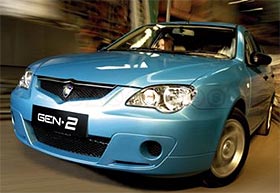 A few months back, Doha Motor (the distributor of Proton cars in Qatar) launched the Gen-2. I happened to notice the quoted prices in the local newspapers which started around RM40,000 for the lower end or basic model. But, how much does a similar model cost in Malaysia?
Granted, for anyone to venture into car manufacturing, it requires a huge investment. But, this investment should not be recouped in such a short period at the expense of tax-payers? The thing is, even after the initial investment is recouped (after producing the first million units) the price of Proton and Perodua kept going up and up.
A car is no longer a luxury but an essential item for today's consumers.
Now that they have recovered the initial costs, the prices should be lowered by taking lower profits so long as they still make money out of the sales. After all, it is the tax-payers and mostly the citizens who are buying the cars. Why can't the companies be more caring towards the tax-payers and citizens? After all, they have been supportive, albeit involuntarily.
Also, why can't they sell the cars at a lesser rate than export prices? Thus, it is possible that Malaysians again are paying the price in order to have local cars enter foreign markets.
Perhaps, the politicians are not aware of the suffering of the citizens, since when they want to buy a car, they are entitled to a tax free car (they each get an Approved Permit or AP). Because of this, they naturally opt for the luxury and branded foreign cars at a fraction of the price.
In business, a company needs to be competitive to survive and grow. In the early stage of its development, it is reasonable for the company to receive a certain amount of protection from the government from other competitors while it develops its competencies and builds up strength. But, it cannot go on receiving protection forever. With less protection, it will have to find ways to be more competitive, effective and efficient in its operations.
Thus, competition is not only good for the company but it is good for the consumers as well. It will result in the company making better cars and in consumers getting better prices.
Further, the companies will be more ready to face the challenge of the Afta (Asean Free Trade Agreement), where more and more cars will enter the local market. Being competitive will also put them in a better position to enter the much bigger Asean markets as well.
With the trend of the automotive industry moving towards consolidation and rationalisation, it might be imperative that local companies will have to collaborate and build an alliance or a new business model with other foreign partners, bearing in mind that within the next decade or so, there will perhaps be only three of four car companies in the world.
Tolls here, there, everywhere
The third related issue is the toll, which is becoming increasingly more rampant and widespread in Malaysia. It seems that the government now has stopped constructing free roads for the people.
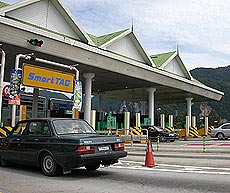 Any new road that emerges will include toll booths, again to the dismay of tax-payers. What has happened to the need for the government to be ethical and socially responsible?
Building roads and other infrastructures is essential to the country's development but it should not be for the benefit of certain private companies.
In other countries, toll-roads are built so that people can use it to avoid congestion, particularly during peak hours. In other words, if you don't want to pay extra and you can stand the slow traffic, then use the free roads. Such is not the case here.
For example, if you want to go to Kajang from Kuala Lumpur or to Kuantan from Kuala Lumpur, you no longer have the alternative to go on non-toll roads. Also, the choice of the non-toll roads, if available, is such a contrast compared to the toll roads, in terms of condition, traveling time and distance.
Besides, if we compare the Malaysian toll rates with the rates in other countries, chances are Malaysian drivers are paying a lot higher, particularly when we compare their disposable incomes.
Latest burden
Last but not least, is the latest burden for tax-payers - the increase in fuel prices.
 Since Malaysia is a net exporter of petroleum why should her people be burdened with such a high increase in petrol and diesel prices? Since we do have the resources, why not let the people enjoy the benefits? After all, they are already paying much in order to maintain and drive their cars.
Why can't the government be more caring? If the issue is to prevent smuggling by unscrupulous people, why can't there be other initiatives such as tightening border control?
The thing is, increasing fuel prices will have consequences on the prices of other goods since petrol is an important input for other industries and not just for the transportation industry.
On the whole, we can easily come to the conclusion that Malaysia (or rather her political masters) are not a caring lot.
With the increase in accessibility to information and knowledge something that the government has been encouraging and facilitating - Malaysians are now more matured. The people now expect nothing less than a caring government, a government that is sensitive to their needs and desires, in line with the country's aspiration to become a fully developed nation by 2020.
It is now time for the government to fulfill the people's wishes before it is too late. After all, the next general election if not too far away!
MOHAMED ZAI PhD is professor of Technology and Strategic Management at the College of Business and Economics, University of Qatar, Doha.


