




Spore's communist 'threat' - was it real?
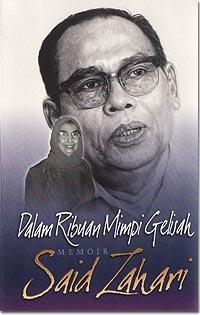
In his latest Malay-language memoirs Dalam Ribuan Mimpi Gelisah (Utusan, Kuala Lumpur, 2006), former editor-in-chief of Utusan Melayu and Singapore political detainees for 17 years, Said Zahari challenges the official reasons for the island-state's two rounds of mass arrests of political dissidents in 1963 and 1987 respectively.
According to Said, Operation Cold Store which saw himself and some 100 other leaders and activists of opposition parties, trade and university students' unions as well as journalists detained without trial on Feb 2 that year was to ensure that "the political security of Lee Kuan Yew and PAP (People's Action Party)" would not be threatened by "a democratic movement " led by the now defunct Socialist Front and People's Party. (p.53)
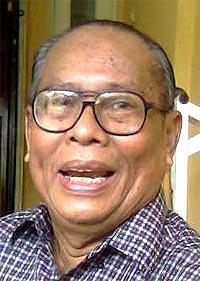
Said himself was detained without trial for 17 years from 1963 to 1979. He was first accused as "a communist" and then "an Indonesian agent" but he was never charged in any open court.
In his latest Malay-language memoirs Dalam Ribuan Mimpi Gelisah (Utusan, Kuala Lumpur, 2006), former editor-in-chief of Utusan Melayu and Singapore political detainees for 17 years, Said Zahari challenges the official reasons for the island-state's two rounds of mass arrests of political dissidents in 1963 and 1987 respectively.
According to Said, Operation Cold Store which saw himself and some 100 other leaders and activists of opposition parties, trade and university students' unions as well as journalists detained without trial on Feb 2 that year was to ensure that "the political security of Lee Kuan Yew and PAP (People's Action Party)" would not be threatened by "a democratic movement " led by the now defunct Socialist Front and People's Party. (p.53)
Said himself was detained without trial for 17 years from 1963 to 1979. He was first accused as "a communist" and then "an Indonesian agent" but he was never charged in any open court.
 Said recalls that Operation Cold Store was justified by the Internal Security Council, which comprised of the security authorities of Singapore, Malaya and Britain on the ground of "saving" Singapore from "communism" because there was a "communist" attempt to overthrow Lee's PAP government in Singapore" and the attempt "threatened the security of Malaya". (p.48)
However, Said reasons in his memoirs that at that period, the Communist Party of Malaya (CPM) had retreated to the Malayan-Thai border and suffered from strategic "low tide" since the 1950s, especially after the failed 1955 Baling Peace Talks.
Moreover, the guerilla forces on the Malayan-Thai border were still bogged down by the military operations of "Britain's colonial army".
As Said further reasons, the 1948 anti-communist 'Emergency' had been declared over in independent Malaya by 1960 and CPM's secretary-general Chin Peng had also left for China in 1961.
Said also asserts that even Britain's colonial intelligence organisation itself "knew and admitted" at that time that "there was no more organised and active CPM organisation in Britain's last Southeast Asian colony in the past several years". (p.52)
Reverse Domino Theory
Said opines that the alleged "communist strategy" of taking over Singapore first and using the island-state as a springboard to launch offensive into Peninsular Malaysia was a kind of "reverse Domino Theory". (pp.50-52)
Said says: "I don't believe at all that there were any CPM leaders who would device a policy to achieve a political objective that was so naive and unrealistic". (p.53)
 Said also explains that the original Domino Theory, which was first "invented by the imperialists in the context of the Cold War", postulated that communist forces would sweep down from China to Indochina and then Thailand, Peninsular Malaysia and, finally, Singapore.
Reflecting on another round of mass arrests of political dissidents in Singapore in 1987, Said says that he "laughed cynically" when he heard young female lawyers Teo Soh Lang, Tang Fong Har and their friends were detained without trial on May 21 that year for being involved in an alleged "Marxist plot" to turn Singapore into "a communist state".
"Communist Singapore" in 1987?
Said says he had known Teo and some of her friends after his release in1979 and, according to his observation, they were only concerned with the "pollution of democracy" and " violation of basic human rights" in Singapore under "Lee Kuan Yew's regime".
He recalls that Teo and her friends were interested to "hear stories" about his life and experience while under detention and they also found it hard to believe that he could "stand that long" (17 years).
According to Said, after being released from their May 1987 detentions, Teo and her friends were arrested, also without trial, for a second time in April 1988 for issuing a public statement alleging tortures during their first round of incarceration.
That statement, signed by Tang Fong Har, Tang Lay Lee, Kenneth Tsang, Teo Soh Lung, Ng Bee Leng, Chang Suan Tze, Yap Hon Ngian, Wong Souk Yee and Kelvin De Souza, is reproduce in full in Said's memoirs as an appendix.
In his memoirs, Said also records, with considerable detail, his memory of the physical and psychological torture suffered by him and other detainees in both the 1963 and 1987 arrests. In particular, he recalls the severe psychological destabilization suffered by Lim Chin Siong and another fellow detainee who tried to commit suicide but saved by a Gurkha prison guard.
Critique of Chin Peng's memoirs
On the memoirs of the CPM secretary-general, titled Alias Chin Peng: My Side of History , Said says that having read it, "many people" are surprised that the book "does not cover the history of CPM in Singapore ".
"Many people asks why the CPM stories in Singapore were not written by Chin Peng, moreover, the name of Fang Chuang Pi is not even mentioned in Chin Peng's memoirs," he adds. (p.143)
Alias Chin Peng: My Side of History was published by the Media Masters in Singapore in 2003.
In his memoirs, Chin Peng clarifies that former Singaporean student leaders Tan Wah Piow and Juliet Chin as well as economist James Puthucheary and his lawyer brother and former Gerakan MP Dominic never joined the CPM, although they were once alleged in Singapore to be so.
 Also, Chin Peng states at the outset that the book is merely a personal recount, not a complete history of the CPM.
In early October 2004, Chin Peng also paid a historic but low-profile three-day visit to Singapore and was invited to lecture in a close-door seminar organised by the Institute of South East Asian Studies (ISEAS).
Since the inception of the CPM in April 1930 in Kuala Pilah, Negeri Sembilan, Singapore had been the main base of its top leadership until 1942/43 when the majority of its top leaders and cadres were arrested and executed, and its organisation and networks destroyed, by the Japanese military administration.
In the period between September 1945 and June1948, the semi-legal CPM, which seconded its cadres like Eng Ming Ching (later known as Suriani Abdullah) to the British Military Administration (BMA), operated an open office in Singapore at Queen Street. There were also similar open offices in Ipoh's now Jalan Laksamana and Kuala Lumpur's Jalan Tun Tan Cheng Lok.
Said also reveals that, in order to find out more about what was said to be the CPM-PAP united front in the late 1950s, he traveled to Southern Thailand in an attempt to meet Fang Chuang Pi, the man said to be CPM's "plenipotentiary" ("The Plen") in forging the said anti-colonial united front but Fang passed away in Yala in February 2004 before any meeting took place.
In any event, Said says in October 2003, he succeeded in meeting CPM chairperson Abdullah CD and central committee members Rashid Maidin, Suriani Abdullah (aka Eng Ming Ching) and Abu Samah Mohd Kassim. They were the leaders and commanders of the all-Muslim10th Regiment of CPM's Malayan National Liberation Army (MNLA) and their collective account of CPM's struggle is now published in a University Kebangsaan Malaysia monograph Gerakan Kiri Melayu Dalam Perjuangan Kemerdekaan (Bangi, 2006) authored by Dr Mohamed Salleh Lamry.
According to Said, he stayed with them for five days to record their versions and accounts of their armed struggle against British colonialism under the leadership of CPM after the declaration of the 1948 'Emergency' by the colonial authority.
Dalam Ribuan Mimpi Gelisah is prefaced by Professor Dr Nik Anuar Nik Mahmud of Universiti Kebangsaan Malaysia's Centre of Historical, Political and Strategic Studies and published by Utusan Publications & Distributors.
JAMES WONG WING ON is chief analyst of Strategic Analysis Malaysia. He is a former DAP member of Parliament for Kampar (1990-1995) and a former columnist for the Sin Chew Jit Poh Chinese daily (now Sin Chew Daily ). He read political science and economics at Monash University in Melbourne, Australia.


Are you sure you want to delete this comment?
This action cannot be undone.