




Mad-cow disease in the Holy Cow
For about a month now, a titanic controversy has been ravaging through the Chinese imagined landscape, although there is hardly a whimper about it in the English and Malay press.
Allegations of kick-backs and corruption among Chinese primary school principals have sent shock waves throughout the Chinese public space across the country. The first salvo was fired by some panel speakers taking part in a forum discussion on one of the Astro Chinese channels. It has since been picked up by the printed press, notably the Oriental Daily , and widely debated on the Internet. Even today, the deluge of daily public opinion on the subject shows no sign of subsiding.
Shortly after the Astro broadcast, a prominent member of the board of management of one KL Chinese primary school published in the Oriental Daily a half-page advertisement, offering a reward of RM500,000 for any information that would reveal corruption among any Chinese school principal. Overnight, the issue became public sensation.
There was an explosion of public outpouring on the subject. Opinion-makers, columnists, writers, educators and parents all joined in the fray, and a long-standing secret has suddenly come under public scrutiny.
For about a month now, a titanic controversy has been ravaging through the Chinese imagined landscape, although there is hardly a whimper about it in the English and Malay press.
Allegations of kick-backs and corruption among Chinese primary school principals have sent shock waves throughout the Chinese public space across the country. The first salvo was fired by some panel speakers taking part in a forum discussion on one of the Astro Chinese channels. It has since been picked up by the printed press, notably the Oriental Daily , and widely debated on the Internet. Even today, the deluge of daily public opinion on the subject shows no sign of subsiding.
Shortly after the Astro broadcast, a prominent member of the board of management of one KL Chinese primary school published in the Oriental Daily a half-page advertisement, offering a reward of RM500,000 for any information that would reveal corruption among any Chinese school principal. Overnight, the issue became public sensation.
There was an explosion of public outpouring on the subject. Opinion-makers, columnists, writers, educators and parents all joined in the fray, and a long-standing secret has suddenly come under public scrutiny.
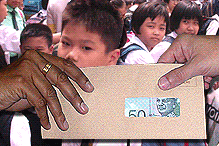
 The problem is indeed extensive, and the financial implication, grave for all parents. According to an analysis offered by one parent from PJ, the sum involved in the kickbacks could be in the region of numerous millions. In short, school principals could be sitting on an educational gold mine.
There are 1288 Chinese primary schools throughout the country, with a total enrolment of well over 600,000 students.
According to those who are involved in the Parents-Teachers Association, they have to pay for numerous expenses prescribed by the school authorities, on top of the regular fees. There are numerous work books, exercise books, and reference books that they have to buy. Then there are the tuition classes, computer classes and outings, for which they are charged. For each student in the primary school, the extra expenses can come up to RM800 or more. Multiply that money by the total number of over half a million students, the business opportunities are indeed tremendous for the suppliers.
Apparently, as the administrative head of the school, the school principal holds the final say in these requirements. According to some former stationary suppliers, some school heads would indeed demand and receive up to 30% in the form of commission from the suppliers. Teachers, who would otherwise concentrate on their job of teaching, end up wasting precious time selling books and collecting money.
Adverse consequences
The adverse consequences are now well known. Poor young primary students have to break their backs like beasts of burden with heavy school bags stuffed with useless stationary. There is never enough time to finish their mountainous loads of homework. At the end of the year, many of these books are used sparingly. Meanwhile, parents are bled to death.
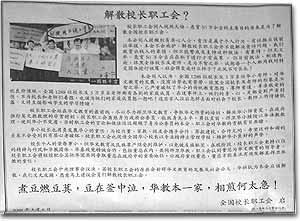
The union of Chinese primary school principals soon struck back, putting ads of their own in the paper, calling it a witch hunt for mostly hard-working and dedicated school heads who stand at the forefront of Chinese education, and even threatening to close down tuition and computer classes in retaliation. This further enraged their detractors, and brought the public blood-letting to a boil.
 The
Oriental Daily
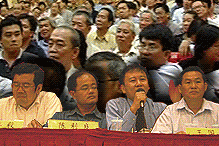
has played a leading role in this whole affair, and kept alive the public debate to which all the other Chinese newspapers have shown alarming reticence. This paper, the new kid on the block in the Chinese media world, has since organised almost weekly public forums, not only in KL, but also in Johore, Klang and Perak. These public talks have been attended by record crowds, many coming forward with personal expose about the misdeeds of some principals. Proceedings from these events have then been given prominent coverage in the ensuing days.
The
Oriental Daily
has played a leading role in this whole affair, and kept alive the public debate to which all the other Chinese newspapers have shown alarming reticence. This paper, the new kid on the block in the Chinese media world, has since organised almost weekly public forums, not only in KL, but also in Johore, Klang and Perak. These public talks have been attended by record crowds, many coming forward with personal expose about the misdeeds of some principals. Proceedings from these events have then been given prominent coverage in the ensuing days.
The conflict found a sort of reprieve last week. There was an election for new officials within the union of primary school principals, and the former recalcitrant chairperson has since been replaced by a more conciliatory leader. They held a round-table conference with the Dong Jiao Zong, the collective name for the Confederation of Chinese Primary School Teachers and the Confederation of the School Boards of management. Four measures have been agreed upon, so that there would be some kind of mechanism in the future to check and audit such financial matters.
The issue will not die there. We can expect more parents agitating for structural change within the system of administration in Chinese primary schools. The unquestioned authority of the school head in the past on matters such as these would unlikely be continued.
This protracted open conflict within the Chinese community is significant for several reasons.
After all, Chinese education is the number one issue on the political, social, cultural and economic agenda of the Malaysian Chinese. Education in their 'mother-tongue', and with it the survival of their language in a multi-racial nation, occupies a revered place in their identity politics.
In the past, the guns of the leading lights within this Chinese education movement are more likely to be aimed at government policies, which have always tended to lean towards the national language policy, at the expense of vernacular education.
Having to struggle for survival for a century, Chinese educators and the entire Chinese community tend to be infected by a siege mentality. They have seemed to plunge into a state of perpetual crisis, and unity within the Chinese community has always been the key to their spectacular success.
 Over time, Chinese education has become a sort of Holy Cow in the Chinese ethos. Rare are those who would want to criticise weaknesses in any vital link within the whole system of Chinese education. Any such criticism would be perceived as weakening the strength of the movement. Who would want to be burdened with the label of "traitors" to the Malaysian Chinese cause?
This new wave of assault on Chinese primary school principals is therefore something completely uncharacteristic of the Malaysian Chinese in general. It is a brand new phenomenon. Does it auger well for the future of Chinese education in Malaysia?
After all, school principals are, or have been for made decades, the pillars of the Chinese community. They have always enjoyed an exalted position, especially in villages and small towns, as wise, learned and strong guardians of Chinese education. To accuse them of massive corruption is to destroy an iconoclastic figure steeped in Confucian traditions.
Unfortunately, it is common knowledge that there are indeed school principals who have been infected by our national cancer of 'pagar makan padi'. Corruption among public officials have always been far more damaging to public interest than the H5N1 virus doing the round now in our country. Principals, as the administrative heads of their respective school, do wield considerable power in the allocation of resources within their domain of influence. Why should they be exempt from temptation?
Demonstration of strength
This recent storm of public outcry against school principals is just a progressive growth of civil society within the Chinese community. It can be interpreted as yet another demonstration of strength at grassroots level, to wrestle back the right to participate in decision making by parents who are concerned about their children's education.
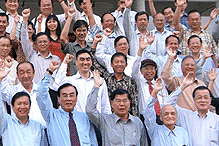 Despite the appeal by certain more traditional conservative quarters to sweep the matter under the carpet, parents, opinion makers and the media have decided to rid the Holy Cow of its mad-cow disease. Perhaps the halo of the Holy Cow has dimmed somewhat. Perhaps it has been restored because of it. Perhaps, the halo ought to have been removed altogether.
For a long time after independence, Chinese primary schools have always struggled to survive in a hostile climate. They are only funded in part by the government. The boards of management and the parents are engaged in a perpetual fund-raising campaign, and the Chinese community have always responded with generosity and love. They see this non-stop financial contribution to Chinese education as their second taxation.
In other words, nowhere is the spirit of civil society more alive than within the Chinese community in relation to the support of their mother-tongue education.
Nevertheless, there exists in this whole business a grave contradiction. Despite their active role in the support of their primary schools, the parents have very little say in the way the education policy has been drawn up, in how the schools are run, and in the manner of appointing and supervising school principals and teachers. Essentially, school principals are civil servants, and answer only to the Ministry of Education. Why indeed should they heed the Dong Jiao Zong or the parents in general? That is the crux of the problem.
Real democratic inroads will be made the day the parents will act en masse in addressing this structural problem plaguing the education of their young. Their target will then be the entire education system, and a government policy which has been fossilised and buried under tons of bureaucratic machinery. It will be a Herculean task, aggravated by long-standing obstacles entrenched within our framework of racial politics.
That will be a task far more daunting than tackling corruption among a few school administrators!


Are you sure you want to delete this comment?
This action cannot be undone.