




Dividing along the NEP
It was shocking, to say the least. Not only to Malaysians, but also to readers in other nations, when the findings of the Merdeka Center for Opinion Research were released. After more than close to 50 years of independence, Malaysia now seems is lurking dangerously back to primeval times when every man was for his own, with no real sense of nation or statehood.
If being 'truly Asia' is much about guarding one's own turf so very jealously to the exclusion of only maintaining only one's own ethnicity; then some very sober lessons in introspection must therefore be in order.
It was shocking, to say the least. Not only to Malaysians, but also to readers in other nations, when the findings of the Merdeka Center for Opinion Research were released. After more than close to 50 years of independence, Malaysia now seems is lurking dangerously back to primeval times when every man was for his own, with no real sense of nation or statehood.
If being 'truly Asia' is much about guarding one's own turf so very jealously to the exclusion of only maintaining only one's own ethnicity; then some very sober lessons in introspection must therefore be in order.
Thus, the bombshell that emerged from behind the government-promoted facade of unity and peace, is a maligned form, if not virulent revelation of racism running deep in one of Asia's most multiracial societies.
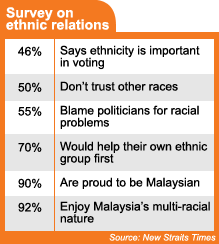 According to the survey, which incidentally was the first of its kind, 1,200 Malaysians found that the majority of the various races found comfort and security in their respective ethnicity and not in the officially trumpeted message of a common Malaysian identity, encompassing an Asian 'salad bowl'.
The survey also found that a majority of the Malays found the minority Chinese and Indians to be 'greedy' and 'untrustworthy', respectively. The minorities, on the other hand, found the Malays to be 'lazy'.
The survey's results, once again, are an indictment of the Malaysian government's stubborn, implacable and hard to scrap National Economic Policy (NEP) known otherwise as the bumiputera-first policy.
Like an oak tree that refuses to be felled, the bumiputera-first policy now adopts the metaphor of 'holy water' with those involved not feeling an obligation to stop partaking in the state-sponsored aid coming their way.
Wrong 'new years'
The end result, as anybody could faintly suggest, is horrendous to the point of perdition. Introduced in 1970, to promote social harmony and economic equality, the obvious truth about it is clearly the reverse.
By allowing for preferential treatment in employment, education, scholarships, business, access to cheaper housing and assisted savings, what has happened as a result of this 'nanny assistance' is a dilution of individual responsibility that in default makes the state perform that moral obligation.
 Expecting the obvious, the findings, according to social commentator Chandra Muzaffar, are not all surprising. "This is partly because ethnic boundaries are real in our society and almost every sphere of public life is linked to ethnicity in one way or another."
The Merdeka Center said the survey 'gives an honest picture of the country's situation and inter-racial perception'. That in turn, however, becomes a very juicy recipe for extremists and political opportunists to take advantage of and bend all these ill-feelings to their benefit.
From this lack of social cohesion comes the inevitable wherein every potential exists in the long run for the country to fall along lines of what the Taliban did in Afghanistan. That could include everything from the nucleus of society, consisting of the family to the state itself.
As tenuous as matters are, another shocking finding of the survey revealed that all three major races had a dim understanding what their major festivals were all about. Many had perceived Hari Raya Puasa and Deepavali to be Malay and Indian 'new years'!
Fostering patronage
As 'Malaysianisation' is not an easily understood term in academic circles, any serious discussion it provokes these days cannot exist within the sub-text of the NEP. The fact that the NEP has only marginally fulfilled its goals, cannot in the least be a cause for celebration.
Malay dominance is still disproportionately lower than what the Chinese by their smaller numbers are able to wield in the nation's economy.
 There is also the factor of how extraneous forces like the Islamic revolution in Iran in 1979 and Arabisation are fuelling a drift to ethnic conclaves within the larger Malay community.
That efforts were not made to check the rising tide of external forces in moulding and shaping Malaysian attitudes, which in turn exude in behavioural patterns, is therefore an indictment of an anaemic nation-state hacked perhaps by the NEP in fostering patronage.
Though schools are indeed the first place to begin with in national integration, another step would be in promoting a neutral official language like English. That will then make it more difficult for people of varied backgrounds to succumb to the temptations coming to them either in soft power or radical messages.
This because English would not capture the essence to transmit in its original hypnotic appeal.
However, the only problem is when the young in Malaysia begin to get too Westernised because of widespread English usage.
But this sure beats getting caught in a racial cauldron.
JAYA PRAKASH lectures in journalism at Beacon School of Technology in Singapore .


Are you sure you want to delete this comment?
This action cannot be undone.