




Sarawak election the giant pork-barrel beckons!
So there is going to be another state general election in Sarawak.
The announcement hardly stirred any interest in the national media. For most people on this side of the South China Sea, Sarawak and Sabah shall remain on the fringes of their consciousness. At most, these East Malaysian states merely conjure up hazy images of socio-economic backwardness, incredible timber wealth, and incomprehensible inconsequential and unnameable natives.
In any case, the BN will sweep into power again, as the ruling coalition has done so many times in the past. So what is there to be excited about? In comparison, the UEFA Cup Finals or the English Premier League offer far more interesting prospects of entertainment, profit, and thrill.
Surprisingly though, the odd reporter friends will still contact me, for information and advice on what is going on in Sarawak. By and large, reporters based in KL know next to nothing about Sarawak politics. I bet you none can name half the Sarawak state cabinet members, or half the political parties. As they say in Sarawak and Sabah, the only time you hear the names of these two states on RTM television channels is during the weather report.
So there is going to be another state general election in Sarawak.
The announcement hardly stirred any interest in the national media. For most people on this side of the South China Sea, Sarawak and Sabah shall remain on the fringes of their consciousness. At most, these East Malaysian states merely conjure up hazy images of socio-economic backwardness, incredible timber wealth, and incomprehensible inconsequential and unnameable natives.
In any case, the BN will sweep into power again, as the ruling coalition has done so many times in the past. So what is there to be excited about? In comparison, the UEFA Cup Finals or the English Premier League offer far more interesting prospects of entertainment, profit, and thrill.
Surprisingly though, the odd reporter friends will still contact me, for information and advice on what is going on in Sarawak. By and large, reporters based in KL know next to nothing about Sarawak politics. I bet you none can name half the Sarawak state cabinet members, or half the political parties. As they say in Sarawak and Sabah, the only time you hear the names of these two states on RTM television channels is during the weather report.
I carry the dubious distinction of having contested as an opposition candidate in my home town of Kuching nine times - in a span of 17 years.
In Sarawak, the parliamentary and the state elections are staggered, and are not held at the same time, as is the standard practice elsewhere nowadays. There is always a general election every two years or so. In between elections, the active campaign canvassing for voter support actually never stops. Politics in that vast underdeveloped state is an expensive and exhausting affair. With rare exceptions, it is the playground for the very rich and very powerful. More than a few candidates have gone bankrupt over their electoral adventures.
By and large, politics has always been the exclusive playground for the very rich and the very powerful in democracies everywhere. But nowhere in Malaysia is it more so than in Sarawak.
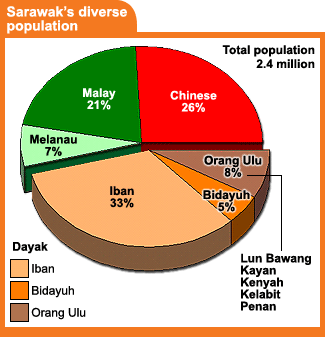 The state is vast, with an area larger than the whole of Peninsular Malaysia. It is also sparsely populated, with a population of 2.5 million or so, in contrast to the Klang Valley alone which has a population of perhaps more than 5 million people. Communication and transport remain very third-worldish, and the candidate's access to his voters, especially in the semi-rural and rural constituencies, poses as the biggest obstacle in his entire campaign.
One of the biggest items of campaign expenditure is the hiring of vehicles and election workers to reach voters in the entire constituency.
Consider the parliamentary constituency of Ulu Rejang at the headwaters of the great Rejang River near the Sarawak-Kalimantan border, where the Bakun Dam is sited. The geographical area is larger than the entire Melaka State, with a voter population of a few thousands only. There are no good roads to speak of, except perilous muddy timber tracks. The river rapids are treacherous and lethal at times. Those who have at their disposal the renting of four-wheel drive vehicles and helicopters certainly have a distinctive edge over their opponents.
Even so, it is well nigh impossible for the candidate to visit even a small fraction of his voters within the short campaign period of 11 days. Politicians will therefore require a large army of election workers serving throughout the entire campaign period as their agents in every village and in every household if possible. This army can number in the thousands. They often use the Form E as a kind of IOU for cash payment later on. The market price for such Form Es varies over a wide range of course.
The good time
Then, there is the intangible but monumental sum of cash required to entice people to give the candidate that all-important vote on polling day. The do's and don'ts stipulated under the election laws are totally irrelevant, since there will never be enough policemen and election officials to go around the sprawling jungle to enforce the laws. Practically, anything goes, as long as it works.
Food and drink on a grand scale are expected by the voters for all kinds of political gathering of course. As far as the rural folk are concerned, this is rare fallout, from which they must reap the greatest advantage while the good time lasts. In keenly fought constituencies, the feasting goes on throughout the entire campaign period, day and night.
At the end of the festive joyful day, the voters can sigh with satisfaction, and claim that a good time has been had by all!
Naturally, there will be a long list of election promises made in each area. Unlike urban voters in Peninsular Malaysia, the rural voters of Sarawak have a very limited but urgent and practical domain of concern. They want simple things like electricity, roads, bridges, jetty, water, community halls, schools, clinics, i.e. things that their urban counterparts elsewhere have long ago taken for granted.
Of course, candidates from the ruling parties will have an overwhelming advantage, since these public amenities require public funding that only the government can give. It does not matter that the BN candidate has reneged on his previous promises many times. Dangling the carrot of providing these amenities some time in the future can ensure eternal electoral support for the incumbent YB.
Nevertheless, to cement voters' support, the largesse needs to be immediate and concrete as well. Anything at all is welcome. Traders and suppliers will all make a kill at the height of the campaign, delivering loads of goodies directly to site. There will be zinc roof for the long-neglected longhouses, gravel and planks for the footpath, farm tools, lawnmowers, and fertilizers. Naturally, cash is king!
Everything, especially the free flow of cash, reaches a climax on polling day. The cost goes up, if the challenger is also cash-rich. Votes can be up for tender, and go to the highest bidder. When it comes to the moment of truth or the moment of untruth no expense is spared.
When the dust has settled, and inevitably the well-wheeled and well-greased election machinery of the ruling parties has returned all BN candidates to victory, the BN chief can then pronounce to the world that the people have given the government another mandate, because of their general confidence in the BN in delivering development, maintaining political stability and multiracial harmony etc etc.
Personal wealth
How much money is required to win an election in a Sarawak rural constituency? Only God, and the candidate, will know. It runs into millions. A BN friend of mine confided in me that he had burnt RM7 million in one single contest. My own opponents from the BN, fighting in relatively cheap urban constituencies of Kuching, dispensed with 2 or 3 million without batting an eyelid. One of my opponents has since gone bankrupt.
So why do so many people still indulge in politics, like moths drawn to the flame?
The prestige is one thing. In a resource rich state like Sarawak, political power means personal wealth, and abiding prosperity for the extended family. There is all that mountains of money to be made from timber. Then there is land, and all kinds of natural resources beneath the land.
Then there are government contracts worth a total of billions. In a state where there is hardly any industrial development to speak of, the government remains as the principle client for big and small businesses. In Sarawak, to be a YB is to be rich, because they are all from the BN, and have exclusive access to the giant pork-barrel provided by the government.
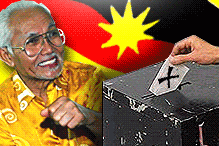 At the apex of this political food chain in Sarawak, sits the chief minister. To be the grand patron of the political game in the entire state, he has considerable state resources at his disposal. His pock barrel is the largest of all available pork-barrels. (He is a Muslim, and the use of the term 'pork-barrel' is not meant to be taken literally.) His hold on power will last, as long as he is alive.
The CM can retire of course, as long as he can appoint a successor to ensure his promotion to the exalted unimpeachable position of Governor of Sarawak. That is the way it is done in Sarawak. But he has leant a lesson from the way he fixed his predecessor, his own uncle, the former Sarawak CM and then Governor. Perhaps that is why he would never retire in office, and the speculation about his heir-apparent will continue unabated indefinitely for many years to come.
So, you see, the only question that interests me is: will this general election be the last for the serving CM? Obviously, it is not a question that will be settled by the outcome of the coming general election.


