




James Gomez and the non-starter elections
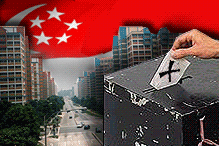
Elections are over in Singapore and as is customarily known, this signals the beginning of something else: a witch-hunt. Not since any election right from the times of the 1970s have opposition politicians in Singapore had it easy. The hard part for them usually happens after the campaigning is over.
 In 1976, opposition candidate Samsudin Tung, from a defeated United Peoples Front (UPF), was hauled up for alleged gutter politics, after speaking on issues germane to the state's Chinese population.
In the 1980s, several other opposition politicians had similar run-ins with the state during electioneering, over allegations they deemed inappropriate.
In 1988, when former Solicitor-General Francis Seow switched loyalty and sided with the opposition, he, too, came to understand belatedly the heavy price one needs to pay for taking on an establishment that does not easily brook challenges.
Elections are over in Singapore and as is customarily known, this signals the beginning of something else: a witch-hunt. Not since any election right from the times of the 1970s have opposition politicians in Singapore had it easy. The hard part for them usually happens after the campaigning is over.
 In 1976, opposition candidate Samsudin Tung, from a defeated United Peoples Front (UPF), was hauled up for alleged gutter politics, after speaking on issues germane to the state's Chinese population.
In the 1980s, several other opposition politicians had similar run-ins with the state during electioneering, over allegations they deemed inappropriate.
In 1988, when former Solicitor-General Francis Seow switched loyalty and sided with the opposition, he, too, came to understand belatedly the heavy price one needs to pay for taking on an establishment that does not easily brook challenges.
And now it has come to James Gomez, a little-known politician from the erstwhile opposition Workers Party (WP) whose left-wing politics have always been a thorn in the side of the ruling Peoples Action Party (PAP).
And of course, before Gomez there was Jufri Mahmud in the 1991, lawyer Tang Liang Hong in 1996 and finally Dr Chee Soon Juan in 2001 who have all incurred the anger of the establishment in various ways. Tang now lives in a self-imposed exile while Chee is barred from standing for election for the next five years as a result of a bankruptcy petition.
Quiet, docile
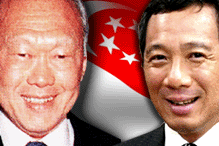
For 47 years since coming into power in 1959, the ruling Peoples Action Party (PAP) has defined debate, its rules of engagement and interpreted integrity in ways and means it deems as fit.
In clear accordance with the ethos of the city-state, anything proving psychologically cumbersome like the noise and clatter of former Workers Party leader, JB Jeyaretnam, or Chee for that matter, has to be quickly tackled and dealt with expeditiously.
 What is preferred in its place are quiet, docile and sedate debates rather than the adversarial ones found in Taiwan, Korea or the Western world.
Like the dark horse he was in 2001, the elections of 2006 proved something about James Gomez in that he supposedly had trouble filling out forms either on time, or not submitting them after he had done so. The controversy roiling him this time around, was the latter.
As is with all minority candidates, Gomez's Indian background makes him a minority in the city-state. Since 1988, when the Group Representations Council (GRC) proposed to include and elect minority voices in parliament, candidates contesting as minorities are required fill out eligibility forms vouching their ethnicity. As Gomez was running in a GRC, he was constitutionally bound to do precisely that.
A non-starter
That, however, was not the issue for Gomez ( pix below ). He was a 'proven' Indian nonetheless. His only sin was that he did not hand in his completed form for verification as was required, and to compound matters began blaming the Elections Department which in turn that gamely countered his allegations by footage captured on installed closed circuit television (CCTV) sets, within the department's premises.
 In the interpretation of local conventional wisdom, he was deemed to have been dishonest and therefore cast as 'morally unfit' to stand for elections. Clearly vexed by such chicanery, the island-republic's founding father, Lee Kuan Yew, made no secret of his disapproval of such tactics.
Another aspect of the fiasco was the well-choreographed way in which the media and campaigning politicians played up James Gomez saga.
Clearly to the exclusion of key bread and butter issues - except for on the eve of the election- the lionising of the James Gomez issue meant that for voters living at the lower heap of the income divide in Singapore, the election was something of a non-starter!
And because the income gap has not been bridged for quite a long time, the ruling party was mindful of its own rules that promising voters what it cannot deliver would simply mean infracting its own rules of engagement.
That was something James Gomez did not bother about, because as they say in politics, it is always about being the art of the possible.
JAYA PRAKASH lectures in journalism at Beacon School of Technology in Singapore
.


Are you sure you want to delete this comment?
This action cannot be undone.