




Wet blanket over World Cup
Since there will be no other significant news for many people for the following month except the World Cup, I like wordsmiths all over the world have no choice but to comment on the event.
Yet, with such massive sound bytes on the airwaves and the ocean of printing ink devoted to the subject of football, one can hardly find anything original or new to say about the event. Fortunately, the world is not often interested in originality or novelty. What the world demands is total immersion in this global hysteria that will burn into the consciousness of the entire world like a powerful psychedelic drug for a whole month.
The Americans like to proclaim their sports competitions as world championships, in such games as American football, baseball, basketball, boxing, and professional wrestling. That tells you something about the American collective psyche as a rich, powerful, but an isolationist inward-looking nation. In contrast, football, or soccer, is the real global game, with teams from six continents participating in this World Cup.
Since there will be no other significant news for many people for the following month except the World Cup, I like wordsmiths all over the world have no choice but to comment on the event.
Yet, with such massive sound bytes on the airwaves and the ocean of printing ink devoted to the subject of football, one can hardly find anything original or new to say about the event. Fortunately, the world is not often interested in originality or novelty. What the world demands is total immersion in this global hysteria that will burn into the consciousness of the entire world like a powerful psychedelic drug for a whole month.
The Americans like to proclaim their sports competitions as world championships, in such games as American football, baseball, basketball, boxing, and professional wrestling. That tells you something about the American collective psyche as a rich, powerful, but an isolationist inward-looking nation. In contrast, football, or soccer, is the real global game, with teams from six continents participating in this World Cup.
 Perhaps, there are good reasons for football to be such a common sport for the whole world. It is cheap and easy. All you need is a bunch of willing bodies, a reasonably flat piece of vacant land, and anything to kick about, which is not necessarily a ball. The acquisition of great skills does not really rely so much on high-tech equipment and prohibitively expensive facilities. Success at the game recognises no colour of the skin, the political climate of the time, and barriers between social classes.
How the World Cup has grown to be such a phenomenal world event is much more difficult to understand and explain. After all, as an army of commentators have pointed out, it is just a game, in which 22 grown men kick a silly ball around a pitch. When games involve two defensive teams, nothing really happen for an hour and a half, except much wild tackling, and kicking of the shin.
Some sociologists have attributed the kind of universal hysteria evoked through the World Cup fever to the perennial tribal instinct inherent in men and women.
Still the basic unit
There is something in that comparison I think, except that we have to conceive of nationalism as tribalism writ large, after a fashion, in its worst mode of manifestation..
It does remind us that whatever doubt some thinkers may have over the essentialist validity of nationalism, the nation-state is still the basic unit of political organisation throughout the world. The United Nations is a community of nation-states. The political "country" is still the ultimate object of loyalty, devotion, and personal identification for most human beings.
The historical impulse of nation-states is to go to war, and all periods of peace are but a lull between two wars.
In a sporting event involving national teams like the World Cup, the warring impulse of nation states is given a peaceful outlet, a substitute for the violent bloody clash of national wills on the battlefield. The renegade battles in football matches sacrifice no human lives, because unlike in wars and international politics, the football players have to follow the same set of rules, which is more than what the UN has achieved.
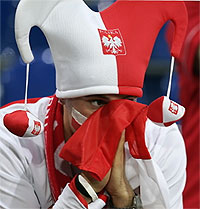 In this sense, the Olympic Games also serve the same function, more or less. But there are too many events in the Olympic Games, and there are too many players. The focus of national conflicts is defused somewhat.
In contrast, in each game during this World Cup, the two opposing nations are locked in a primordial struggle, and as it was described by the philosopher Hegel, it is a "fight to the death", until one emerges victorious as the master, and the vanquished kneel in slavery. The lust for war among the followers is thus satisfied in this renegade battle on the pitch, and the God of War is pacified.
That is why the World Cup games are flooded with a tsunami of symbols of nationalism, like the colours, the flags, the national anthems, the chant of national mantras, and of course, the driving force of national pride behind the players and the fans.
Nevertheless, this account has its limitations in explaining the national fanaticism that accompanies each World Cup. While it does make some sense of the behaviour of the teams and their fans from those 32 nations which have made it to the finals in Germany, there is still the question of why the whole world is going nuts over just a sporting event, as if it is the most important thing in one's life.
For instance, many Malaysians like their fellow human beings elsewhere in the world are going completely bonkers in anticipation of the World Cup games, despite the fact that Malaysia has not qualified for the finals at all. The sudden national outburst of enthusiasm for a sporting event half way round the world can best be described as an obsessive fixation, even among those who usually do not follow football at all, and know nothing of the off-side rule. Even genteel ladies who have not a single sporting fibre in their body join in the fray in betting!
Greatest Show on Earth
A clue is provided by a common accolade given to the World Cup. It has too often been touted as "The Greatest Show on Earth"!
The World Cup event is a sporting spectacle, a premier item of entertainment more entertaining than any other entertainment which the entertainment industry can serve up. Here, the Hegelian model has to be modified somewhat. A "fight to the death" is always entertaining to idle onlookers.
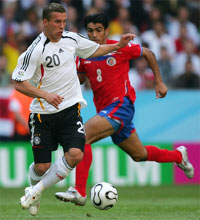 The ancient Romans loved to watch gladiators hacking one another to death. More civilised moderns turn to less bloody alternatives like bull fights, cock fights, and even cricket fights of the insect variety. Even two stray dogs fighting by the roadsides never fail to attract a ring a spectators betting on the outcome sometimes.
The naked confrontation between two competing nations in Germany in a symbolic fight to the death does satisfy a universal blood lust for just such a spectacle.
But the universal appeal of the World Cup as a mammoth spectacle is more than driven by the emergence of satellite-directed, digital, real-time television coverage. The television is the single most influential instrument of globalisation, providing the public space for the imagination of a global community.. As the Astro ad aptly broadcasts, "The best seat is in your house", in your living room, in the comfort of your massive easy chair, with your endless supply of beer and chips.
In that one instant of a live broadcast of a game in progress, without stirring a hair in your seat, you are enjoined with a universal audience of millions, or billions. You are not alone anymore. For once, in this alienated existence in an uncaring world, you can set aside your woes and tribulations of grinding out a weary life of mere survival, and revel in the imagination that you belong to a fictitious world of fellow human beings all devoted to the conflict on this one football pitch. Life has some meaning after all!
The driving force that makes this global audience possible is of course big money. The total contract worth of all the players on the Brazil team alone comes to roughly RM 2 billion! Ronaldo gets paid US$150,000 per game.
The World Cup represents an explosion of astronomical income and profit for the entertainment, telecommunication, and media industries. Then it is also boom time for legal and illegal gambling, and rich harvests for all sorts of money lenders. It is to their interest to manufacture the perception that the World Cup meets a real need of a global population, when in fact, one can live very well without the games.
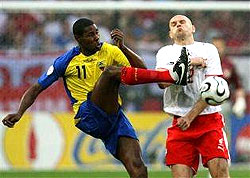 In short, the World Cup symbolises the trends in this process of globalisation in business terms. Sports have very little to do with the ideals of the ancient Greek when they instituted the Olympic Games. Sports is now big time entertainment cum mega-business.
I remember the first time when I followed the World Cup in 1966. There was no television then. I stayed glued to a humble radio which worked on valves that gave off both heat and light, since the mighty transistor had not been invented yet. The team from North Korea was the surprise of the tournament. England won, and the BBC commentators went berserk.
I was a Form Five boy actively participating in sports then. We were taught that the most important thing for an athlete was to take part, and not merely to win. Such a teaching in our present world of universal spectators would sound out-dated, nave, and downright boring indeed.
Since then, I have stopped being a fan of the World Cup, because the football being played there is just about a whole bunch of extremely rich men kicking a ball around the pitch, and their being accorded the exalted image of icons and near gods.
I am a wet blanket I know. Perhaps I should climb down from my high alter, which nobody seems to care anyway.
Perhaps I should watch a game or two, and make my prediction of the outcome.
World Cup 2006 will be won by Ghana or South Korea. Are there any takers?


