



COMMENT | Why we have failed Pavithra
COMMENT | The YouTube sensation S Pavithra was the fairy tale we wanted.
First, you start humble in making cooking videos teaching millions of Malaysians local cuisine. You use only a basic smartphone camera without advanced editing software - you film only from your backyard.
Then you start earning high advertising income from viewership and subscribers. After that, you start appearing on news portals as well as magazine covers, and you start receiving awards from your city and the prime minister.
After all that, you move from your small, dilapidated house in the estate to a bigger, more comfortable environment. Then you break out of poverty as a loving couple, defying all odds in completing the perfect rags-to-riches story.
But this was not meant to be...
COMMENT | The YouTube sensation S Pavithra was the fairy tale we wanted.
First, you start humble in making cooking videos teaching millions of Malaysians local cuisine. You use only a basic smartphone camera without advanced editing software - you film only from your backyard.
Then you start earning high advertising income from viewership and subscribers. After that, you start appearing on news portals as well as magazine covers, and you start receiving awards from your city and the prime minister.
After all that, you move from your small, dilapidated house in the estate to a bigger, more comfortable environment. Then you break out of poverty as a loving couple, defying all odds in completing the perfect rags-to-riches story.
But this was not meant to be.
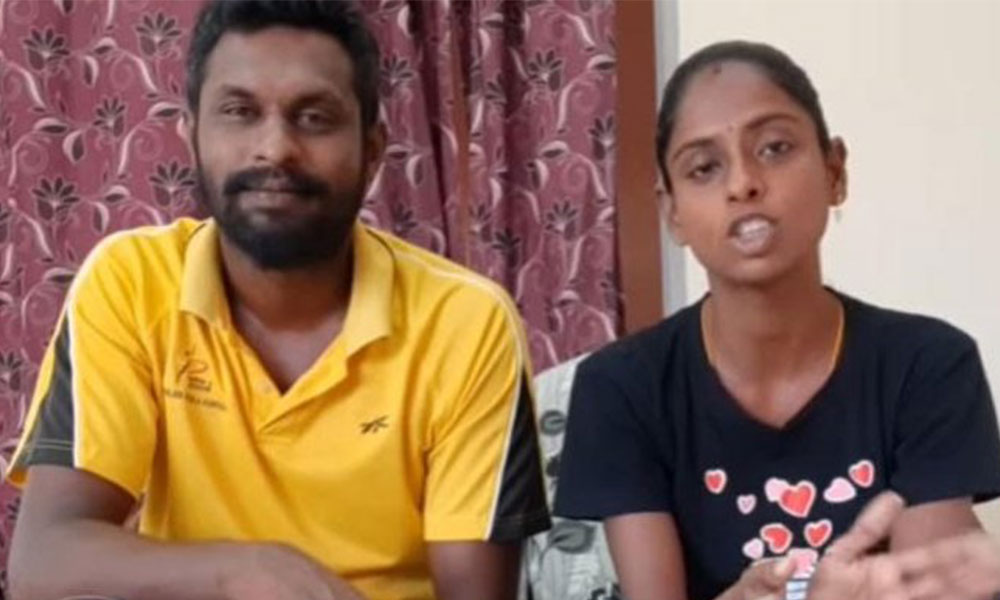
Instead, we were thrown back to reality. Pavithra’s husband, M Sugu, was reported to have stormed the hospital on a Tuesday afternoon with a sickle, wanting to hurt Pavithra. He was in a drunken stupor and out of his mind. Pavithra came out with her lips, left arm and right cheek cut and scarred. Sugu had to wear handcuffs and a purple shirt the next day.
Forgiving the attacker closest to you
But two days later, Pavithra told everyone that she had forgiven her husband, who was charged in court for possession of an offensive weapon and intentionally causing injury using weapons or dangerous objects. Pavithra even renounced her Ipoh Icon award, claiming she was unworthy and requested for everyone to give them a normal life.
Before leaving, the couple posed for cameras, Sugu towering over Pavithra, with huge thumbs-up and wearing half-smiles.
This sounds shocking to us. Why would she, after almost being violently hurt by her husband, with a sickle, forgive her husband and instead of calling out for help, requested everyone to back off?
Although this sounds shocking, forgiving the abuser is the most common response of domestic violence victims. The larger tragedy in all of this is that the cultural values of our society have convinced Pavithra to think that forgiving her husband is the most rational and strategic choice she could make in this situation.
Hard to fight back
First, the law. Compared to other countries, our domestic violence legislation protects the victims in the form of protection orders, rather than merely focusing on punishing the perpetrators.
Ideally, the orders could help separate the violent perpetrator from the victim immediately and make sure that the victim receives support while the authorities investigate, charge and prosecute the perpetrator.
However, the biggest problem is that it relies on the victim to make a report. It requires the victim to be aware of this law, to make the report and to risk the cultural ostracisation from her family and community once they know about it.
Most domestic violence victims do not fight back because the perpetrator will come back even more intimidating and violent than before. Reporting against the perpetrator is the highest form of fighting back, and most victims believe that the attacker will become angrier and they will be in trouble should the reporting and prosecution be unsuccessful. The low reporting rate explains this fear and the low conviction rates (or success rates) amplifies this fear.
The easiest route is to forgive her husband and continue to suffer.
The ego of the husband
Second, culture. Women who are hit by their husbands are told that this is normal if they have disobeyed the husbands’ orders. Any attempt to report and charge the husband is seen as wrecking the family unit, and the woman will be regarded as an irresponsible mother and disloyal wife.
A woman is told that they bear the burden of making or breaking the marriage and family. Taking action against domestic violence may also risk being divorced and being seen as having failed in the marriage.
A society that puts a high premium on unquestioned loyalty to the husband puts the husband’s ego on a pedestal. If the husband’s ego is scarred by the wife’s actions, including earning more than him, having more awards than him and enjoying greater success than him, then it is a cultural right for the husband to act violently against the wife.
If a woman is told this, she knows that she has no family or community to fall back on should she decide to fight back against the violence. She knows that doing so would only risk cutting ties with everyone she knows who ostracised her. She will also find it hard to stand on her own two feet.
Once again, our cultural beliefs mean that it is significantly easier for a domestic violence victim just to forgive and accept her fate. The price is permanent physical, psychological and emotional pain to the abused wife.
Behind closed doors
Third, it is a private family matter. We still think that matters like domestic violence are things that should be resolved between the husband and wife behind closed doors. Even if this is violence warranting police attention.
When a man hits a woman, we will call the police, and he shall be charged under the Penal Code upon sufficient evidence. But when a husband hits his wife, we find it natural to turn a blind eye and ask them to resolve this quietly.
Worse, we regard any conflict known to the public as a form of shame and humiliation to the family. Instead of helping, extended families would take the side of the perpetrator and see the victim as the troublemaker and shame-maker to the family name. Shame is sometimes greater than fear.
A victim under this is left with no choice. Over time, they tell themselves that this is expected and they are indeed a troublemaker who brought shame to the family, and the only recourse is to forgive and continue to suffer.
So, this is how we have failed Pavithra. Our laws, culture and perceptions have built over time to make forgiving her husband the most rational and strategic thing to do. She knows that she is risking too much if she takes action.
After all, the fairy tale was built by us, anyway.
JAMES CHAI is a legal consultant and researcher working for Invoke, among others. He also blogs at jameschai.com.my. You may reach him at jameschai.mpuk@gmail.com.
The views expressed here are those of the author/contributor and do not necessarily represent the views of Malaysiakini.



Are you sure you want to delete this comment?
This action cannot be undone.