


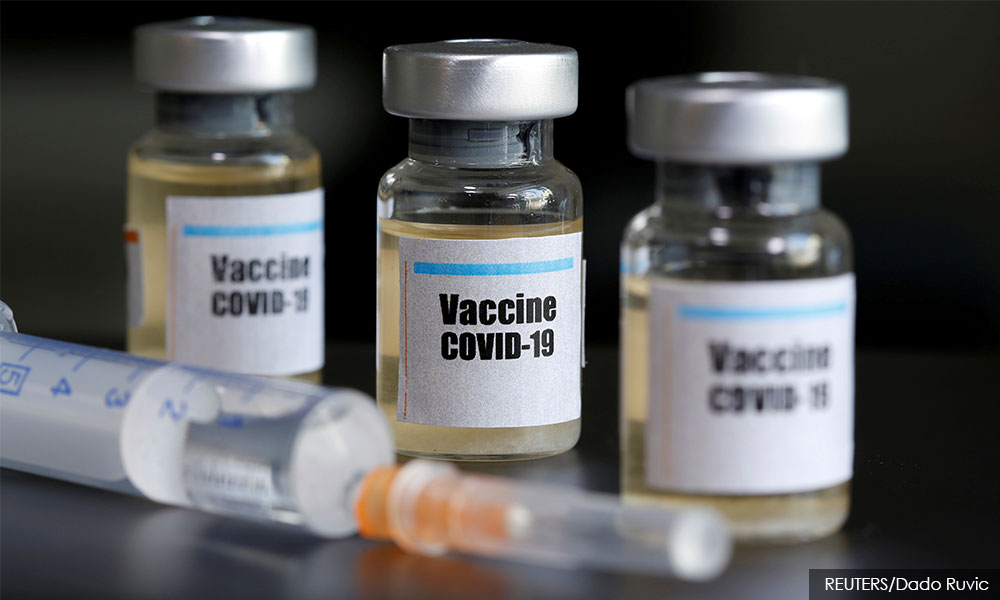

COMMENT | Bleak future for M'sia to get workable Covid-19 vaccine
COMMENT | On Aug 2, a Bloomberg news report stated that "Wealthy countries have already locked up more than a billion doses of coronavirus vaccines, raising concerns that the rest of the world will be at the back of the queue in the global effort to defeat the pathogen.
"Although international groups and a number of nations are promising to make vaccines affordable and accessible to all, doses will likely struggle to keep up with demand in a world of roughly 7.8 billion people."
The report then stated that "The possibility that wealthier countries will monopolise supply, a scenario that played out in the 2009 swine flu pandemic, has fueled concerns among poor nations and health advocates."
Although there are so far, at least 40 Covid-19 vaccines undergoing Phase 1 & Phase 2 human clinical trials and seven vaccine candidates in the final Phase 3 clinical trials, I am not optimistic that a developing country like Malaysia would be able to secure a successfully-tested Covid-19 vaccine. Here’s why.
1) Unlike some Asian countries, we do not have any human vaccine manufacturing facilities that we can leverage on with a vaccine developer concerned to manufacture their vaccine here under licence.
It might have been a strategic mistake that when our BioValley Project started in 2003, we did not embark on such a vaccine manufacturing programme.
2) In a global population of 7.8 billion people, even if a vaccine is found now, there is not enough...
COMMENT | On Aug 2, a Bloomberg news report stated that "Wealthy countries have already locked up more than a billion doses of coronavirus vaccines, raising concerns that the rest of the world will be at the back of the queue in the global effort to defeat the pathogen.
"Although international groups and a number of nations are promising to make vaccines affordable and accessible to all, doses will likely struggle to keep up with demand in a world of roughly 7.8 billion people."
The report then stated that "The possibility that wealthier countries will monopolise supply, a scenario that played out in the 2009 swine flu pandemic, has fueled concerns among poor nations and health advocates."
Although there are so far, at least 40 Covid-19 vaccines undergoing Phase 1 & Phase 2 human clinical trials and seven vaccine candidates in the final Phase 3 clinical trials, I am not optimistic that a developing country like Malaysia would be able to secure a successfully-tested Covid-19 vaccine. Here’s why.
1) Unlike some Asian countries, we do not have any human vaccine manufacturing facilities that we can leverage on with a vaccine developer concerned to manufacture their vaccine here under licence.
It might have been a strategic mistake that when our BioValley Project started in 2003, we did not embark on such a vaccine manufacturing programme.
2) In a global population of 7.8 billion people, even if a vaccine is found now, there is not enough global manufacturing capacity to produce vaccines for even half the global population for the first few years.
3) Many vaccines may also require more than one dose to deal with a mutating virus.
4) Outside of China, most vaccines will be manufactured in the US and Europe, so the powerful West, led by the US, would still call the shots on who would get the vaccines first.
5) Many of the wealthy and powerful countries have already started over-ordering to hoard and stockpile all the promising vaccine candidates that they can get.
Based on the latest report by Nature Briefing dated Aug 24, “Wealthy countries have struck deals to buy more than two billion doses of coronavirus vaccine.” SCMP just reported that Japan booked 521 million doses, four times its population.
6) The US, still the world's largest economy and the most influential power over the biotech developers in the West, does not agree to give equal and fair access of a Covid-19 vaccine for all countries as demonstrated in the World Health Assembly on May 18 to 19.
The US government then objected against the rest of the world on the proposal by Costa Rica and Chile to create a global “Patent Pool” for sharing all Covid-19 vaccines and medicines so as to facilitate greater access to all. The current US government is placing too much emphasis on rewarding Big Pharma with large profits for innovation in vaccine development even in times of an emergency health crisis.
7) A certain Asian power is not likely to be able to help us even if it would like to. It may not have enough vaccine manufacturing capacity and it has to take care of its own very large population. There is no problem for this Asian power to sign Memorandums Of Understandings, including long term research and development collaboration, based on its good intentions but providing others with a vaccine is another matter.
Meanwhile, there are at least 90 developing countries participating in the COVAC (Covid vaccine global access) Facility co-led by a Western-led vaccine funding initiative called CEPI (Coalition for Epidemic Preparedness Innovations) with another Western-led coalition of donors, recipients and big players in the vaccine industry called GAVI (Global Alliance for Vaccines & Immunisation), as well as the World Health Organisation.
With the lack of global vaccine manufacturing capacity and the fight to control and hoard Covid vaccines by powerful nations, the situation does not look hopeful for developing countries.
It seems that some rich and powerful nations have forgotten about the 2001 Doha Declaration by the World Trade Organisation (which was agreed then by all governments of the world, including the US Government) on affirming the principles of public health and access to affordable medicines (especially for developing countries) taking priority over patent control as outlined in the agreement on TRIPS (Trade-Related Aspects of Intellectual Property Rights).
The US government practices double standards when it comes to access to affordable medicines and it has used its own laws (such as Section 1498 and “March-In Rights”) to compel pharma giants (such as Bayer during the anthrax crisis of 2001) to provide drugs to the US at lower prices but it would not allow other countries to do so.
Here are recent cases of the US government trying to control as many Covid medicines as possible:
1) President Trump sought to buy German vaccine developer CureVac as reported on Mar 17.
2) Statement by Sanofi CEO on May 14 that the US would get preference over others if their vaccine tested successfully.
3) Possible merger of US biotech giant Gilead Sciences with Anglo-Swedish Astra Zeneca, which is jointly-developing with Oxford University a most promising Covid vaccine, reported on June 9.
4) The US Government buying up the entire world's stock of treatment drug Remdesivir reported on July 1.
Meanwhile, there have also been allegations of espionage and hacking to steal patent secrets on Covid vaccines, showing how serious the issue has become.
The Malaysian government, as the regulator, facilitator, and protector of public health, may wish to directly acquire a Covid vaccine.

However, as most biotech vaccine developers overseas are from the private sector and in order to increase the chances of securing a vaccine for our country, any genuine private sector initiatives which are knowledgeable and have links to overseas biotech developers should be supported by the government and the financial sector.
Like the rest of the world, we are still sailing in unchartered waters. We never had such a deadly and economically devastating health crisis in our lifetime. While for some measures, we can learn from the past and other countries. For others, we may have no “playbook” to refer to for guidance and direction.
Therefore, we would need to be open, smart, and innovative in finding ways to save our people and economy from this terrible pandemic.
KK TAN is a writer, as well as a political and corporate strategist on local and global issues. He is also the director of the Covid Research Centre in Kuala Lumpur.
The views expressed here are those of the author/contributor and do not necessarily represent the views of Malaysiakini.


Are you sure you want to delete this comment?
This action cannot be undone.