




Justifying limits to democracy
Democracy may not be perfect, but is the best we have got among the worst forms of government, said Winston Churchill in the heyday of his statesmanship as Britain's prime minister.
If the best indeed has to emerge from the worst to gain acceptance, than the standards by which the 'best' is judged opens itself to a whole set of variables that neither Churchill nor any of us can guess.
For this reason, democracy takes on various hues and shapes in different nations, from corporate democracy in Singapore to the rambunctious model in India and the free-wheeling one in the United States.
Democracy may not be perfect, but is the best we have got among the worst forms of government, said Winston Churchill in the heyday of his statesmanship as Britain's prime minister.
If the best indeed has to emerge from the worst to gain acceptance, than the standards by which the 'best' is judged opens itself to a whole set of variables that neither Churchill nor any of us can guess.
For this reason, democracy takes on various hues and shapes in different nations, from corporate democracy in Singapore to the rambunctious model in India and the free-wheeling one in the United States.
It is not the best form of government by the standards that we wish for; and certainly not many in our midst would wish for the kind of government represented by Palestinian group Hamas, which won because democracy had allowed it to do so.
In such a situation, we get into a bind as to what to make of democracy and its so-called best form or governance, because the best political methods do not necessarily produce the best kind of government.
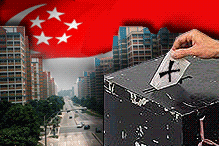 Consider Singapore. There has virtually been one-party rule from 1959 but despite the many controls on constitutional rights and liberties, it has thrived and prospered albeit sometimes at the expense of a human face.
Its nascent civic society functions nonetheless along with a discernible and psychological distaste for the kind of din epitomised by the ongoing political spat between Malaysia's former and current prime ministers.
"I believe the test of leadership is for governments to provide for their peoples such that there is a perceptible difference in the living standards of their subjects," said Singapore's founding father and first prime minister Lee Kuan Yew.
Such has been the driving mantra behind the city-state's political ethos that the Mumbai bomb blasts earlier this month brought home the dangers of what may arise out of unbridled debate, especially when this has to do with racial and religious sensitivities.
Racially-motivated blogging
Earlier this year, Singapore jailed two individuals for using cyberspace - and the freedom it affords - to spread anti-Malay invective.
The message was that racial and religious harmony is fragile and simply non-negotiable whatever the litmus test of democracy may be - that what's best for others isn't necessarily true for some.
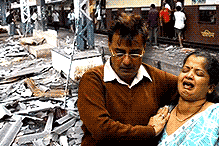 More than relativity comes into play as far as the Mumbai attacks go.
In India, with democracy imposed by its departing British colonials, the curse of a religious divide continues to haunt, even amidst surging economic renaissance.
Whether it was due to bomb blasts or otherwise, Indian authorities swiftly moved to ban blogging and assign stiff penalties.
This was not only an acknowledgment of the limits of democracy as a vehicle for politics and good governance, but also reflected the special circumstances required for its effective functioning.
In India, Singapore or Malaysia - nations that have experienced racial conflagration - the conditions must reflect special needs and careful tempering of the orthodoxy of the democratic creed.
 India's ban on blogging was necessary for the lasting and communal benefit of its people. Not only is peace preserved but people will not misuse the freedom of responsible and enlightened debate meant for Parliament.
If such an exercise were to spill on to the streets, it would threaten the peace vital for sustenance and to safeguard democracy.
One such episode occurred in 1993, when Hindu-Muslim riots resulted in a horrific orgy of violence. The cause of that outrage was the language of political exhibitionism used by enraged mobs of rival communities.
Interestingly, though, that incident happened even when there was no blogging. Only imagine what would have happened if people had been allowed the safety of blogging to preach whatever they wished.
JAYA PRAKASH lectures in journalism at Beacon School of Technology in Singapore.


