




Desensitising sensitivities
The PM has spoken ex-cathedra . The mainstream media must be responsible and constructive. They must not sensationalise racial and religious issues. All activities held to discuss religious freedom under Article 11 of the Federal Constitution must cease. Malaysians are very sensitive. The proposed Inter-faith Commission is off - indefinitely.
He also cautioned the media people not to try to compete with blogs and internet news portals. By implication therefore, net portals like malaysiakini are sensational, irresponsible, and destructive. Predictably, the next day, the ministry in control of the media wondered aloud whether the laws should not be amended to exercise greater control on internet news.
These are familiar words of course. We have heard them for over two decades, for this sort of political narrative was institutionalised by the former PM.
The PM has spoken ex-cathedra . The mainstream media must be responsible and constructive. They must not sensationalise racial and religious issues. All activities held to discuss religious freedom under Article 11 of the Federal Constitution must cease. Malaysians are very sensitive. The proposed Inter-faith Commission is off - indefinitely.
He also cautioned the media people not to try to compete with blogs and internet news portals. By implication therefore, net portals like malaysiakini are sensational, irresponsible, and destructive. Predictably, the next day, the ministry in control of the media wondered aloud whether the laws should not be amended to exercise greater control on internet news.
These are familiar words of course. We have heard them for over two decades, for this sort of political narrative was institutionalised by the former PM.
One does not have to second-guess the reaction of those media big shots present at the occasion to hear the decree of the current PM. This is an old game that they have played in Malaysia for a long time. Given the prestige and the power of the PM's office as the premier political institution in the country, the PM's gentle verbal advice is often far more compelling than all the laws of the land in eliciting voluntary acquiescence.
 The PM may have been expressing the views of Umno, having just chaired an Umno Supreme Council meeting before speaking to the press. But it does not matter. The Umno president is the PM of Malaysia, and Umno is nearly equated with the government, at least in the eyes of Umno.
We are familiar with this language game, because we are Malaysians. Our social ethos is such that we can imagine the entire nation to be a school room, with the PM as the head-master. Once every so often, when things get a little rowdy, the headman has to stand up on the podium and dictate the rules of discipline.
Discipline is the most neglected and least understood aspect of power. Those in positions of power inevitably feel this ethical compulsion to deal out rules of discipline and to enforce those rules effectively. They often do so with the best of intentions, in the name of some totalising reality, i.e., the collective good of the whole, the economic well-being of the greatest number, survival of the ship of state etc.
Find meaning
In modern life, the most powerful political institution is the state. The modern state is the invention of man, and its emergence on the world stage a few hundred years ago was congruent with the capitalist mode of economic production and the new discourse on "society", as exemplified by the political theories of Hobbes, Locke and Reausau.
By imagining a general will which is also ethically good, members of this new political organism find meaning in their individual existence. The state is not only totalising, but it also individualises through a process of categorisation, classification, and stratification. Thus, the state is principally responsible for giving a personal identity to individual members, no matter how arbitrary that identity is.
The function of the state is to impose order, at all costs. Only with the stability that comes with political and social order can the institutions of the state ensure continuity in economic production, and in their political agenda of "nation-building".
In more ancient past, reward and punishment - mostly punishment - were the twin pillars in the matrix of institutional powers to ensure obedience. After the emergence of the state in the 17th/18th century, the techniques of discipline were much more refined, much less obvious, and certainly far more effective. Apart from the usual apparatus of reward and punishment, we now have a pervasive system of training.
Malaysians nowadays are trained from the cradle to the grave. They live in an ocean of normative messages emanating from a whole host of political, social and religious institutions, dictating what is considered the code of "normal" and good behaviour.
Their bodies have been put through an assembly-line of training stations, with definitive spaces in which the body is subject to almost reflexive obedience to various rules. Malaysians are trained and drilled all their lives, starting from the nursery, the kindergarten, the primary and secondary schools, the colleges and universities, the national Service boot camps, the work places and the seminar rooms.
In this obsessive pursuit of order in the name of political stability, no anomaly is tolerated. The hospitals, the army camps, the courts, the penal system, and the ubiquitous police presence form a tight cauldron of invisible wire-fences separating the normal and the anomalous.
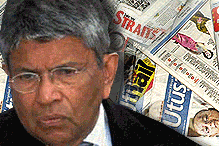 Laws like the ISA and OSA, working in collusion with other laws that control all aspects of a citizen's existence, are probably the most effective instruments to coerce national discipline.
They do not even have to be used often. Their effect is a little like Bentham's famous panopticon in a jail. There, prisoners live under the impression that they are watched from all sides 24/7, even if no such watching takes place. That is enough to compel them to behave according to a prison code - gladly and voluntarily.
Conditioned
Nevertheless, the fear of threat of punishment is still dependent on an external source of power. To be truly effective, disciplinarians must allow their subjects to internalise what is originally external. This is done by the monopoly of the right to interpret political reality, through a process of legitimating only certain language in the political discourse.
This is what the PM has done in his advice to the media. Heavily value-laden words like "constructive", "responsible", "sensitivity", and "positive" have been hurled at media practitioners and the national audience, and branded like hot-iron into their consciousness.
Once the subjects to be trained have been conditioned to think in those words, they internalise the values that have been prescribed by power.
After all, words are not mere tools. They are the framework through which one sees and interprets the world. They are the complex grids of references and significations, upon which the meaning of the world is founded. Once words with definite hues and colours are used exclusively to think one's thoughts, one's view of the world is formulated, and so becomes closed to alternatives.
Take the word "sensitivity" for instance, especially that of the religious and racial varieties. Mention the word in the Malaysian political concept, and almost by a reflex action, the mind conjures up the images of race riots and May 13.
It is as if the word "sensitivity" has no other meaning at all!
We know for a fact that a certain sensitivity is a sign of good breeding and social grace. A socially sensitive person will try not to displease other people without good cause. A civilised person will also be sensitive to the sufferings of other people and would try to do what he can to alleviate the pains of the world.
There is also that special type of sensitivity that will empower a person to appreciate and create the beauty of great art and great music. Unlike the social sensitivity in social interaction which can be acquired by all, artistic sensitivity seems to be something with which only some people are born and it needs to be developed as well.
We also know that not all sensitivities are good. For instance, in adolescence years, a teenager can be very sensitive to how others think about how they look and behave. At a time when they are struggling for the autonomy of the ego that comes with adulthood, they can be over-sensitive. They get hurt easily, and harbour deep resentment.
We have to decide
If this teenager is also not well-adjusted and not properly "socialised", then his sensitivities may lead to psychosis, depression, schizophrenia, and even suicidal tendencies.
In short, there are good sensitivities, and there are bad sensitivities. For those bad sensitivities, we have to talk to the afflicted persons frankly, and try to help them onto the path towards civilised graceful maturity.
We do not condone bad sensitivities blindly. In fact, we try to talk with the troubled individual and desensitise him, even behind closed doors under intimate circumstances, because that bad sort of sensitivity will hurt him and others in the long run.
Then perhaps we have to decide what good or bad sensitivities are. This is subject to social customs which may take a long time to strike a happy balance between traditions and the need for change.. But values do evolve and change over time. Part of this change for the better is through talking about what constitutes good sensitivities.
If the big fatherly figure thinks that father knows best, and that people must not discuss sensitive subjects because of some ugly past events, then the father will imprison a person in his teenage stage of emotional development. His children will remain immature forever.
Frankly, I think those people involved in the Article 11 controversy have shown reasonable restraint. Some have shown a little immature over-enthusiasm for their cause, but their mistake - if it is a mistake - can only be realised by them through open discussion in the press. And I have not seen any sensational reporting on religious controversies at all!
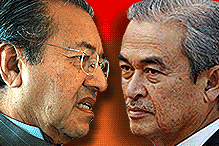 We know the PM wants to make meaningful changes in the country. He is still a moderate, albeit a moderate on the conservative side. At least, Malaysia under him will not degenerate into the kind of horrific mess into which the Middle East has sunk.
Having sad that, I think his latest decree on media "responsibility" smacks too much of the legacy of the previous PM.
What this country needs badly is perhaps a little less discipline, and a little more desensitising of immature sensitivities. Otherwise, we will be a third-world nation forever.


