
COMMENT | Simulation predicts 15,000 active Covid-19 cases in M'sia by Nov 8
COMMENT | We want to bring to your attention about a recent report in a local news portal regarding the predictions that 10,000 active cases will occur by Nov 4, 2020.
Our Covid-19 modelling group, which consists of several applied mathematicians, epidemiologists, public health specialists and a biostatistician from major public universities would like to offer an alternative view with regard to this prediction.
We made our analysis using a mathematical model of Susceptible-Infected-Recovered-Death (SIRD) type and calculated the trajectory of the active cases, which are predicted by the model till the end of this year (red curve); in comparison, we also plotted the actual active cases in Malaysia (blue curve) (see Figure A)...
COMMENT | We want to bring to your attention about a recent report in a local news portal regarding the predictions that 10,000 active cases will occur by Nov 4, 2020.
Our Covid-19 modelling group, which consists of several applied mathematicians, epidemiologists, public health specialists and a biostatistician from major public universities, would like to offer an alternative view with regard to this prediction.
We made our analysis using a mathematical model of Susceptible-Infected-Recovered-Death (SIRD) type and calculated the active cases trajectory, which are predicted by the model till end of this year (red curve); in comparison, we also plotted the actual active cases in Malaysia (blue curve) (see Figure A).
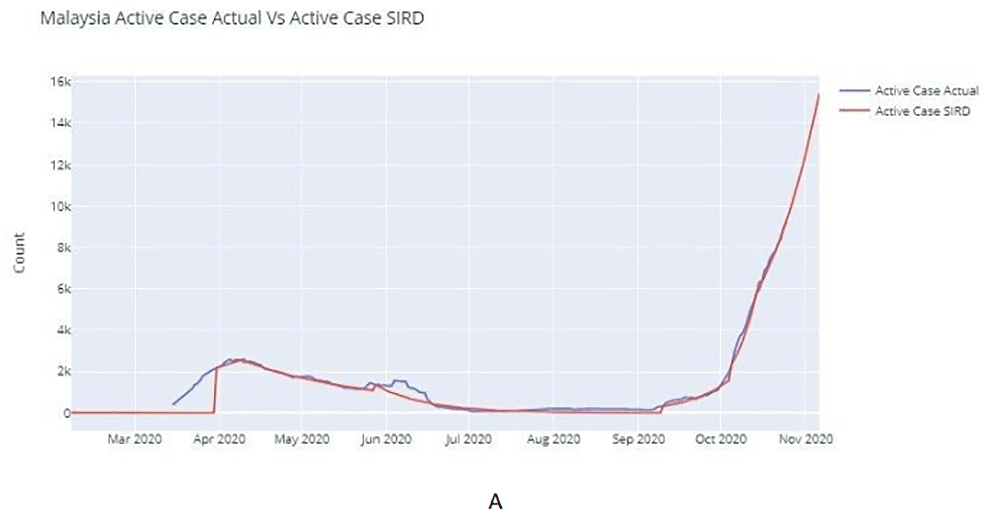
Overall, we can see that the SIRD model analysis agrees with the number of active cases in Malaysia, and the model is able to mimic the trend of infection trajectories of our country’s Covid-19 scenarios.
To better understand the overall predictions of Covid-19 transmission dynamics in Malaysia, we illustrate the following numerical solution of this SIRD model with the infected (blue), recovered (green) and death (yellow) trajectory curves are as follows:
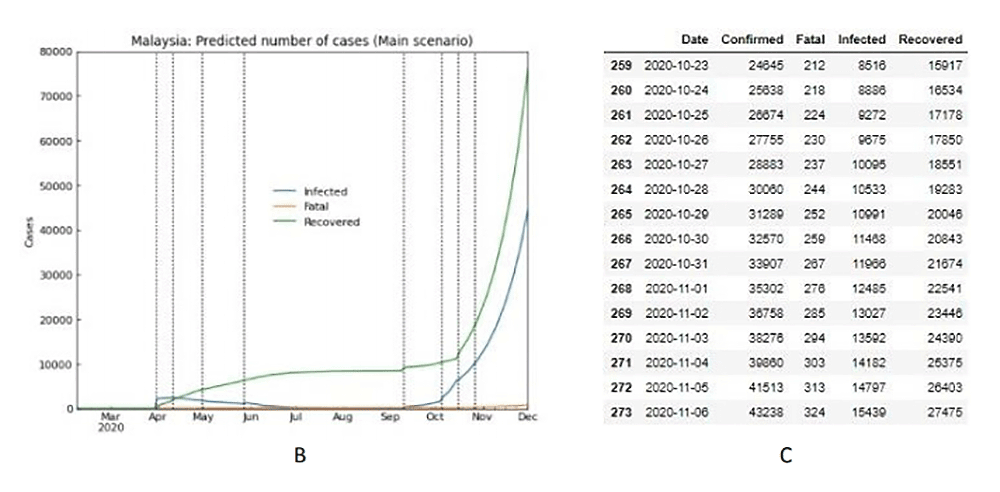
Based on the simulation of this model as shown in Figure B, we observe that the number of active Covid-19 cases (blue curve) in Malaysia can pass 10,000 cases as soon as Oct 27, 2020.
Without proper suppression measures, once the active cases achieve this five-digit level, the model predicted that it would portray the “super exponential growth” characteristics and increase unboundedly (see also Figure C).
This trend is predicted to continue till next year, and this might overwhelm our health care infrastructure and medical resources.
Our observation is verified using a different modelling approach which analyses nonlinear trends in the data. The graph below depicts the 14-days ahead prediction produced by this approach, and it is abundantly clear that the predicted trend matches exactly the findings we obtained using the first method.
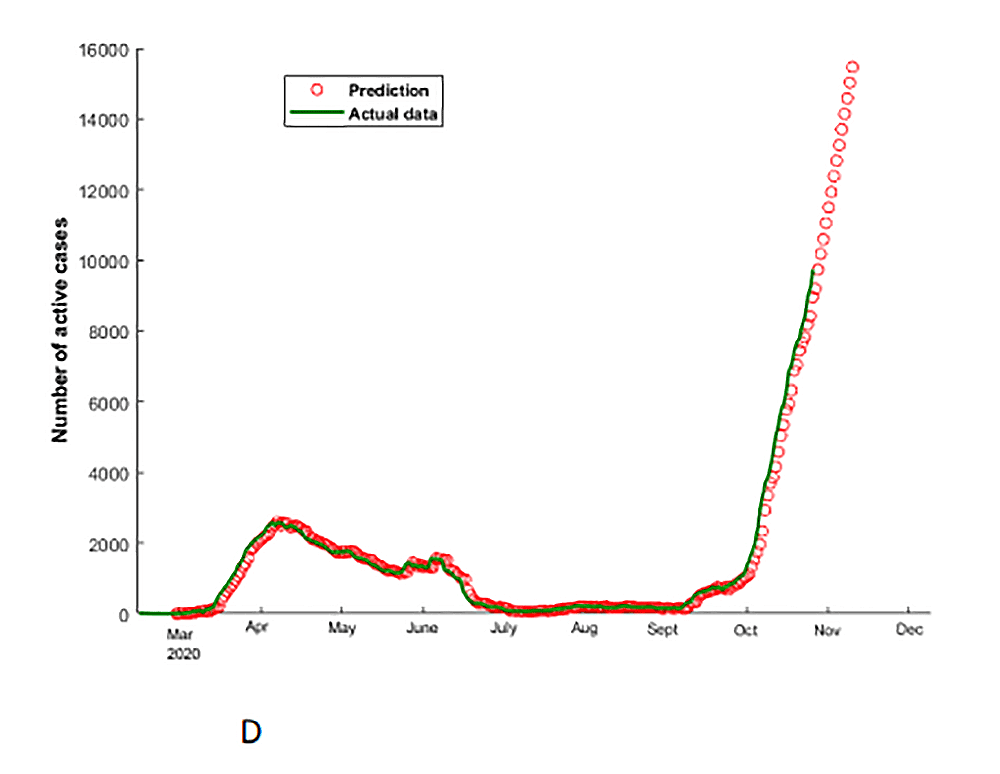
The number of active cases (Figure D) is expected to continue on an exponentially increasing trend under the existing control regime. What is more worrying, is that the number of total deaths (see Figure E) is also expected to grow exponentially within the next 14 days.
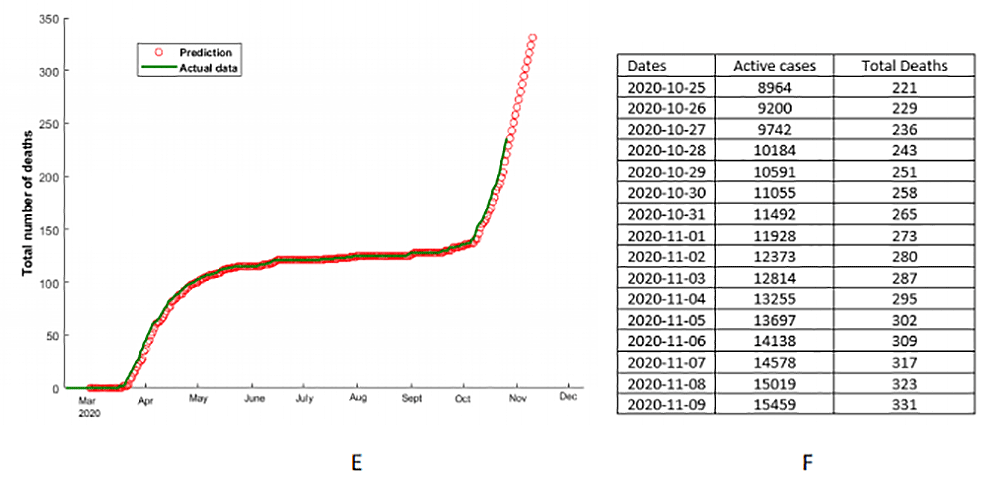
The tabulated data in Figure F predicts the number of active cases to cross the 10,000 mark as early as Oct 28 and can go up to more than 15,000 in two weeks.
Our predictions and forecasts are based on existing data. Data may change in the days to come, but the science behind these approaches is formulated to capture persistent trends in the data.
The persistent trend that we see in our results is that the current control measures are not enough to tame the raging spread of infections.
From Figures A, B, D and E, we can confidently say that up until Oct 1, 2020, Malaysia had everything under control. But from Oct 1, 2020, onwards the virus appears to have the upper hand.
It is time to get the intervention strategies into full throttle. Movement control in the red zones must be adhered to more strictly, quarantine and physical distancing are paramount to break the chain of infections. We need to reduce the strain on our already limited medical resources.
We hope the mathematical insights we share through our results are able to highlight the importance to conduct more tests so that we will be able to detect the possibility of community transmission and asymptomatic cases in Malaysia.
If we increase our testing capacity, then more possible cases will be picked up. The number of cases is likely to increase, however, the quality of data will be much better than what we have now, thus allowing us to come up with a better prediction, for example in the analysis of reproduction numbers.
A similar strategy had been employed by Singapore, which led to a high number of daily Covid-19 cases initially but helped the country to curb the spread of infection effectively.
This crucial information from the community testing will help the Health Ministry and government to devise an early but effective contact tracing strategy because all newly identified active cases detected could be placed on a 14-day quarantine – a process epidemiologists call as isolation – to contain the spread of this disease in the community further.
MOHD HAFIZ MOHD, NOOR ATINAH AHMAD, KAMARUL IMRAN MUSA and MOHAMMAD SUBHI JAMILUSSIN are from Universiti Sains Malaysia.
The views expressed here are those of the author/contributor and do not necessarily represent the views of Malaysiakini.