




Ghostly reflections
Until to-day, the Chinese press is still buzzing with commentaries about and against the recent spate of racial diatribe from the PM's son-in-law. You wish this chap is Chinese, reads the Chinese papers, and works in a Chinese political party, so he can know and feel how it is like to be belittled and humiliated so publicly.
He probably does not care two hoots about the Chinese press. His constituency is the Malay masses, or more specifically the Umno heartland, him being the deputy leader of Umno Youth. In fact, such attack from the Chinese parties and the Chinese community at large is a stamp of his credential as a bona fide Umno leader. As he said himself, "I need not apologise to anybody because I am fighting for my race and religion."
Blame it on an overdose of racial politics clouding the Malaysian sky for too many decades. Nowadays, I feel sickened to the pit of my stomach whenever somebody proclaims proudly and loudly that he is fighting for his race and religion. My knee-jerk reaction is to ask: what is in it for him?
Until to-day, the Chinese press is still buzzing with commentaries about and against the recent spate of racial diatribe from the PM's son-in-law. You wish this chap is Chinese, reads the Chinese papers, and works in a Chinese political party, so he can know and feel how it is like to be belittled and humiliated so publicly.
He probably does not care two hoots about the Chinese press. His constituency is the Malay masses, or more specifically the Umno heartland, him being the deputy leader of Umno Youth. In fact, such attack from the Chinese parties and the Chinese community at large is a stamp of his credential as a bona fide Umno leader. As he said himself, "I need not apologise to anybody because I am fighting for my race and religion."
Blame it on an overdose of racial politics clouding the Malaysian sky for too many decades. Nowadays, I feel sickened to the pit of my stomach whenever somebody proclaims proudly and loudly that he is fighting for his race and religion. My knee-jerk reaction is to ask: what is in it for him?
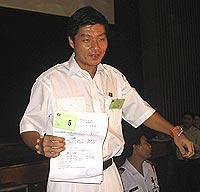 Take his counterpart in the Chinese party for instance. The deputy chief of the MCA Youth felt that he had to respond to the PM's son-in-law over the allegation that the Chinese are taking advantage of the internal discord within Umno. They had an inconclusive meeting and nothing came of it. That MCA chap is the son of a former MCA president, and a young man who had gotten himself on the board of many listed companies when he was just 27.
It does not surprise Malaysians that these days, many political parties are run like family empires. As the Chinese proverb goes, the sweet and nourishing water should not go to other people's rice fields. Sons, daughters and sons-in-law are all potential heirs to the party throne. This must be a secret agenda never alluded to in Vision 2020.
Budget, what budget?
Nowadays, the ordinary people are well versed in the craft of political observation. I walked into the neighbouring store on the eve of budget day. The streets were deserted, and there were more workers than customers in the store.
I suggested to the Chinese owner that poor business all round around KL was probably due to the long Month of the Hungry Ghosts. People prefer to stay at home, rather than braving an encounter of the occult kind. Business should pick up soon, upon the arrival of the eighth month on the Chinese calendar, the month of the Moon Cake Festival. The young towkay agreed.
I suggested to him that perhaps the budget will bring some good news. He disagreed. Whatever big money spent by the government, he said, would only benefit "them" - those with political connections. The pages and pages of macro-economic analysis of the budget in the papers would mean nothing to this small businessman working seven days a week, 12 hours a day.
Without going into details or making enquiries, I know this businessman is one of the millions of marginalised people in Malaysia.
His small capital probably comes from years of savings, and perhaps a small loan or two from relatives. His request for bank loans would almost certainly be turned down, unless of course if he is already loaded with tons of fixed assets, which very few people are.
As far as those much touted government programmes to help businessmen are concerned, he is never included. "Government" is almost an obscene word for him. In his business, he needs approval from many government agencies and countless departments from the local councils. For each application, there is always a long delay, and the mandatory greasing of palms.
Costs are rising. The clientele is hard put to part with their rapidly-shrinking ringgit. He manages with the only way he knows how: hard work and thrift.
Small Chinese businessmen in the small and medium industry across the country share the same fate, that of total neglect by the government. But then, the Chinese people are born stoics, long conditioned to the maxim of survival that "there is no free lunch anywhere". They have accepted the Malaysian reality that they must compete in the murderous market with a crippling handicap. That is life.
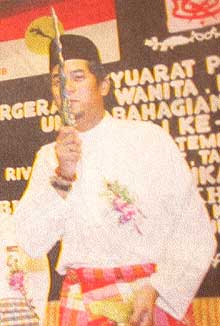 How would they feel when they hear the PM's son-in-law ranting about the Penang Malays being marginalised, with the undertone that the Chinese people are the culprits who do the marginalising.
There would be suppressed anger. But they would be used to this sort of racial tirade by now.
Bitching about marginalisation
Shrewd and streetwise, they would understand the forces behind this shadow-play of racial posturing. This young man has come to political prominence only very recently. He carries the additional burden of being husband to the PM's daughter. Without sounding like a champion of Malay rights, or Malay privileges, his meteoric climb to the top may be attributed to his link to the first family of the land, rather than his competence or commitment to the Umno cause.
Then of course, Umno general assembly would be held in November. Many Umno Youth divisions and branches are having their obligatory meetings. He would be invited to talk to his constituency, thereby gaining the platform to expose himself. He is a young man on the go, in a hurry.
Since this is supposed to be a free country, having achieved independence and all that, I too must claim my right to bitch about marginalisation.
I am marginalised, just because of my opposition background, my big mouth and my big pen. But that is alright, because in public affairs, it is best not to allow one's writing to become a mere extension of one's puny ego. One tries to look at the larger picture.
I do see many Malays being marginalised, by the policies and the system created by the Umno-dominated government. The millions of newly emergent Malay middle-class salaried workers in all the cities are suffering the effects of inflation and bad governance, just like Malaysians of other ethnic origins.
Many of these new Malays are heavily indebted to banks for housing and car loans. Others are burdened by their credit card expenditure. Some of them try to work at two jobs, or moonlight for side income on their own time. They pinch pennies, and look aghast at a bleak financial future like everybody else. It is not the case that the shower of government cash falls on every Malay person.
Of course, the rural people of all races are marginalised, since development is concentrated in the towns and cities. They have become hostage to fortune, subject to the vagaries of commodity prices, the weather, and ubiquitous government control of their activity.
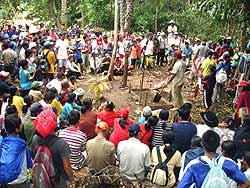 Countless government agencies have been set up to help our farming communities, but the huge bureaucracy that runs them are the first beneficiary of government allocation. The farmers themselves, if they participate in these programmes, end up being labourers on their own land, with little say over how their farming activities are planned and executed.
I know for a fact the people in Sarawak and Sabah are marginalised. They have little say over national affairs, and submit themselves with lame resignation to the political will emanating from Kuala Lumpur. As for the indigenous people in those two vast states, who form the majority of the population there, they hardly count for anything in the national scheme of things. They are just there to make up the numbers, required by the head-counting during general elections. They are too far away. As they say, out of sight, out of mind.
I know many young people of all races are marginalised, including those with a piece of university or college parchment. Many are unemployed, unemployable, or underemployed. They have been made victims of a deadening education system, and a society that stifles their creativity and initiative.
Foreign workers suffer too
Millions of them flock to the large cities for job opportunities and excitement. They end up living from hand to mouth, festering in the impersonal alienating city landscape, with practically no recreational facilities except for shopping malls. They have been uprooted from their own community, removed from their traditional social control, ignored by the government, and so they are completely lost.
I know many women are still marginalised, including those who have to work to secure a second income for the family. They are still under tremendous pressure to conform to religious or cultural code of behaviour as women, often holding the entire family together despite their husband, worried to death about their teenage children falling victim to dadah and gang threats.
 I know that the five million foreign workers in Malaysia are marginalised. They are exploited beyond belief. They have no rights, and live in constant fear. They are also very lonely. But I must not dwell here too long, since Malaysians have very low opinions of foreign workers as human beings anyway.
It would seem that the majority of Malaysians are marginalised one way or another by a power centre dominated by Umno and their political minions of all shades and hues.
And this chap is now making noise about Malays in Penang being marginalised, as if a Malay chief minister will solve the problems.
As I said, this is the Month of the Hungry Ghost still. By a quirk of astronomical adjustment, we have two such months this year. The ghosts are still wandering around, before their return to Hell in about two weeks' time.
I remember the advice given to me many years ago by a wise Iban old man who knows a thing or two about the supernatural. Ghosts will not harm human beings, he says, especially in the name of race and religion. Only human beings can do great harm to their fellow human beings.


Are you sure you want to delete this comment?
This action cannot be undone.