


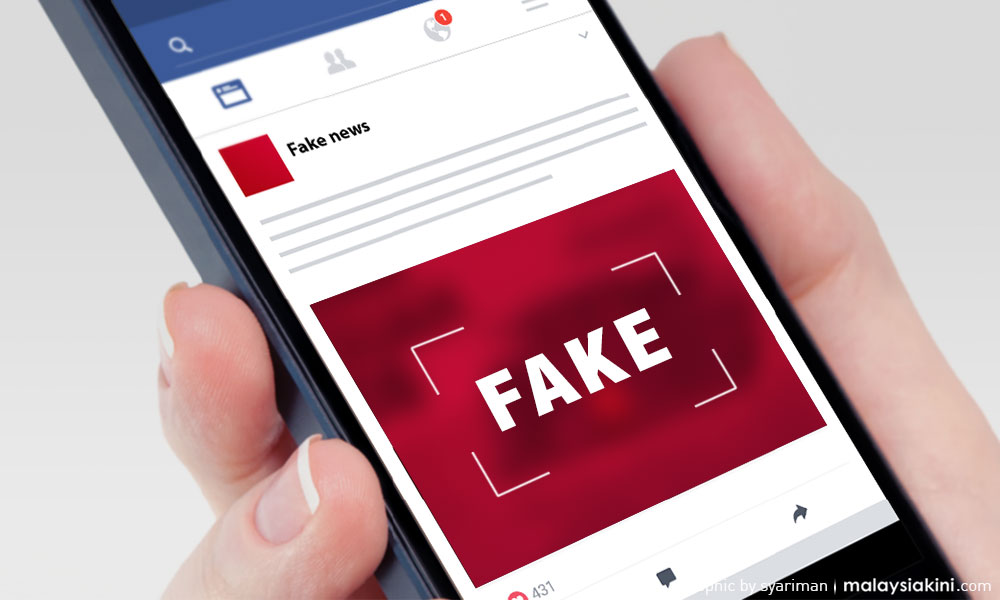

COMMENT | If in doubt, check it out – or else, don’t share
COMMENT | There is no easy way to stem the unceasing flow of falsehoods. But we need to start somewhere – like thinking about our social media practice and paying more attention to accuracy before we share ‘contents’.
While most of us do not set out to spread misinformation, we do unthinkingly click ‘share’ because it felt ‘right’ and ‘true’ when we read it.
As a former journalist, I have learnt that if something sounds too good to be true, it seldom is - more so from what we read daily on our social media feeds.
Here’s what’s often overlooked: social media algorithms from our browsing history are optimised for social engagement with the like-minded rather than for establishing the ‘truth’. Hence, the echo chambers on social media.
Next, where change in social media practice could occur is with the younger generation, some of whom may grow up to be social media influencers.
Case studies in other countries have well established a need to teach students to be smarter and more discriminating in how they use social media to engage with the world.
Just as teaching good hygiene reduces the risk of contracting diseases, teaching digital media literacy will better prepare young minds to decipher what is reliable or unreliable news, what is true or false in what they see on their screen.
Media literacy may not be the ...
COMMENT | There is no easy way to stem the unceasing flow of falsehoods. But we need to start somewhere – like thinking about our social media practice and paying more attention to accuracy before we share ‘contents’.
While most of us do not set out to spread misinformation, we do unthinkingly click ‘share’ because it felt ‘right’ and ‘true’ when we read it.
As a former journalist, I have learnt that if something sounds too good to be true, it seldom is - more so from what we read daily on our social media feeds.
Here’s what’s often overlooked: social media algorithms from our browsing history are optimised for social engagement with the like-minded rather than for establishing the ‘truth’. Hence, the echo chambers on social media.
Next, where change in social media practice could occur is with the younger generation, some of whom may grow up to be social media influencers.
Case studies in other countries have well established a need to teach students to be smarter and more discriminating in how they use social media to engage with the world.
Just as teaching good hygiene reduces the risk of contracting diseases, teaching digital media literacy will better prepare young minds to decipher what is reliable or unreliable news, what is true or false in what they see on their screen.
Media literacy may not be the silver bullet to disarm the onslaught of misinformation. But starting with students at an early age seems like a more proactive option than reactive media-suppressing legislations.
Adults, too, need to be better educated about online satire, parody and news. Even those in authority can be easily fooled online. (Remember a re-tweet of a satirical article on Osama bin Laden published in The Onion which former police chief, Musa Hassan, believed was real news?)
The philosophical discourse on what constitutes “truth” or “falsehoods” aside, it suffices to emphasise this basic precaution: fact check the veracity of what you read and see on social media before sharing.
The vicious cycle of misinformation will keep turning if we know that something is probably false but choose to believe and act on it anyway because it serves our best interest.
This cognitive regression was evident among the Maga ('Make America Great Again') pack over four years of Donald Trump’s presidency that had turned truth and reality on its head.
Our own partisan crowd from the BN to the Pakatan Harapan and Perikatan Nasional administrations are not immune either to spreading misinformation and misrepresenting issues to serve their narrow political interests.
Practical steps
In recognising that the misinformation plague is a problem, we can help to slow down, if not to stem, its unceasing flow to our screen.
There are abundant online resources on how to break out of the social media echo chamber. I have written about this in relation to fact-checking journalism. It is worth revisiting some of these practical steps:
- Always check the source of the original article, the writer’s background, and institutional affiliation.
- Ask when the article was written; who were quoted and the research cited.
- Check the ‘About Us’ section and the people managing the contents. The website’s mission statement and goals usually frame the contents and commentaries.
- Crosscheck with other authoritative sources the contextual and factual accuracy of the articles.
- Check the authenticity of the images with Google Reverse Image Search. Many images could be digitally altered and cloned to mislead and misrepresent what actually happened.
- Scrutinise what you see online with a critical understanding of who is saying what to who, and for what purpose.
- Resist the impulse to re-post what you think is important before checking whether what you have read is reliable and evidence-based.
- Research for contrary articles to lessen the risk of being caught in the confirmation bias loop.
- Diversify your source of news outlets for a more complete picture of the issues - from the political left to the centre-right, from the government to the opposition, from the liberal to conservative.
- Lastly, as every journalist is taught: if in doubt, check it out. Otherwise, leave it out.
ERIC LOO is the founding editor of the academic journal Asia Pacific Media Educator.
The views expressed here are those of the author/contributor and do not necessarily represent the views of Malaysiakini.


Are you sure you want to delete this comment?
This action cannot be undone.