




The new world disorder
The past week has been a dizzying week of dramatic events, both abroad and at home. It is a bonanza of raw materials for political commentators all over the world.
Japan will get a new PM. His grandfather was also a PM shortly after WW2, a nationalist who was charged, but not convicted for war crimes. Apparently, public office in Japan is very much considered a family heirloom among political dynasties, a trend that Malaysia is quickly emulating.
Japanese democracy is a strange mutant species from the Western model, and I must confess that I do not understand it much. That is probably why a former PM of Malaysia extolled Malaysians to look East. Fortunately, like many of his vacuous though attractive slogans, this Look East Policy has been diluted and almost forgotten.
The past week has been a dizzying week of dramatic events, both abroad and at home. It is a bonanza of raw materials for political commentators all over the world.
Japan will get a new PM. His grandfather was also a PM shortly after WW2, a nationalist who was charged, but not convicted for war crimes. Apparently, public office in Japan is very much considered a family heirloom among political dynasties, a trend that Malaysia is quickly emulating.
Japanese democracy is a strange mutant species from the Western model, and I must confess that I do not understand it much. That is probably why a former PM of Malaysia extolled Malaysians to look East. Fortunately, like many of his vacuous though attractive slogans, this Look East Policy has been diluted and almost forgotten.
The world should pay attention to this changing of the guards in Japan of course. It is the second largest economy in the world, and its products filled every Malaysian home. How it relates to its neighbours in this region in future, especially China, is a matter of concern to people in this part of the world.
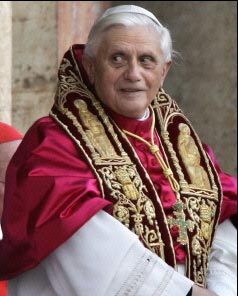 Then there is this business of the Catholic Pope offending the sensibilities of the Muslims worldwide. By reputation, this new Pope from Germany is an awesome theologian, but he is obviously not a diplomat. This world is more impressed by malleable impressions, superficial perceptions, and symbolic images, rather than intellectual exploration into possible truths through rational debate.
This is really the subject on which I would like to give my two cents worth this week, except that I have learned a lesson about religious sentiments from this little farcical fracas. So one refrains from rushing in where angels fear to tread. Or pouring oil on a raging fire!
Fortunately, we are lucky to be living in Malaysia. There has not been much raging against the Pope or Christians in general. Some politicians make their usual mandatory noise in protest against the Pope, and that was that. They are politicians trying to defend their race and their religion after all. For once, I am pleasantly surprised by the PAS people.
The woes in Africa
Meanwhile, far away, the genocide in the Darfur region in Sudan threatens to break out again. But the international community has not been moved much. Africa has always fascinated me since I read Joseph Conrad's Heart of Darkness in my school days
The day Africans get their act together as a continent would be the moment in a shift of world history. Meanwhile, Africans of all tribal, religious and national persuasions continue to suffer on a scale that makes one feel ashamed of our common humanity.
Meanwhile, the UN general Assembly has brought world attention back to this noble but rather impractical idea of a world body that could reconcile world conflicts and bring peace to men of good will on earth.
There, there is hardly any significant mention of the hunger and sickness in Africa, nor is there any urgent move to stop the wars and the genocide. Instead, it has turned into another platform for partisan sectarian and nationalist rhetoric.
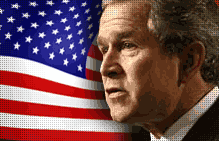 Fresh from their rehearsal in the Non-Aligned Movement meeting in Cuba, the leaders of Iran and Venezuela lambasted the US president as the biggest threat to world peace. In his turn, the US president warned the world against the nuclear menace from Iran and North Korea. You wonder why these very important persons take the trouble to go to New York, and spend all their time attacking one another.
At least, the US president seems to have steered away from his philosophy of unilateralism that he favoured so much in the earlier part of his presidential career. He is insisting on a diplomatic solution to the Iran nuclear crisis. I think he has finally realised the US alone cannot solve all the problems of the world.
Even if the US can open up a third military front in Iran, after Iraq and Afghanistan, it is cheaper for the US to avoid another armed conflict by seeking allies to shoulder part of the responsibility of fighting terror.
So there have been days of demonstrations and riots in Hungary against the PM there. What happens there is nothing compared to the political tornado tearing through Taiwan. Mass rallies are held on the streets across the island against and in support of President Chen Shui Bian.
The Western press, notably CNN and BBC, pay scant attention to the upheaval in Taipei, but the media in Taiwan, Hong Kong and China are giving blow-by-blow blanket coverage to the event. The Chinese press in Malaysia is also carrying pages and pages of reports everyday on the political crisis there.
Apparently, members of the president's family have been accused of benefiting from shady deals in the past. The protestors are demanding his resignation, and he is determined to tough out the storm.
Military coup
In any democracy, people who hold the highest office of the land seem never willing to part with their power and influence, no matter how tenuous their hold on power is. They will use every trick in the book to thwart all attempts to topple them. That was what happened in Thailand, before a military coup removed Taksin from office.
The coup caught me completely by surprise. Military coups were a common political phenomenon in Asia, Africa and South America in the post-war era. They were a by-product of the pan-global Cold War tussle between the two super powers of that time.
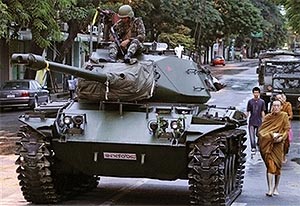 The generals who succeeded in toppling civilian governments tended to establish very brutal dictatorial and corrupt juntas, pocketing huge sums of money from their national coffers as well as aid money pouring in from international aid agencies. Under their iron hands, no democratic rights were allowed to any citizen, and dissent was always repressed with excessive force. Massive torture and disappearance of their citizens tended to be a common occurrence.
However, in the last two decades or so, especially after the conclusion of the Cold War in 1989, military coups have seemed to go out of fashion. In the new world order, dictatorships established through military coup have been crumbling one by one, especially in South America. In South East Asia, the last one booted out of office was President Suharto in 1997. Despite murmurs of coup attempts, the elected Philippines government remains firmly in place.
Thailand too has a long history of the powerful military interfering with civilian rules for many decades after WW2. We got used to news of coups and counter coups in our next door neighbour once in a while. In the early 90s, a people revolution with massive demonstrations on the streets of Bangkok managed to force the military from Thai political life.
You would have thought that the spectre of another military coup has finally bitten the dust after that. In the past two decades, free from the threat from the generals taking power with the support of troops and tanks, Thailand has grown to be one of the most vibrant democracies in Asia. The Thai economy has also jumped ahead of Malaysia in many ways.
Personally, I find military coups most distasteful. Military dictatorships lack political legitimacy. They strangle civil societies. They are always corrupt at the expense of the welfare of the people they rule. A government like the one in Myanmar is a reminder of how ugly such a military dictatorship can be.
Therefore, the recent coup in Thailand is cause for great dismay, no matter how popular it is to the Thai people. The political crisis that has ravaged that beautiful country and her beautiful people in months past could still be resolved through a peaceful constitutional process.
I have wanted to comment on this, and other dramatic developments on the international scene. Malaysians generally are not too concerned with what goes on in the world, so perhaps my fellow columnist Josh Hong in malaysiakini will not be left alone to grapple with matters of international relations.
Then, I was suddenly overwhelmed by a sense of weariness.
The Sophists of ancient Greece have said it all 2,500 years ago. In the mouth of the Sophist Polymarchus in Plato Republic, justice is to the advantage of the stronger.
All that cacophony of noise flooding our world and local media signifies nothing but the voice of brute power speaking the language of greed, violence and domination. It is as if we humankind have not learned anything noble from our eons of historical errors, and that all our great religious prophets and philosophical teachers have lived and died in vain.
I suspect that if Jesus were to come to the aid of humankind again, he will be crucified for a second time.


