




Faith and rationality
The two-week old controversy stirred up by Pope Benedict of the Catholic Church has not subsided despite his repeated apologies in several variations. At the time of writing, the Organisation of the Islamic Conference (OIC) comprising 56 member nations are still demanding a retraction from the Pope.
The Pope had, during a speech in Germany on September 12, quoted the 14th century Byzantine Emperor Manuel II Palacologus, who said everything the Prophet Muhammad brought was evil "such as his command to spread by the sword the faith he preached".
That drew strong protests from Muslims worldwide, including those in Malaysia. That sort of quotation has been seen as an attack on the core belief of Islam that Prophet Muhammad was a perfect being, and that Islam is a religion of peace and compassion.
How are we to make sense of this potentially explosive episode, seeing that a clash of the two largest religions of the world can easily cause global bloodshed?
The two-week old controversy stirred up by Pope Benedict of the Catholic Church has not subsided despite his repeated apologies in several variations. At the time of writing, the Organisation of the Islamic Conference (OIC) comprising 56 member nations are still demanding a retraction from the Pope.
The Pope had, during a speech in Germany on September 12, quoted the 14th century Byzantine Emperor Manuel II Palacologus, who said everything the Prophet Muhammad brought was evil "such as his command to spread by the sword the faith he preached".
That drew strong protests from Muslims worldwide, including those in Malaysia. That sort of quotation has been seen as an attack on the core belief of Islam that Prophet Muhammad was a perfect being, and that Islam is a religion of peace and compassion.
How are we to make sense of this potentially explosive episode, seeing that a clash of the two largest religions of the world can easily cause global bloodshed?
For a start, I am glad no Muslim cleric has issued any edict for the execution of the Catholic Pope, although it is certain security measures around the person of the Pope will be tightened manifold from now on. Although there were some attempt to use this episode for the purpose of political mobilisation, especially in Egypt, all the protests around the world has been peaceful and free of violence.
By and large, the very diverse Muslim "world" has been quite restrained and moderate in reacting to the Pope's alleged offence, thereby refuting the claim by the 14th century Catholic theologian. I hope they will keep it that way. Centuries back in history, an incident like that might have led to a full scale war between Christians and Muslims. Perhaps there is hope for mankind yet.
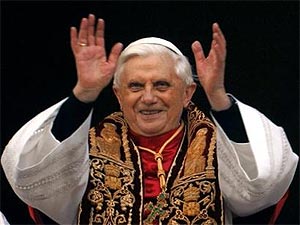 Then again, the world has changed. In the distant past, the Catholic Church did weld great political power, before the Reformation and the European Enlightenment. The retreat of the Church from the political arena was a slow but certain historical development in Europe and North America, leading to the idea of secular nation-states that we witness to-day. This is a process in the human learning curve that has eluded the Islamic world.
Nowadays, although the Vatican is recognised as an autonomous state, strictly speaking it is not a nation state like the US. It would be ridiculous for any army to march on to Rome and conquer the Vatican. The situation would be vastly different if George W Bush had uttered insult against the Prophet Muhammad. Americans would be in great peril.
Reason in religious faith
Then again, we do not know why the Pope chose to quote the anti-Islamic saying from 600 years ago. Merely quoting such a saying is not a sin, since in the distant past, cruel things must have been said publicly about other people's religion. We do have to know the context in which the words were uttered, before we can decide whether the Pope did indeed mean to insult another major religion.
I would like to read the full text of his speech in Germany, but that would be difficult. He is reputed to be a formidable theologian in the modern sense, and therefore unlikely to propagate simplistic religious bigotry, even though he is known to be leaning towards theological conservative orthodoxy on doctrinal matters.
From very scanty reports on the media, the Pope was merely trying to emphasise the importance of reason in religious faith. The tension between reason and faith is a long-standing issue in the history of the Church.
According to St Augustine (354 430 AD) for instance, he "believes in order to know God." God is so great that he is beyond the capability of puny human reason to comprehend fully. Only through strong faith in the absolute truth revealed through the prophets can a Christian begin to wonder at the all-encompassing greatness and sanctity of God. Reason is always subservient to faith. Believe first, and then you will know God. Without faith, reason is sterile. I think many Islamic scholars may agree with him on this point.
The debate within the Church took many tortuous twists and turns through the centuries, and great theologians at various times have joined in the fray.
The final word on the subject, at least within the Catholic Church, was said by St Thomas Aquinas (1225 or 12261274). He admitted that reason is always deficient, but not entirely insignificant. When speaking to non-believers, for instance, reasoning is the only recourse in discussing religious truths, because the audience has no faith altogether to begin with.
Since the pursuit of religious faith is God's Truth, and God has given man the ultimate gift of natural reason, reason can indeed complement faith in one's religious devotion. Of course, there is no contradiction between the mysteries of religious faith and the logic of rationality.
The philosophy of St Thomas Aquinas became the official theological doctrine of the Catholic Church, following a rescript by Pope Leo III in 1879. I understand that to-day, all educational systems within the Catholic Church have to teach his system as the only right one, and criticising his thoughts is almost an impious act.
I am more inclined to the view of St. Thomas Aquinas for two reasons.
For one thing, we all know the inherent danger of blind religious belief, especially when that blind faith is accompanied by great intensity of passion. The faithful can mistakenly identify the strength of his faith with the truth of his belief. Unquestioned belief can also spring from devotion to the charisma of a religious leader. It is the material of which religious fanatism is made and propagated.
For another thing, reason is indeed the only viable recourse towards a meaningful relationship between the faithful and the non-believers. It allows the followers of one religion to develop a working relationship with the members of other faiths, as well as people with no strong religious conviction at all.
Others' religious sensitivities
Here lies the reason why, writing in Malaysia as I do, I avoid discussing religious issues altogether. I am very sensitive to other people's religious sensitivities. Eventually, whatever I say about any religion in a critical sense is bound to make some people angry, even though their anger and sensitivities are not always justified by their own religious teaching.
Inevitably, I ask how people with very strong religious faith regard people who do not belong to any organised religion like me. Am I a "pagan", a "gentile", an "infidel', merely fit to be condemned to Hell in the afterlife? Am I therefore an object of some pity at best, and an unrepentant contemptible sinner whose very existence insults their God?
Am I forever an outsider without any moral or legal locus standi to question any edict or creed of any of these major religions, even if we live under the same sky, and their religious faiths affect me indirectly, in one way or another?
Or am I a fellow creature of God by their own reckoning, to be respected because of my immortal soul, and to be consulted on matters that involve our collective pluralist way of life.
In short, I am asking how religious people can account for themselves for their belief to people like me, who are unbelievers or non-believers. What ought to be the power-relation between one religion and another, or between any religion and atheists? What is the common ground that will make any kind of such a political and social relation just and amiable?
The only avenue for the exploration of such an inter-faith relation is the natural reason common to us all, irrespective of our respective belief system. Your relationship with your God is an intense personal experience for you, but for other people who do not share your faith, your personal experience is entirely your experience alone.
In other words, the only way the followers of any one faith can relate to the devotees of other gods is through language, in which is immersed our common rationality. Dialogues and discourse is the only peaceful avenue for people of different faiths to live together in peace and harmony.
Failing any kind of peaceful existence through reasonable talking, the alternative is violence, either physical or verbal violence. It would end in the total self-destruction of mankind, a sad destiny for a miraculous species surely not intended by the god of any great religion!
People of different faiths may enter into a conversation, and there would still be little communication. Inter-faith dialogue must mean more than a group of people engaging in mere talk, each asserting its own doctrine, trying to persuade others that theirs is the only correct interpretation of their holy texts, and that all others are wrong. That is hardly mutual respect.
In short, even before such inter-faith dialogues are conducted, one has to reflect with all the spiritual and intellectual integrity possible, on the objective of such dialogues, as well the basic ground-rules that would constitute reasonable talk.
Faith without reason is blind, and reason without faith is sterile.


