




Affirmative action weakens
Affirmative action policies do not promote, but instead weaken a society's fabric.
That much came from a finding in a Wellington newspaper report in New Zealand in 2000, which said, "there appears to be little or no research whether teaching kids the standard curriculum, but in Maori, has improved their educational outcomes."
The lack of any interest in New Zealand on the empirical consequences associated with adopting affirmative action policies is the other disturbing factor.
Of the many slanted premises global affirmative action policies spring from, they commit an unmatched disservice to our real intentions behind those policies.
Thus there is little surprise behind the chant of Indian students: "Indians born free but bonded by quota", to the understandable outrage they feel over their government's recent decision to reserve college places for lower caster Hindus.
That the advocacy of affirmative action is good, cannot be anymore ignorant, naive or ill-informed than to substituting the real cure for an illness with the relief prescription of a race or caste-based preference programme.
Thus, these advocates should not and must not console themselves that their false assumptions are mostly, social quackery. Their prescriptions are nothing but merely substitutes for dealing with real problems, which whilst tearing a society apart are nothing more than transferring to a later time the resolution of real social problems in the present.
Malaysian example
Let's take the case of Malaysia.
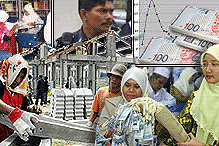 When she was convulsed by race riots in the 1960s, uneven income distribution caused by what conceivably was the 'marketplace' led to the erroneous belief that the minority Chinese were having an unfair advantage in the economy of their country, as a result of their competitive streak.
So just like India of today, they began reserving places in colleges and universities for preferred communities, in the hope that these will somehow attain parity. Or artificial parity, that is!
But after some 40 years and many handouts later, Malaysia continues to teeter on a fragile social peace in clear testimony to the failure of its affirmative action programmes, known as the bumiputera (sons of the soil) policy.
Affirmative action programmes also generate major social costs that fall on the population as a whole.
Losses of efficiency are among these costs, either because less-qualified persons are chosen over more-qualified persons or because many highly qualified members of non-preferred groups emigrate, as is presently happening in Malaysia.
However, the cost of inter-group polarisation, violence and loss of lives overshadow the cost of inefficiency. Regular bloody riots over affirmative action in India are the clearest examples but there have also been young Brahmins immolating in protest against policies that have once destroyed their prospects.
One of the weakest defences against group preferences and quotas is that there are precedents for them. If students can be admitted into universities based on their athletic performance or because they are the children of alumni, why can't race and ethnic preferences feature as the other criteria?
Such an argument whilst clearly taxing the critics of affirmative action, is loose, simplistic and heaps contempt to the real consequences of such programmes. If everything needs a precedent for justification, then murder, pogroms and other nefarious acts can simply exist because they have all had a precedent for their continued existence, without any due recognition to their results.
Without a moral leg to stand on, arguments from a precedent standpoint cannot be conclusive because it fails to address such key issues of differing value systems among different races as well as other intangibles like the intrinsic quality of work ethic within social groups.
When an assumption is made that we must be magnanimous to the less fortunate by the allocation of job quotas, it is always hard to ignore the fact that more than supposed 'good intentions' are involved.
Behavioral and other differences among the various populations themselves are arbitrarily banished from discussion, and therefore adds to what I must say, the 'injustice' towards the move to magnanimity.
Excelling in sports
Data from the United States reveals that 'fortunate' African Americans receive a disproportionate share of benefits, as opposed to African Americans as a whole in the United States. It is also the same with Malays in Malaysia or the untouchables in India.
Yet a gross misrepresentation is that whilst empirical evidence clearly supports that most African Americans got themselves out of poverty by their own steam before the civil rights movement in the 1960s - the travesty of it all indicates otherwise. That is African Americans owe their advancement to government beneficence!
Indeed, some of the same groups discriminated against show a strange and amusing kind of ascendancy over the majority population in such fields as sports and entertainment; endeavours where only individual talents and efforts can produce success.
Just as no one should believe that Maoris can keep white New Zealanders off their country's sports teams except by outperforming them on the field; African American basketball players can do likewise for the United States.
The empirical consequences of affirmative action programmes abetted by vague, emotional, confused and dishonest words are only but incidental to the raging controversy such a universally administered programme triggers.
As only few such programmes can stand on the basis of their actual empirical consequences, their moral basis should hardy be called tenable.
Some groups in some countries claim they are entitled to preferences and quotas, all because they are indigenous 'sons of the soil'.
Why an accident of history and geography should have moral implications that last for centuries is a question seldom raised, let alone answered.
JAYA PRAKASH lectures in journalism at Beacon School of Technology in Singapore. He can be reached at prakruby@pacific.net.sg


