



DAP’s long march to Bukit China
The following is an exclusive excerpt from Chapter 33 of ‘Lim Kit Siang: Malaysian First, Volume One: None But the Bold’, a new biography by Kee Thuan Chye.
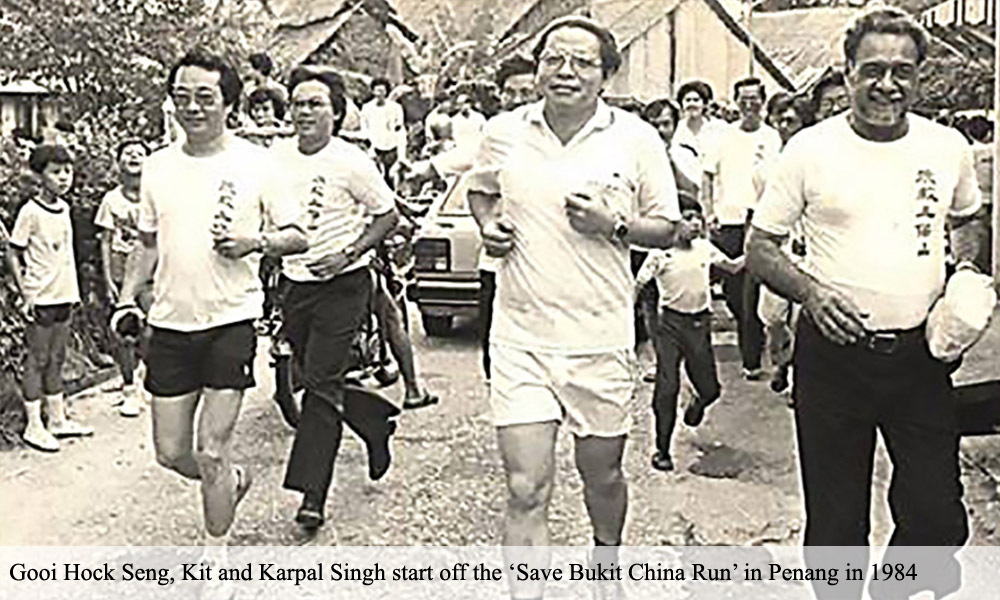
The police continued to hound the DAP’s ‘Save Bukit China’ activities [in 1984]. Another one they targeted was the cyclethon from Cheras, Kuala Lumpur, to Bukit China [a hilltop cemetery in Malacca].
Tan Kok Wai, who was then national secretary of DAP Socialist Youth (Dapsy) and organising chairman of the cyclethon, remembers that occasion to be “quite an experience”.
Vincent Wu Him Ven, who was at the time a teenager and a bright-eyed supporter of the DAP, also has memories of the event. It is particularly memorable for him because that was when he met his idol, Lim Kit Siang, for the first time.
Early that morning, Vincent, Kok Wai, Ronnie Liu and a group of cyclists set off from Cheras, led by Lee Lam Thye and Liew Ah Kim, who was the secretary of the ‘Save Bukit China’ national campaign’s committee.
As it was a relay event, other participants followed in a bus while waiting for their turn to ride. They were joined by more participants as they passed the towns along the route. One of those who joined from Tampin was Robert Ang.
All went well until they were stopped by police at Pulau Sebang in Alor Gajah. The police seized their bicycles and their bus on the allegation that the group was taking part in an...
The following is an exclusive excerpt from Chapter 33 of ‘Lim Kit Siang: Malaysian First, Volume One: None But the Bold’, a new biography by Kee Thuan Chye.
The police continued to hound the DAP’s ‘Save Bukit China’ activities [in 1984]. Another one they targeted was the cyclethon from Cheras, Kuala Lumpur, to Bukit China [a hilltop cemetery in Malacca].
Tan Kok Wai, who was then national secretary of DAP Socialist Youth (Dapsy) and organising chairman of the cyclethon, remembers that occasion to be “quite an experience”.
Vincent Wu Him Ven, who was at the time a teenager and a bright-eyed supporter of the DAP, also has memories of the event. It is particularly memorable for him because that was when he met his idol, Lim Kit Siang, for the first time.
Early that morning, Vincent, Kok Wai, Ronnie Liu and a group of cyclists set off from Cheras, led by Lee Lam Thye and Liew Ah Kim, who was the secretary of the ‘Save Bukit China’ national campaign’s committee.
As it was a relay event, other participants followed in a bus while waiting for their turn to ride. They were joined by more participants as they passed the towns along the route. One of those who joined from Tampin was Robert Ang.
All went well until they were stopped by police at Pulau Sebang in Alor Gajah. The police seized their bicycles and their bus on the allegation that the group was taking part in an illegal procession.
But Kok Wai contends this point. “The police were acting in a high-handed manner,” he says. “We were crossing from the Federal Territory to Selangor to Negeri Sembilan and then Malacca, how could you be expected to secure a permit from every one of these states before you start?”
Vincent recalls the group being taken to the Pulau Sebang police station and questioned by the cops. Then Melaka DAP leaders like Lai and Sim Tong Him came over to help when they were told about the incident. Kepong MP Tan Seng Giaw also showed up.
As Seng Giaw and Pulau Sebang DAP branch chairman Hu Hup Hin were parleying with the police, Melaka DAP member Wang Swee Teck’s car got pulled aside and checked. The police found iron pipes in it and asked Swee Teck what they were for. He said he was a licensed plumber working out of his car because he couldn’t afford an office, and the pipes were part of his equipment.
The police asked if he could kill people with those pipes, and Swee Teck cockily replied, “If I hit them in the balls, they can die.” The police arrested him and impounded his car. His comrades had to bail him out of the lock-up.
He would appear a few months later in an Alor Gajah court, represented by the fearsome Karpal Singh. The proceedings of his case would be something he still vividly remembers because of the passionate way that Karpal handled it.
The eminent lawyer emphatically stated that there was no law to prevent a man from using his car as his office and keeping his equipment in it, and to dramatise his anger at the levying of the inane charge against his client, he threw his wig on the floor and thumped the table and yelled, plaintively, to the judge that he had had to take a flight all the way from Penang to Kuala Lumpur and then charter a taxi to Alor Gajah just to defend a man who was wrongly arrested and charged! Why were the police and the court causing him and his client so much unnecessary aggravation and inconvenience?
Swee Teck was awed by his lawyer’s performance. He had heard of Karpal’s fierce reputation, but never seen him in action. Now he was getting it first-hand from a ringside seat. And, better still, getting acquitted as well.
The 35km walk
Back to that cyclethon incident in Pulau Sebang, as Swee Teck was getting bailed out and the DAP leaders were negotiating with the cops, Kit arrived at the police station.
He had received news of the police harassment and rushed over from Malacca. Vincent was thrilled to see his idol up close.
DAP chairman Chen Man Hin also came by. But his and Kit’s presence didn’t help. The police adamantly refused to release the bicycles and the bus. So Lai asked Kit what they should do next. Kit replied, “Let’s carry on. They take away our bicycles, we can still walk.”

Liew Ah Kim was aghast. It was quite a distance from Pulau Sebang to Bukit China. He asked Kit, “You can walk so far ah?”
Kit said, “It’s not a matter of can or cannot. We have to walk to show our protest.”
But the police objected. They warned everyone that if they walked as a group to Bukit China, they would all be charged for illegal assembly.
Wily Robert then came up with a counter: “In that case, we’ll walk in groups of two by two and keep the distance of a few metres between each group. That way, we won’t be breaking any law.” The police were stumped. They had no answer to that.
And so they all walked. About 35 kilometres to Bukit China. In the heat of midday and afternoon.
But Kok Wai remembers being “very excited”, walking with comrades, carrying DAP and Malaysian flags, shouting slogans, and singing. “We were in high spirits,” he says.
Kit was not wearing the proper attire or the proper shoes, but he led by example in walking with the group. Kok Wai says that in doing so, Kit showed not only his support for his comrades but also that “we should not succumb to political pressure or high-handed police action”.
Ronnie says, “Kit was not used to walking such a long distance, but he soldiered on even when his feet got swollen.” He was offered a ride in one of the accompanying cars, but he turned it down.
They walked for eight hours.
When they passed the villages and small towns along the way, people were lining the side of the road and cheering them on. This was the result of Tong Him’s initiative in driving ahead to these places to alert the residents beforehand that the group was coming, and rallying them to give support. This gave the walkers much-needed moral encouragement and kept their spirits up.
By the time they reached their destination, which was the Poh San Teng Temple at the foot of Bukit China, it was already late evening. There was a big crowd waiting, and the event that had been planned at that venue proceeded with speeches given by DAP leaders. Kit, Chen and Seng Giaw still had the energy to go on stage and whip up the crowd against the forces that were threatening Bukit China.
It said a lot about the three men that they completed the walk from Pulau Sebang whereas many others did not. As Ronnie recounts, “We started our walk with about a hundred at Pulau Sebang, but only 20-over made it all the way, the rest gave up and continued in cars.” Even young Vincent Wu gave up.
“But Kit Siang was very tough,” says Ah Kim. “For Chen, okay, because he was a marathon walker, and Seng Giaw, also okay, he was trained as a military doctor. Those two could walk. But Kit Siang had not been walking like this. And yet he still walked all the way.”
In the end, everyone developed blisters on their feet. Ah Kim saw Kit’s feet and gives an amusing description of it, “The whole foot was koyak (in a mess). And full of blisters. Can see the blood, water coming out!”
“But what to do when you want to walk in protest?” Kit comments cheerfully on looking back. “Crazy people do crazy things.”
When Kit Siang had a run-in with the headmaster
How Kit Siang met his high-school sweetheart
Kit Siang - from journalist to MP’s aide
The time when Kit Siang stood up for PAS
‘Brave political experiment’ failed in Gopeng
Dr M unable to stop probe into BMF scandal
‘Lim Kit Siang: Malaysian First, Volume One: None But the Bold’ is available in all major bookstores. The book will be officially launched online on Nov 9. Click here for more information.




Report this comment
Are you sure you want to delete this comment?
This action cannot be undone.