




CNY The Chinese enigma
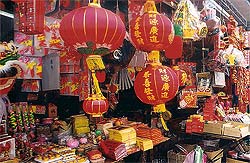
IN a week's time, the six million or so Malaysian citizens of Chinese descent, together with the 1.3 billion Chinese in mainland China, Taiwan, and Hong Kong, as well as the countless members of the Chinese Diasporas in all corners of the world, will be celebrating the Chinese Lunar New Year of the Golden Pig.
The CNY is a major global event, involving a quarter of the Earth's population. As long as you consider yourself a Chinese, wherever you are, the CNY is still the centre piece of your social and personal calendar.
Of all the homo sapiens that walk this good earth, the Chinese surely must be the most enigmatic people that have ever existed. Theirs is the only civilisation that has flourished with great fervour continuously for over four millennia, while most other equally ancient civilisations have since perished.
IN a week's time, the six million or so Malaysian citizens of Chinese descent, together with the 1.3 billion Chinese in mainland China, Taiwan, and Hong Kong, as well as the countless members of the Chinese Diasporas in all corners of the world, will be celebrating the Chinese Lunar New Year of the Golden Pig.
The CNY is a major global event, involving a quarter of the Earth's population. As long as you consider yourself a Chinese, wherever you are, the CNY is still the centre piece of your social and personal calendar.
Of all the homo sapiens that walk this good earth, the Chinese surely must be the most enigmatic people that have ever existed. Theirs is the only civilisation that has flourished with great fervour continuously for over four millennia, while most other equally ancient civilisations have since perished.
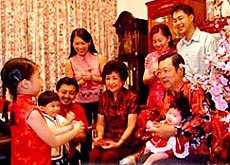 There is much to celebrate this year in China. That Oriental Dragon that has slept for centuries while the Western civilisation swept the globe finally wakes up, and breathes economic-military brimstone and fire.
The People's Republic of China has finally overtaken Germany recently to become the world's second or third largest economy. Their hunger for energy and natural resources has propelled their widening influence to the Middle East, Africa and South America, to fill the vacuum created by a deep seated distrust of the West in those parts.
People in the rest of the world witness this unfolding of the new Chinese reality with puzzlement, and not entirely without uneasiness either.
Of course China is the fastest growing market in the world nowadays. There is no shortage of financial and business carpet-baggers rushing to invest and cash in on the booming economy on the Mainland. But vast cultural differences exist, blocking real dialogue between civilisations, and harbouring mutual suspicion between the Chinese and the other three-quarters of mankind.
Proud to be Chinese
In Southeast Asia, and in distant lands that can be reached by sea water, local populations and their government eye their own Chinese migrants among them with envy and apprehension. These alien-looking Chinese are so well-off, while at the same time, resisting all attempts to assimilate themselves into the native identity. Wherever they drift, in whatever exotic communities they find themselves, Chinese will always be Chinese, and be proud of it.
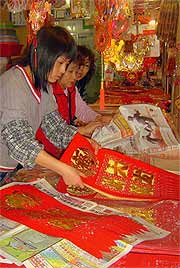 They will build a Chinese enclave to recreate the physical and cultural ambience of their village or town back home. There will be a temple, a school, a guild or clan association, a graveyard, and a Chinese newspaper. They cling fiercely to their traditions. They will never compromise their self-identity. They would seem unreasonably exclusivist, rightly or wrongly, in the eyes of many people in their adopted homeland.
Sometimes, when there is political unrest, the local population will turn on the Chinese migrant community as easy and obvious targets for mob rule. This has happened in Indonesia and the South Pacific Islands in recent times.
Edward Said once said about Islam, that there is no one Islam, but there are many Islams. The same can be said about the Chinese, though it is tempting to think that all Chinese are alike, especially when they do look alike. Likeness does live in the eye of the prejudiced beholder.
The Chinese in Malaysia for instance, are very different from the Chinese in Taiwan, Hong Kong and Mainland China.
Culturally, they may share the same origin that sprang forth on the plains of the Yellow River 5,000 years ago. Therefore, they would tend to think in similar conceptual archetypes, especially when they all have the same written Chinese script, which is practically inaccessible to non-Chinese.
In the depth of their soul though, Malaysian Chinese know for certain that they are vastly different from those in China. They would gladly go to China for a visit to their parents' relatives. They would love to travel to the exquisite landscape of that beautiful country. But they would not dream of living there. If they do, they will become strangers in their cultural homeland.
What Malaysian Chinese have gone through over a couple of hundreds of years, is a conscious, deliberate, and unique mental evolution The leaf may have fallen from the large tree somewhere in China, and been blown across the raging seas, but it has taken deep roots in a foreign land.
Language their vehicle
Today, most Chinese people in Malaysia will tell you that they are proud of being Chinese, but they are also proud of being Malaysians too. Unlike Chinese people in other countries, most of our Chinese Malaysians are multi-lingual. The younger generation will have little difficulty with the Malaysian national language, and yet Mandarin, or any one of the more popular dialects, is still their language of choice when interacting with one another.
This is not always the case elsewhere, especially for the Chinese in other Southeast Asian nations. There, the younger generations may still be identified as descendents of early Chinese immigrants, and yet they may have lost their mother tongue.
Since the period before independence, the Chinese people in our country have always identified the Chinese language as the vehicle of their cultural identity. They pay dearly for this principle, through massive voluntary donations to support their Chinese school system. Today, outside of China and Taiwan, Malaysia is the only country in the world where there is a complete Chinese education system from the kindergartens to the college level. I look forward to the day when the New Era College in Kajang will be elevated to the status of a full university.
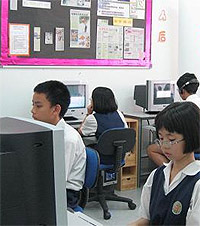 Nevertheless, even Malaysian Chinese who have been educated exclusively in English or Bahasa Malaysia would still insist that they are Chinese, and proud of their culture. They may not have read or studied Confucius, but most of them would have Confucian values drummed into their heads by their parents, relatives, and the Chinese community at large.
The teaching of Confucius laid down 2,500 years ago, on the virtues of love for learning, filial piety, love between siblings, respect for elders, the Middle Way, harmony in political and social relations, are still very much alive and well in Malaysia. Whatever the merits and demerits of Confucius' teaching, it has cemented social cohesion among the Chinese here. Perhaps, it is the most significant marker in their sense of self-identity.
There is much to celebrate this CNY for our Chinese friends in Malaysia.
Their forebears came to these shores penniless. They had nothing much except the shirt on their back. Driven by war, famine and natural disaster back home, they were eager to make an honest living in the strange land called Malaya and North Borneo.
Through thrift, hard work, and mutual assistance, they have carved out a comfortable niche in a land far away from home. If anything stood out in comparison with the other ethnic communities, it is the Chinese respect and love for education. Literacy and learning ensured social and economic upward mobility for their off-springs. From parents who worked as farmers, miners, labourers, younger generations of professionals, business entrepreneurs, and skilled technicians have emerged to occupy centre stage in the Malaysian economy.
Grateful and appreciative
Today, there are still pockets of extreme poverty among some Chinese. You get them in every community. Nevertheless, by and large, the Chinese have risen to form the backbone of the Malaysian middle class. They are one of the main factors that have fostered social and political stability in our country.
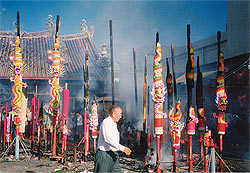 Many Chinese are still disgruntled about the political status quo, for they feel they are like second-class citizens in a country where they have given their contribution as loyal subjects of the land. I do have a lot of problem convincing my Chinese friends that they are far better off than the Indians, the Malays, the Ibans, and the Penans.
At the end of the day though, most of my Chinese friends will admit that Malaysia is a wonderful place to live in, despite the bad politics. They are grateful and appreciative of their adopted homeland that has nurtured them and provided them with sustenance for the family, and given them more opportunity for political participation than governments in neighbouring countries.
As many Chinese will tell you in private, if Malaysia is invaded by a foreign army, they are quite prepared to lay their lives down for the defence of the territorial integrity of Malaysia if only they are trusted and be allowed to do so.
The CNY celebration will be somewhat subdued this year. Despite what the macro-economic statistics may tell you, the economy is not that rosy. Cash flow is tight. The plight of the flood victims in Johor and Malacca also dampens the festive mood. Even if they have the means, they would rather conserve their resources in savings. The Chinese are always worried about their future.
 I always have a great respect for the human spirit of the Chinese in triumphing over adversities. Their eternal preparedness to sacrifice immediate satisfaction of their desire for the sake of delayed rewards and for the well-being of their children is particularly crucial in their success at survival as a community and as individuals.
As they sit down to their sumptuous family reunion dinner on CNY eve, which falls on February 17, a Saturday, they will be renewing not only their family and blood ties, but also all their traditional values which have served them so well in their survival in all kinds of hostile environment.
The wonderful thing about the Chinese people is this: the flame of hope will burn eternal in their breasts.
The rest of humankind have a lot to learn from the Chinese!
The writer can be contacted at keyalang578@hotmail.com


