




Will the Chinese M'sians survive 50 years from now?
As you read this, our Chinese friends all over Malaysia are finally into the thick of their Lunar New Year celebrations.
As much of their debts as possible have been settled. Greeting cards have been sent. Chinese companies would have rounded up their business, and feted their workers with a lavish feast. Where possible, they will also pay out some year end bonuses, even if the market has been less than encouraging lately.
As you read this, our Chinese friends all over Malaysia are finally into the thick of their Lunar New Year celebrations.
As much of their debts as possible have been settled. Greeting cards have been sent. Chinese companies would have rounded up their business, and feted their workers with a lavish feast. Where possible, they will also pay out some year end bonuses, even if the market has been less than encouraging lately.
Housewives are probably exhausted from their preparation, doing the last-minute shopping, sending out gifts to relatives and friends, getting ready goodies for the young ones, cleaning the house inside out and then decorating it. Before the sumptuous CNY eve reunion dinner begins, they must rush to the crowded and over-priced saloon to do their hair.
To get home for the reunion dinner, countless drivers would hit the roads throughout the nation. The highways would be jammed again. It saddens me that many will have to perish on the roads on this otherwise joyous occasion.
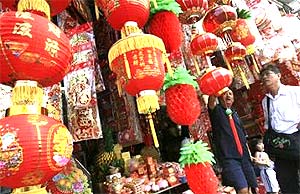 The successful Chinese people can survive so well in all kinds of adverse circumstances, because of their willingness to work very hard and be thrifty to a fault at the same time. They work all through the year, and some coffee shops never close even on public holidays and Sundays. CNY proper is the only time when they close shop and devote themselves entirely to their hard earned rest.
Nothing on earth is going to distract them from days and nights of feasting, visiting, drinking, and a spot of harmless gambling. The police should be sensible enough not to arrest everybody around every mahjong table. This is the only time when the Chinese people allow themselves the luxury of letting their hair down because whatever they do, it is just done 'once a year'.
These 15 days in the 'New Spring' season are a time for bidding farewell to all the bad luck of the previous year, and for renewing hope in the future year. It is also a time to renew family and communal ties, and reaffirm their traditional values.
Carved out a niche
They have their fair share of stormy weather in the past year, politically speaking. Ethnic and religious sentiments expressed by certain politicians have caused a great deal of resentment and unease among the Chinese. Like all those years in the decades after independence, the Chinese citizens of Malaysia have been reminded that due to a certain mythical 'social contract' in which they took no part, they must continue to submit themselves to this strange theory of ethnic dominance by one single indigenous community.
Nevertheless, deeply rooted in the teaching of Confucius, the Chinese people are a stoic lot. They have already accepted that they must depend on themselves for their survival.
Except for the very well connected Chinese tycoons who have been wise in choosing Malay business partners, the Chinese entrepreneurs in general would have no chance in bidding for big or small government contracts. The public sector is virtually closed to them. Few would even consider going into the civil service, the police and the army because the chance of fair promotion is slim.
So they have carved out a niche for themselves in the private sector, especially in the small and medium enterprises, concentrating on trade and manufacturing, in the service and retail industries. Others run small family businesses, or go into petty trading.
When these small Chinese businesses are hit by hard times, as in 1997, or when their cash flow shows signs of great strain, they know that nobody will bail them out. The banks and financial institutions have also become much more conservative in their loan facilities, and prefer to invest in low-risk high-yield lending. The difficulty of the SMEs in getting assistance from large banks is one of the principle reasons why loan-sharking is pretty prevalent among the Chinese community.
Fortunately, the Chinese people always have their traditional network of family and community at their disposal. Even if the extended family tends to break down with rapid urbanisation and industrialisation, Chinese business persons can still turn to the nuclear family members for help in times of great financial crisis.
Socially, the 7,000 or so clans and associations still play an important part in maintaining their social cohesion and pool together considerable Chinese social capital. Nowhere is this social capital more prominently displayed than in the area of vernacular education. A whole system of Chinese education exists in Malaysia, against all odds, because of very strong support from the entire community given towards funding and managing Chinese primary and secondary schools throughout the land.
Cultural nationalism
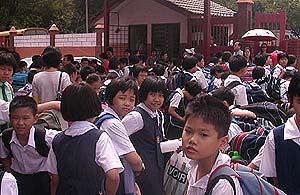 No political issue is closer to the heart of the Chinese than educating their young in their mother tongue. The survival and the propagation of their Chinese language are so crucial to them because that language is deemed to be the vehicle or the expression of their self-identity as Chinese.
Theirs is a kind of cultural nationalism, which unlike political nationalism, makes no exclusive territorial claim on any homeland. At the same time, Malaysian Chinese see no contradiction between remaining as Chinese while being fiercely loyal to the Malaysian nation-state. This philosophy was first pronounced by the late Lim Leong Gek, a legendary Chinese school teacher in the 50s.
My English educated Chinese friends may do well to study the life and times of Lim, and the Dong Jiao Zong movement that he spawned, for there lies the locus of the very unique sense of Chinese identity in Malaysia. Naturally, the path of that Chinese language movement in the past 50 years of independence has been nothing less than perilous.
Perhaps the Chinese people in this country have inherited their love and respect for learning and scholarship as taught by Confucius 2,500 years ago. Perhaps, their pragmatic instinct for survival has taught them that education is the key to financial independence and upward social mobility in life. Parents would go to no end of self-sacrifice to ensure that their children are well educated, sometimes incurring great debt in the process. Those Chinese students who can get help from government scholarship are very rare.
Finally, the factor that congeals their collective sense of identity is the Chinese-language newspapers. Together, the host of Chinese newspapers enjoy a readership of millions throughout the nation, with the national dailies listed on the KLSE main board. The political commentaries there are often far more open than the Malay and English press. This common print medium has allowed the Chinese to imagine themselves as members of a collective community, as Anderson would say.
I suspect that no Chinese citizen would harbour no resentment against the NEP at all. It has placed them at a great disadvantage, making them feel neglected, alienated and unloved by a country that they so love. But the Chinese people are also very realistic, and they just dig in their heels on this uneven playing field and work harder.
Valuable asset
To-day, by and large, the Chinese community is a pulsating, vibrant, and productive community. Their community spirit is still very strong. They are a valuable asset for the entire nation.
 Despite their political frustration and unhappiness, many Chinese citizens will still declare that ours is a great country to call home. Nature is kind to Malaysia, and we seldom have to suffer the kind of natural disasters that ravage through some of our neighbours. There is still peace and stability, and nobody needs to go hungry as in Africa, as long as people have good health and four limbs to work hard for a living.
I was asked by a Chinese friend recently whether I thought the Chinese would survive in Malaysia 50 years from now. My answer was a resounding "yes".
What he meant was probably more than mere physical survival, but the holistic survival of the Chinese as one of the many component ethnic communities in Malaysia. The Chinese in this country have always lived in fear of losing their ethnic identity, as they survey the deliberate effort of some neighbouring countries to assimilate their Chinese population into the national native culture.
None the less, the Malaysian Chinese do have the strength of numbers, and a long tradition of keeping their culture very much alive. As long as the younger generations of Malaysian Chinese can keep up that socio-economic lan vital, and preserve the ancient teaching of their philosophers, there is no reason why they cannot build and advance on that social cohesion that has been their communal trade mark.
There are risks and hidden dangers ahead for the Chinese people of course. But this is no time for me to spoil the mood of the five or six million Chinese determined to celebrate their good fortune.
It is far more fitting to wish all my Chinese readers a healthy and long life, and harmony and peace in your good heart. Just remember that there are things more important than making money only.


