


/file/1015/2e02a4d094a55db9b13837bba41aa75f.jpg)

COMMENT | Before the contest begins - some early thoughts
COMMENT | This coming Malaysian general election will be historic.
It will surely be the last “political hurrah” for Dr Mahathir Mohamad, for Tengku Razaleigh Hamzah (whether he is chosen to run again in Gua Musang or not), possibly for Muhyiddin Yassin, and also for Anwar Ibrahim, if once again he fails to deliver for his PKR.
And, speaking personally, this will certainly be my last Malaysian election as an “on-the-ground” bystander-observer - the last in a sequence going back to various by-elections in the late 1960s and then the fateful general elections of 1969.
And these elections will be like no other that we have seen.
Those leading national figures of the last half-century may have reached the end of their political roads. But apart from that, nothing much else is at this stage at all clear. And that means that GE15 will be not only historic but also unprecedented.
What is unusual about the election to be held some three weeks from now is that the result is genuinely uncertain and almost unfathomable - in a way that earlier elections have not been. GE15 will be unlike GE14, and also unlike those that preceded it.
The outlook is unclear, at the superficial level, because of the bewildering array of parties and party-alliances that are now offering themselves to the people.
But how has the national political situation come to this?...
COMMENT | This coming Malaysian general election will be historic.
It will surely be the last “political hurrah” for Dr Mahathir Mohamad, for Tengku Razaleigh Hamzah (whether he is chosen to run again in Gua Musang or not), possibly for Muhyiddin Yassin, and also for Anwar Ibrahim, if once again he fails to deliver for his PKR.
And, speaking personally, this will certainly be my last Malaysian election as an “on-the-ground” bystander-observer - the last in a sequence going back to various by-elections in the late 1960s and then the fateful general elections of 1969.
And these elections will be like no other that we have seen.
Those leading national figures of the last half-century may have reached the end of their political roads. But apart from that, nothing much else is at this stage at all clear. And that means that GE15 will be not only historic but also unprecedented.
What is unusual about the election to be held some three weeks from now is that the result is genuinely uncertain and almost unfathomable - in a way that earlier elections have not been. GE15 will be unlike GE14, and also unlike those that preceded it.
The outlook is unclear, at the superficial level, because of the bewildering array of parties and party-alliances that are now offering themselves to the people.
But how has the national political situation come to this?
A clouded outlook
National politics are still centred upon Malay politics. And Malay politics are in disarray. And Malay politics still revolve around Umno politics. And Umno itself and its politics have been and remain in awful disarray.
Umno has fragmented and fallen apart. Its internal lines of division do not reflect any deep or genuine ideological difference, nor do they express any deeply grounded group interests. Umno’s internal struggles reflect only the intense personal rivalries among individual leaders: their personal egos and ambitions, and their hopes of again seizing hold, for themselves and their networks of followers, of whatever state-provided benefits and openings and access that electoral victory may offer them.
Umno really does not know what it stands for any more. It cannot and its leaders cannot know what is not there available to be rationally known.
But, ominously and once again - and this is a point to return to later - there is a party in the field that does know what it stands for and wants. That is Umno’s old “frenemy” rival, PAS. PAS knows what it wants. Substantively and ultimately it wants Malaysia to become an Islamic state, one that implements and operates on the basis of “syariah law” (or a certain understanding of its precepts and demands). And it knows how it intends to achieve that objective. Its approach remains, after decades, the same. It hopes, by making its command of significant Malay voter support count, to bend Umno to its Islamist will and doctrine. To have Umno implement PAS’s programme for it.
Origins of the present crisis
How did this happen?
The underlying cause of this rampantly advancing incoherence in Malay politics warrants recognition and some comment.
The dire situation that now presents itself to the nation’s voters is the cumulative result of the politics of the last 20 years.
When Mahathir concluded his 22-year-long first term as prime minister, his successor, Abdullah Ahmad Badawi, tried to move Umno and BN more, and slowly, to the centre. He wanted to head a mildly and moderately “reforming” government.
But he was soon stopped in his tracks. His signature plans, for example, for an Interfaith Religious Commission and a body to exercise public oversight over the Malaysian Police (PDRM) elicited a furious reaction.
Abdullah Badawi, so those unhappy with the prospect of change felt, had to be stopped. And rhetorically turbo-charged appeals to familiar Malay sentiments and so-called “Malay interests” were the means adopted to stop Abdullah Badawi and his “liberalising” measures.
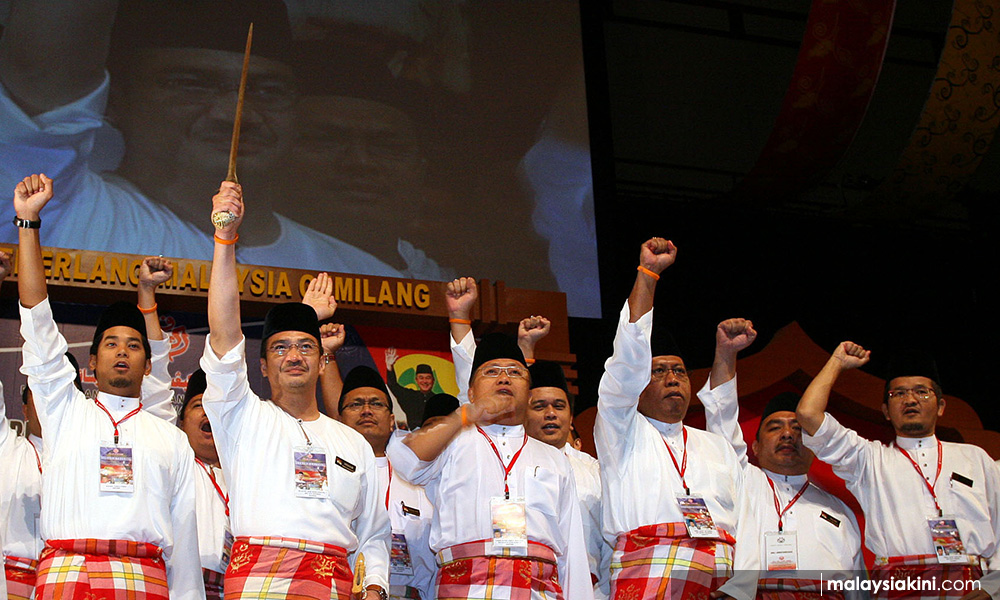
So began the era of intimidatory keris-brandishing by the Pemuda Wing at the opening of Umno general assemblies and of the escalated promotion, to justify such actions and attitudes, of the Umno "ideas man" Abdullah Ahmad’s quirky revisionist, even fictive, historical ideas of a nationally foundational “Social Contract” embodying a universal acceptance of “Ketuanan Melayu”, of Malay primacy and ascendancy and even domination in national life.
Abdullah Ahmad’s ideas were not born, or any part, of the Merdeka process itself in 1955-1957, nor did they reflect it. They were developed and presented in the late 1980s, from 1986, as the end of the initial 20-year period of the pro-Malay “catch-up affirmative action” NEP was closing in, and some people, especially Umno people, were beginning to ask “After NEP, what?”
Abdullah Ahmad’s radical ideas about Malay ascendancy, floating around since 1986, did not really begin to take hold until they were called upon to frame and justify the opposition to Abdullah Badawi’s intended “reforming” initiatives.
Pursuing ‘Ketuanan Melayu’
After that they really began to gain traction. They were promoted within the Umno party by its more radically ethno-nationalist elements up to GE12 in 2008, then by the Umno party as a whole to wider society up to GE13 in 2013, and then most forcefully by Umno through the formal apparatus of the state in the period leading to GE14 in 2018.
On one side of the political ledger, the promotion of this emphatically new line - briefly typified by some as affirming “Malays on top, now and forever; that is Malaysia, like it or leave it!” - was a great success. It came to dominate national political discourse. And if you did not agree with it, you had to be very brave to say so.
But on the other side of the ledger, this powerful new emphasis on Malay primacy in national life had its own troubling and paradoxical consequences. A serious problem was in the making. And its results can be seen in the strange line-up of forces arrayed today on the GE15 battlefield.
The post-Abdullah Badawi emphasis on Malay primacy led inexorably to the marginalising, the “delegitimation”, the disempowerment, the silencing and even the intimidation of all other political views, forces and tendencies. If you were not part of, or “on-side” with, the powerfully co-ordinated push for Ketuanan Melayu then you became politically irrelevant, a nay-saying by-stander to the main course of national political evolution and development. Of national symbolic self-definition and ideologised self-awareness.
Fighting with whom? Over what?
The result?
As all other forces were silenced and marginalised, the people in what was politically now the “main game” of Malay affirmation were left with nobody to fight with and against other than amongst themselves.
So began the breakdown of Umno political hegemony, of its BN ruling doctrine and formula and framework, and of Malay political cohesiveness. (And the massive 1MDB fiasco was triggered by these developments, as an attempt to consolidate state-underwritten Malay power in perpetuity.) All the talk of “Malay unity” that suddenly boomed at that time was not meaningless or empty; it was a powerful indicator of a deep anxiety. An anxiety about how problematic the maintaining of Malay political unity had become. And of how elusive it had been made by the hard-driving activities of ever more desperately competing Malay political leaders.
“Malay Unity” was always more an aspiration or a rhetorical device than a reality. And the entire momentum and consequences of the NEP from the 1970s, with its goals of diversifying the national Malay “community" - socially and occupationally, economically and demographically - had been to make the attainment of Malay unity ever more difficult and unrealistic. Runaway sociocultural diversification among the Malays of the peninsula was unstoppable, but for Umno to rule in its familiar ways and go on ruling, diversification had to be managed. Hence the largely forlorn but hugely costly attempt to counter these diversifying and “pluralising” and fragmenting tendencies through efforts to impose Malay cultural and religious conformity and conventionalism, deference and homogenisation. (That effort largely failed, and it also played into the hands of PAS.)
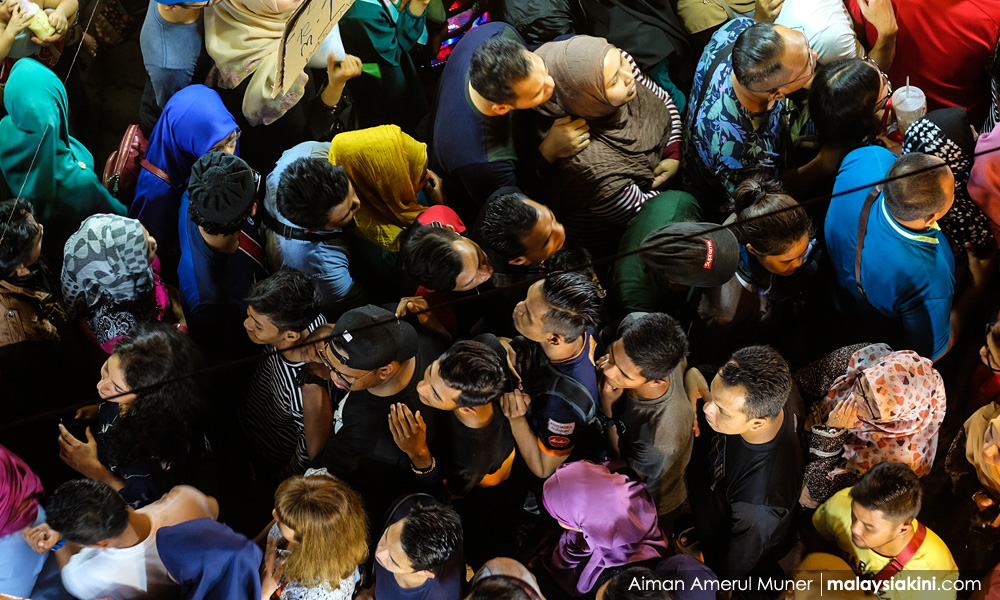
So now, as GE15 draws near, the nation is faced by a plurality of differing Malay political parties and forces and groupings: all of them ambitious for power and eager to govern, all seeking to advance their position by appealing “to Malays as Malays” and so harvesting Malay votes; but none of them capable of securing an effective majority of “the Malay vote”, and all of them needing to sketch out, in the pre-election phase, the political coalitions (including non-Malay groupings and forces) that they hope to lead in the campaign. That is to say, not in government, after the election, but on the election battle-field itself: as a way to win small but numerically crucial pockets of votes here and there to enable them to win seats for themselves in closely contested fights.
These various alliances and “coalitions” are simply about winning extra votes, beyond the main party’s core voter support, and hence securing seats for the lead-party in the grouping. They are not formulae or understandings for building prospective post-election cabinets and governments. They are merely fish-nets for catching a few extra fish that might just make the difference. The major parties (Umno, PAS) have these “fish-nets”; the smaller parties (meaning Bersatu and notably Pejuang) have these “fish-net” arrangements too, but they are really small “fish-net” parties trying to pass themselves off, by means of these devices, as major players.
Umno’s own doing
This is the strange situation that now exists. It has not simply happened. It did not suddenly fall down upon people. It was done. It has come about as the consequence of people’s political choices and actions. Above all, it has not been a malign fate that has stricken Umno and torn it apart; it has all, or largely, been Umno’s own doing.
It is the result of Umno’s adamant and unyielding promotion of Malay political ascendancy, and its immediate consequence. That after the sidelining of everyone else, there was nobody left standing for so-called “mainstream political Malays” to fight with other than with and amongst themselves.
In short, Umno’s main 21st century achievement has been a double-faceted one. Umno made it impossible for others, for anybody other than Umno, to govern the country; and, in the pursuit of that cause, it also made it impossible for Umno itself to govern credibly as well. To retain its plausibility.
This Umno-produced collapse of Malay political coherence at the centre of national politics, and its related failure to develop and promote a genuinely Malaysian political outlook to replace the “rhetoric of Malayness” as the basis of national life, is the reason for the uncertainty and open-endedness of the present situation in the days before GE15 nomination day, Nov 5.
The election-eve configuration
An election is approaching. But its results are far less certain and predictable than those of earlier elections have been.
Now, more than ever before, Malaysia is politically a “nation of fragments”. It is to these disparate fragments that the oddly cobbled together political alliances and “vote-fishing” groupings must appeal, and with which they must engage.
Yet, in the end, the configuration of those fragments today makes quite a simple pattern.
The febrile PKR heads into the election with a strong partner, DAP.
Umno needs some strong partners, but with MCA and MIC has none inside BN.
PAS will also need partners. But, holding back still in righteous dissimulation, it has its own strategy.
Bersatu and Pejuang - the spluttering vehicles created by Mahathir's post-Umno improvisations - are not credible partners. For anybody, really. They are marginal players, not masters of serious coalitions or consortia of parties. They will likely not survive this election.
So, in the end, either PKR and DAP with their Pakatan Harapan coalition will win the election, against the odds, in the peninsula.
Or, if not, PAS and Umno will come together to do a deal. A deal to govern together: in a government largely run by Umno, but one that will have to govern in crucial respects on PAS's terms. That is what PAS always aims and has aimed to do. So Akta 355 and all that will return.
When that Semenanjung mess settles down, the eastern friends, having bided their time, will cut their deals.
Sarawak and Sabah are no longer just a simple "fixed deposit" for Umno/BN. But in forming a new government, the numbers of the East will again be called upon and brought into play to resolve the uncertainty and instability in the West, the Semenanjung impasse.
The bottom line here is worrying. People in the West are basically indifferent to the people and politics of the East; and, weary of Peninsular condescension, the people of the East are now totally opportunistic and "gymnastic" in their engagement with the politics of the West, Semenanjung, and of the Federation as a whole. This nationally disabling situation is the fruit of now almost 60 years of short-sighted politics - on both and all sides, be it noted - since 1963. Given all that, where to from here? Not just for East and West. For all Malaysians.
The banquet table has been set. Let the feast begin!
CLIVE KESSLER is Emeritus Professor of Sociology and Anthropology at The University of New South Wales, Sydney.
The views expressed here are those of the author/contributor and do not necessarily represent the views of Malaysiakini.
/file/1168/9f30b8e1e9490474c7d344f60f61eea7.jpeg)
/file/publisher-c1a3f893382d2b2f8a9aa22a654d9c97/2021/04/8b3ad2d0854f0e8a4485988027d81208.jpg)
/file/publisher-c1a3f893382d2b2f8a9aa22a654d9c97/2022/03/044747ea9d8da7a54317e9806726ffa0.jpg)
/file/publisher-c1a3f893382d2b2f8a9aa22a654d9c97/2022/10/5891d71a63d170d9315745de57538e19.jpg)
/file/publisher-c1a3f893382d2b2f8a9aa22a654d9c97/2020/10/aef2b00854807196d5d5054cfba4b041.jpg)
/file/publisher-c1a3f893382d2b2f8a9aa22a654d9c97/2022/10/72bd70f8e664eede83eb03fd9f7f6c22.jpg)
/file/1224/042e42e7be52701adccb20be8841f065.jpeg)


Report this comment
Are you sure you want to delete this comment?
This action cannot be undone.