




Murky waters of anti-corruption
The political climate in Malaysia is definitely changing for the better. Public events are unfolding at a rate and in a manner unimaginable 10 or 20 years ago.
The Director General of the Anti-Corruption Agency (ACA) has been accused of corruption and abuse of power by a former subordinate. The PM has ordered a police probe. The DG himself has promised to co-operate with the police. He has declared publicly his assets. The Parliamentary Select Committee has also decided to summon the accuser and the accused, and both parties seem eager to oblige. Then the Select Committee cancelled the hearing. As any good chess player will declare: the plot is thickening.
The case was exposed by Ezam Mohd Nor acting in his capacity as head of the Movement for Democracy and Anti-corruption or Gerak. It would appear Ezam is far more effective working within the NGO family than as Parti Keadilan Rakyat youth chief. That fact itself is revealing, both about the role of NGOs and the nature of party politics in Malaysia.
The political climate in Malaysia is definitely changing for the better. Public events are unfolding at a rate and in a manner unimaginable 10 or 20 years ago.
The Director General of the Anti-Corruption Agency (ACA) has been accused of corruption and abuse of power by a former subordinate. The PM has ordered a police probe. The DG himself has promised to co-operate with the police. He has declared publicly his assets. The Parliamentary Select Committee has also decided to summon the accuser and the accused, and both parties seem eager to oblige. Then the Select Committee cancelled the hearing. As any good chess player will declare: the plot is thickening.
The case was exposed by Ezam Mohd Nor acting in his capacity as head of the Movement for Democracy and Anti-corruption or Gerak. It would appear Ezam is far more effective working within the NGO family than as Parti Keadilan Rakyat youth chief. That fact itself is revealing, both about the role of NGOs and the nature of party politics in Malaysia.
Apparently, the case is an old one. There was some kind of official investigation many years ago, but the DG was cleared. With cynicism burrowing deep in the Malaysian psyche, one wonders if the present probe should not also include a look into the previous investigation, just to make sure there was no cover up of any sort at that time.
In a letter to Malaysiakini , a reader laments that his friend the ACA chief is now the victim of a trial by the media. He asserted the noble principle that every man is presumed to be innocent until he is proven guilty in a court of law. He also wondered whether the Parliamentary Select Committee on Integrity has the jurisdiction to call the DG and his nemesis for an interview.
Massive corruption tops list
We will leave law professors to debate on issues of jurisprudence. Fortunately, every non-too-learned common man and woman is a consumer of all our laws, and therefore has the locus standi to speak on the issue within the confine of the existing laws. After all, of all the many problems that plague our nation, is there one that is more important and urgent than massive corruption in our opaque public sector?
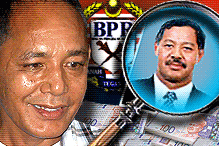 The ACA was instituted with the declared intention of weeding out corruption. I am quite certain there are many officers serving in the ACA who are honest, dedicated, and God-fearing. Given the pervasive phenomena of corruption throughout the country though, it is too much to hope for everyone in the ACA to be clean as a whistle. They surely have the means and the opportunities.
In any case, how many people actually believe that ACA has the ability to arrest corruption in a significant way? I wish there have been public opinion polls conducted to find out how much credibility the ACA enjoys in the eyes of Malaysians. In the absence of such polls, I will stick to my prejudice. The ACA will only prove its worth when it starts to investigate all the ministers and their deputies in the federal cabinet, and all the menteris besar and Exco members of all the state governments.
Eventually, the credibility of the ACA does not lie solely with the integrity and the efficacy of the officers. Their Achilles' heel is firmly planted within the political structure.
The ACA is a statutory institution under the jurisdiction of the prime minister. Strictly speaking, the PM is the real boss of the ACA. This raises many questions. Will the ACA investigate allegations of corruption involving the PM and his family members?
 Then again, for argument's sake, let us imagine a worst case scenario in which senior members of the ruling parties and holders of important government positions are generally corrupt. How is the PM going to direct a massive ACA investigation on all of his leading underlings? Well, his government may collapse for a start. Either that or the PM will threaten so many powerful vested interest groups in the ruling elite that he faces a real possibility of being thrown out in no time at all.
The opposition parties have for many decades proposed that the ACA be made answerable to the Parliament. In theory, that sounds fine. All you need to do is to devise some kind of legislative instrument to make it work. In practice though, even if the ACA answers directly to a special parliamentary select committee and is funded by Parliament entirely, how can they really work properly when Parliament itself is overwhelmed by the ruling parties?
Public perception
Within the realistic parameters by which they operate, the ACA is condemned to be a lame duck. In short, we are still a long way from building effective institutions of democratic checks and balances that will lower the level of corruption.
This bottle-neck is amply manifested in the case of the ACA boss being accused of corruption. The AG has directed the Inspector General of Police to conduct an investigation into various allegations. But in a recent survey, nearly 60% of the respondents named the Police Department as the least transparent government agency in the country. If the police finally clears the ACA chief of any misdeeds, the findings will only entrench the popular belief that all these watchdogs of crimes are merely scratching one another's backs. Of all the tasks that the new IGP has taken on, this assignment has to be the hottest of potatoes, if he is really concerned about fairness.
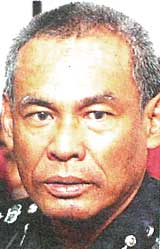 In any case, the public perception is that the police is one of the most corrupt government agencies around, and that the ACA is supposed to be given the task of investigating allegations of police corruption. Now, the supposed investigatee has turned around and begun to investigate the top investigator of corruption. How ridiculous and surreal can one get?
This ludicrous situation is further complicated by the Internet report that the deputy internal security minister in charge of security has been receiving bribes amounting to RM5 million for releasing criminals detained under emergency laws.
Suddenly, the defender of the rule of law and of such noble principle that everyone is innocent until proven otherwise fall silent on detention under those emergency ordinances. There guilt is proven by suspicion without a trial in an open court. But that is beside the point for the moment here.
That fact that even a rumour spread on the Internet by anonymous bloggers against a prominent deputy minister gets the PM's attention is proof that the Internet is coming of age. Every Tom Dick and Harry should now start to expose all the corrupt practices committed by our political-business elite. This will open a flood-gate of exciting revelations on ill-gotten gains by our VVIPs and VIPs. I cannot wait for the new era of virtual justice on the net.
But then, who should be given the task of investigating the accusations against the deputy minister but the ACA, when the ACA chief is being investigated by the police who are underlings to the deputy minister in question!
These are dizzying times indeed. All of a sudden, the public sphere in full of many different voices from a large array of sources questioning traditional wisdom.
Faith in open society
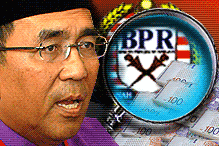 Should the ACA chief and the deputy minister be suspended while they are under investigation? If they are, will the government be subject to accusation of weakness, of giving in to every malicious rumour monger and whistle blower? If they are not, how will the department and agency under their charge function without loss of morale and credibility?
Then again, should the definition of corruption being employed by the government be reviewed? Is the mere declaration of personal assets be sufficient to ward off charges of corruption, without determining whether the income of the public official is sufficient to buy and maintain those properties? How about businesses and properties acquired and run by those officials with permission from their superiors? Should well paid senior officials be allowed to run business at all, without consideration of conflict of interest, abuse of power, and self-enrichment? How about their businesses and properties held under the name of faceless nominees?
All these discussions on the media and on the Internet are a good sign. The air over Malaysia is much more refreshing than when it was ruled by the former PM. There is now a plurality of views all round. With so much public limelight on these two sensational cases, any attempt at a cover up will be highlighted, and the PM will have to pay at the next general election.
Will all these attention on them, will the two prominent suspects ever get a fair deal, or will they be trialled by the media?
I still believe in an open society. When these two prominent public servants are so openly scrutinised, they are also given this chance of proving their innocence, rather than being convicted by public opinion alone in the murky world of the Internet and overactive grapevine.
Naturally, the ruling parties do not like this new trend of events. What they do not like may be good for the future of our nation. Civic minded and patriotic citizens ought to work harder on this the 50th anniversary of our independence to whittle away the comfort zone of corrupt power. Those corrupt politicians and public officials who cannot withstand the heat should stay out of the kitchen, or risk getting scorched beyond repair.


Are you sure you want to delete this comment?
This action cannot be undone.