




Oh, taxi drivers! (Pt 1)
With this hype about the current Visit Malaysia Year, errant taxi drivers are getting some very bad press these days.
Taxi drivers are frontline foot soldiers in public transport and in the tourism industry. All too often, they are the first point of contact a foreign visitor will have with the entire country. Their professional demeanour- or lack of it - will naturally have a bearing on our image as a tourist destination internationally. You could say that how our taxi drivers go about their job is a matter of national interest.
None the less, KL residents would be used to the ways of their errant taxi drivers by now. Everyone has a horror story to tell about a cab driver or two. I have had 30 year experience of getting from point A to point B for no less than 30 years in the KL area. As a semi-professional taxi passenger, I have many tales of strange encounter with this breed of unusual citizens.
With this hype about the current Visit Malaysia Year, errant taxi drivers are getting some very bad press these days.
Taxi drivers are frontline foot soldiers in public transport and in the tourism industry. All too often, they are the first point of contact a foreign visitor will have with the entire country. Their professional demeanour- or lack of it - will naturally have a bearing on our image as a tourist destination internationally. You could say that how our taxi drivers go about their job is a matter of national interest.
None the less, KL residents would be used to the ways of their errant taxi drivers by now. Everyone has a horror story to tell about a cab driver or two. I have had 30 year experience of getting from point A to point B for no less than 30 years in the KL area. As a semi-professional taxi passenger, I have many tales of strange encounter with this breed of unusual citizens.
For locals like me, the errant taxi drivers are easy to detect. It has something to do with their eyes.
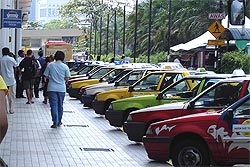 The other day, I approached one of those many taxis parked among the gargantuan buses outside the KL Central station. Within two seconds of talking to this burly Malay driver, I knew it was going to be one of those futile attempt to get on a cab. With blazing though expressive and shifty eyes, complemented by the body language of a typical tout, he told me boldly that a trip from the KL Central to Cheras would cost me RM30, three times the normal fare if he uses the meter. I took the train instead.
You find these crooked taxi drivers everywhere in the city. They prey on weary and gullible travellers at train and long-distance bus stations. With this boom in tourism, they haunt favourite tourist spots like the KLCC and the Bukit Bintang area. I used to watch them at work at the taxi stand in front of the Sungei Wang Shopping Complex, and wonder why it is so hard for the authorities to catch them red-handed.
All shapes and sizes
Sometimes, an urge would come over me to report them to the authorities. Then, prejudiced by my perception of corruption and immovability of the relevant authorities, I just shrug my shoulders like everyone else.
Top politicians may mumble about improving the government "delivery system", but on the ground, like many other government agencies, those authorities in charge of public transport will continue to fossilise in their remote offices till thy-kingdom-come.
You get to form my kind of "anti-government" prejudice if you have been talking to honest, polite, and hardworking taxi drivers for three decades. They come in all shapes and sizes, irrespective of their ethnic origin. They are certainly not in the minority among our population of taxi drivers.
For one thing, they must certainly be the best drivers on the road. The experienced ones certainly know how to get to their passengers' destination in the shortest time possible, using little-known short-cuts wherever possible. This they also do with great care, because a bad accident would mean endless delay at the repair workshop and loss of income, apart from appearance in court and before the relevant authorities.
Their professional hazards can only be imagined. Having to drive a cab to make a living in the nightmarish traffic of KL must be injurious to one's physical and mental health. Unable to afford any accident, they have to endure the antics of crazy fellow road users stoically.
No wonder some taxi drivers hang some kind of religious relics from their rear view mirror. Buddhist, Christian, or Islamic, these relics always warm me towards the man at the steering wheel. On more than one occasions, I have had many theological and philosophical discussions with these taxi drivers all the way to my destination.
I have also learned that when the notorious thunderstorm hits the city, one must not waste time to look for a taxi. The risk of having to brave a flash flood and the prospect of getting jammed in the long immoveable queues will drive the taxi driver into refuge, at a coffee shop, or near high ground. Time is money in this business, and they cannot afford getting stick and burning away precious petrol.
Their fear of heavy rain and traffic jam is only exceeded by that of robbery, especially in the dead of night. Most of the time, the criminals would just take their day's collection, and a cellular phone or two. Sometimes, the robber would take the entire cab, drive off in his car, and pretend to be a taxi driver, committing a series of crimes, including rape. These unlucky taxi drivers who have been robbed would count themselves fortunate as long as they are not harmed. They have learned to become good judges of people's character based on appearance only.
Work for 10-12 hours
We all know how discourteous the general population of Klang valley can be. Imagine having these rude aggressive penny-pinching customers in your cab everyday. The natural tendency of human nature is to return rudeness with rudeness. To stay courteous in this sea of unpleasant customers must indeed be a severe test of the taxi-driver's breeding.
Any self-respecting taxi driver would usually work for 10 to 12 hours, with short meal breaks in between. If they are lucky, they will take home about RM50 at the end of such a long day, after deducting expenses. I get this vague impression that the average income of a marauding cabbie would be around RM 1,500 per month. That would be a good month for them.
One chap who told me this while he was driving me down town said that his income was not sufficient to make ends meet. With two children in secondary school, one in college, housing and car loans to service, he found it hard to pay all his household bills on time. His wife had to work as a cleaner for RM800 a month to make ends meet, barely. His worse fear was to get seriously sick.
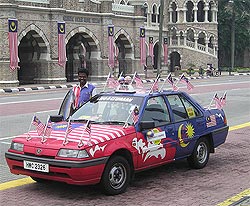 He, like many other taxi drivers I have met, still preferred this job which he had chosen more than a decade ago. Without much schooling and special skill, he could at least put three square meals on the table and support his children through long years of education. At least he could be his own boss, and did not have to play politics as in working in a large company.
These experienced taxi drivers will usually leave their customers alone in the back seat. One night, I was particularly tired and weary, and kept silent throughout the trip thinking my own morbid thought. As we neared my home, this old Chinese taxi driver started turning around and offered me advice how not to take life's adversity too much to heart. Life is too short, he said. Nothing is worth too much heartache, he opined loudly. I suddenly realised that he felt some compassion for my state of mind. The experience touched me deeply.
Then there was this Malay driver who played this religious lecture on his radio. It was the holy month of Ramadan, and the voice over the airwave was advising Muslims not to take income that was haram . When I got off, he refused politely and with gratitude my offer of a small tip, and wished me good night. Generally, I find Malay taxi drivers to be the most polite ones, unless of course if they are young and look like they are on drugs.
Taken for granted
Sometimes, I wonder. These taxi drivers must have a lot of interesting stories to tell. They must have met some really weird customers, and been through many weird experiences. A budding novelist would do well to drive a taxi for a living for a while.
There is a column on the Chinese language Oriental Daily written by a senior taxi driver. His account of life as a taxi driver and the many extra-ordinary incidents during his long years of being a cabbie does make fascinating entertainment.
Unfortunately, taxi drivers generally are not so expressive. They remain the voiceless invisible stratum often taken for granted by the society at large. If you think about it, driving a taxi for a living cannot be the profession of choice for our modern day university graduates. There is no big money in it, and the job is not sexy enough.
These men in glum faces fetching you around the crazy city of Kuala Lumpur actually sit at the bottom of the heap in the transportation industry. They suffer their lot as quietly as they accept the occasional announcement of hikes in fuel prices. Nobody really cares about them. They are also never represented in the public sphere. Are they not the underclass of citizens in our midst trying to provide an essential service?
 Their only audience is nosy people like me, who will listen to their views on the world with a political ear. I thought I would lend them my meek voice, so this bad press about bad taxi drivers would not prejudice the entire citizenry against them as a whole.
If you care to listen to their stories with a kind heart, then you will hear many grouses they have about their job, especially the way the government has ignored their existence.
But that would be for next week's column.
Oh, taxi drivers! (Pt 2) next Saturday


Are you sure you want to delete this comment?
This action cannot be undone.