




Rock the boat? Not Malaysians, no sir ...
Nathaniel Tan says the so-called debate between malaysiakini reader Umar Mukhtar and I is too personalised for attacking each other, and rather emotive. I have to say it's quite remarkable and fanciful for Tan to think that politics and emotions can be mutually exclusive. Perhaps he should tell this to Julius Caesar, Saddam Hussein, George Bush, or indeed Dr Mahathir Mohamad and Abdullah Ahmad Badawi, whose ongoing war of words via the local media is so vituperative that it makes the discussion between Mukhtar and I seem innocuous by comparison.
Tan then asks me for whom I would vote 'if' I were a Malaysian. I find this bemusing, to say the least, because I am not a Malaysian (I shall never become one in a million years even if Prime Minister Abdullah pays me). When one is not a Malaysian citizen, one therefore cannot vote in any Malaysian election. So it's hardly a question that bears any kind of relevance for me.
Nevertheless, elsewhere, Tan offers some interesting points worthy of response and discussion. His chief argument is that, if Malaysians want change, they ought to become direct participants in a political party so that, if change from above does not materialise (for the better), then change from below, from within opposition political parties, could prove more effective. In some ways I agree with the proposition. However, as I have been suggesting over the past week or so, I don't think it'll work ever.
Nathaniel Tan says the so-called debate between malaysiakini reader Umar Mukhtar and I is too personalised for attacking each other, and rather emotive. I have to say it's quite remarkable and fanciful for Tan to think that politics and emotions can be mutually exclusive. Perhaps he should tell this to Julius Caesar, Saddam Hussein, George Bush, or indeed Dr Mahathir Mohamad and Abdullah Ahmad Badawi, whose ongoing war of words via the local media is so vituperative that it makes the discussion between Mukhtar and I seem innocuous by comparison.
Tan then asks me for whom I would vote 'if' I were a Malaysian. I find this bemusing, to say the least, because I am not a Malaysian (I shall never become one in a million years even if Prime Minister Abdullah pays me). When one is not a Malaysian citizen, one therefore cannot vote in any Malaysian election. So it's hardly a question that bears any kind of relevance for me.
Nevertheless, elsewhere, Tan offers some interesting points worthy of response and discussion. His chief argument is that, if Malaysians want change, they ought to become direct participants in a political party so that, if change from above does not materialise (for the better), then change from below, from within opposition political parties, could prove more effective. In some ways I agree with the proposition. However, as I have been suggesting over the past week or so, I don't think it'll work ever.
For starters, I don't think there are many Malaysians who are active members of political parties, at least in the opposition. All political parties go on membership recruitment drives during an election year but I'll bet almost all return virtually empty-handed. What works for the Barisan Nasional parties, in terms of membership and in terms of rigging elections, is money politics. It's so embedded in the Malaysian political system that even the supposedly independent Election Commission is more a dead Peking duck.
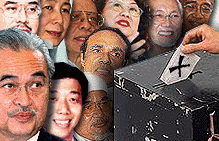 The reason why Malaysians are averse to signing up with opposition political parties is that they are not politically action-oriented. They're too lame. They're all talk. Politics may be a favorite discussion topic in the 'kedai kopi' and 'mamak' stalls but I doubt if it is generally one at dinner tables in homes. And so when it comes to acting out their political convictions, most Malaysians, particularly the non-Malays, back away quite effortlessly.
To be sure, in 1998, when I was in Kuala Lumpur covering Anwar Ibrahim's sacking and his subsequent arrest at the hands of dictator Mahathir and his hooded police thugs, I rarely saw Chinese or Indians in the streets openly demonstrating against the Mahathir regime's cowardly lies and deception. Except for the protestors and the army of baton and gun-wielding police, life went on for the Chinese and Indians without so much as batting an eyelid. Or else they were mostly curious onlookers, as often seen at sites of motor vehicle accidents. They may as well have been taking down the number of thrashings of the protestors by the police to chance their luck in illegal betting syndicates.
If nothing else, the pro-Anwar protests ought to have been all the more reason the clarion call for Malaysians to have poured onto the streets to protest against a repressive state using its repressive apparatus to suppress popular dissent and, in particular, scandalous injustice and the blatant abuse of human rights. To scare them off, Mahathir had quickly sent in his stormtroopers his riot police thugs to pulverize pro-Anwar supporters. I saw it first-hand as I stood amidst the protesting crowd near Masjid Negara and elsewhere in Kuala Lumpur.
Business chatter
Over the years I've seen the Malay-dominated regime's security gangsters brutalise political opponents many times. In almost all cases, the ones who were being beaten up by the police were the Malays. That's right, Malays. Young, radicalised, thinking, conscionable Malays who went out on a limb to fight a corrupt, elitist Malay injustice.
Unlike the Chinese and Indians, it's the Malays who are far more politically-oriented, who are prepared to spill onto streets and launch anti-regime demonstrations according to their political convictions. Another one-third of Malays are mere rent-a-crowd types who allow themselves to be hired by mediocre Umno elites for their predictably ludicrous show-of-force causes.
Still, all this says an awful lot about Malaysian Chinese and Indians. For the most part, they prefer to hide behind closed doors, turning their backs to just political causes. The only time they activate their political judgment publicly is during elections. But that's just mere nuisance and formality, because the outcome is always predictable - and largely inconsequential. Just ask Barisan Nasional's corrupt cronies, whose political and business chatter can be overhead when they congregate during lunch and dinner at the Concord Hotel on Jalan Sultan Ismail.
Yet Tan is adamant that greater membership of political parties can produce change from below and subsequently drive out party elites and apparatchiks. He ignores that these very folk will continue their struggle to maintain the status quo. It is in their interest to do so. You'd have to be blind not to see the same kind of struggles happening in PKR, as they also happen in DAP.
 No doubt change from below does happen in most Western democracies. The odds are that the Democrats will topple Bushite Republicans from power at end of 2008 in the US presidential elections. The momentum is there, and building. So is the general American citizen's chagrin for the lies and deception of the Bush administration. And, more interestingly, such a possibility in a country where voting isn't compulsory.
But Malaysia is no Western democracy. It's barely a democracy despite the regular cycle of national elections and the existence of a parliament though one that is littered with predominantly incompetent, self-interested, corrupt politicians and who, in the same breath, boldly claim to represent the people's voice, rights and aspirations via a dominant Barisan Nasional that routinely uses state funds (money) to buy votes and rig electoral boundaries right under the eyes of the Election Commission. And the mainstream media unthinking, unscrupulous mouthpieces of state propaganda conveniently turn a blind eye to such nefarious deeds instead of doing its watchdog duty.
Therein lies the point that Tan conveniently ignores - the struggle for political power, whether at a national or local level, including within political parties, is never, ever, as smooth, clean or easy as Tan suggests. For if it were, the Barisan Nasional parties would long have been in strife by a people's 'yellow revolution'.
Money is king
Yet there's the other problem. Don't hold your breath for an indigenous Malaysian yellow revolution to happen at any time soon, at least not until the Malays, Chinese, Indians and others put aside their ethnic and other historical differences, unify behind a single just cause, and single-mindedly work together for widespread political and social change.
Tan's position is as peculiar as it is also startlingly a-historical. Then again, I'm hardly surprised by this. The Malaysian (and Singaporean) students whom I teach in Australia show the same naivety, the same ignorance, the same apathy. Worse, they know so little of their own country's history, economy, society, and the nature of Malaysia's political institutions and processes. Many especially the Chinese just don't care. Just as many in Malaysia also do not. Money is king.
Let's be frank: the apathy displayed by many younger generations, and even older ones now, belongs those who have been touched by the swathe of modern capitalism. And Barisan Nasional sees a neat fit between modern market capitalism and a patrimonialist, Malay-based political socialism, one not dissimilar to China's.
If Tan wants change from below, and specifically from within a political party, there has to be a revolutionary zeal among all Malaysians that will produce the kind of revolutionary change from below that does not come and go according to one's whims and desires at a particular hour. But let's face it: Malaysia is no Chile, Guatemala, Venezuela or indeed even Indonesia, the Philippines or South Korea.
 Most Malaysians to whom I have spoken, in a country I have closely observed over many years, from the inside and outside, say their economic livelihoods are far more important than national or even local politics. But most will still say politics in Malaysia is too dangerous, that it is taboo, that it has the potential to be too violent and bloody. May 13, 1969 is deeply etched in their minds. If not it has scarred many forever. Lest one is ignorant, naive or in denial, that fear is inherent, and it has been passed down through the generations.
Malaysians will happily tell foreigners like me about draconian, anti-democratic, anti-human rights laws such as the Internal Security Act, the Sedition Act and a gamut of others that are designed by the state to specifically run down political dissent with state-backed violence if necessary. But Sept 11 has cemented such vile and repressive laws for a long time more.
Whilst the economy has been modernised, and the government has pushed through pro-business policies, one thing in Malaysia has not fundamentally changed since 1957: the political elite, viz. those within the racially chauvinistic Barisan Nasional who are the occupiers of visceral repressive political power structures and institutions. The Malay-dominated regime controls the instruments of the state, in the sense of actual institutions, and therefore real political power, on behalf of 'invested interests'. These instruments and institutions were created, and have been refined and reproduced over time, to deal with political and social circumstances of the adverse kind.
That is the prize for all Malaysian opposition parties to capture. But Malaysia's opposition parties have been playing the same political game as the dominant Barisan Nasional. All are equally racially chauvinistic, despite their claims to the contrary. And the parameters for this game were set not in 1969 or 1957 but 1946, during the Malayan Union, and in 1948, on its demise.
The opposition parties have not been able to 'modernise' themselves beyond their racially motivated enclaves, notwithstanding that they're good at snapping at the heels of the Barisan Nasional, and they're good at exposing scandals and government policy stupidity. But what credible alternatives has any one of these parties PAS, DAP, PKR and others offered Malaysian voters who do want change? What are Malaysian voters to do then? Would they not vote for the devil they know than they don't?
The battle royale
The problem for opposition parties isn't all policy driven, but, again, the institutionalisation of Malaysian identity by race and the separation of social, political and economic identity by race. Unless and until the opposition parties drop their racial calling cards, explicitly and implicitly I am skeptical that they can or are willing to do so they will never win new membership any more than they will credibility and legitimacy and go on to formidably challenge the current regime.
Fact is, race gives half if not more of the legitimacy for the survival of Umno, MCA, MIC and Gerakan. Malaysian voters know this. They understand this. They understand the game. They also generally acknowledge that all these parties are parasites on the national wealth. But what is to stop the opposition parties from seeking the crumbs of a pie from a nimble economy that is half-dissected by racial politics if one or more of them should win national power?
Foreign investment has to role to play in national wealth creation, for itself as much as for Malaysians. But the end point of that wealth creation isn't the creation itself but its distribution. And that economic distribution is deeply nestled in the politics of New Economic Policy of 1969-70, and it continues unabated by the balance of racial politics.
 As long as some of that wealth after subtracting that which is siphoned off by corrupt cronies aligned to various dominant, ethnically-based political parties comes to the people, voters consider such an outcome infinitely better than nothing. And nobody, but nobody, in a country as racially volatile and virulent as Malaysia, would want to rock the boat.
If the likes of Tan think it is as simple as more Malaysians joining political parties and producing change within them from below and all will be hunky-dory, they had better think again. Opposition parties have almost no hope of winning government, not in the next fifty years, the way they have been plying their trade. You can wait until the economy goes horribly pear-shape, which does not mean the spoils of cronyism and nepotism will be reduced. There'll be a greater struggle between different crony class factions and their political collaborators in power to consolidate their ill-gotten gains and political influence.
But that will only harden the state. It happened during the Asian financial crisis of the late 1990s. The regime turned increasingly repressive and wielded its structural power through those embedded racialist institutions through which it applied the instruments of power on all Malaysian races, the political opposition, and on political dissent, especially the politicised Malay population, when Anwar was sacked, demonised, persecuted and physically mauled by the thuggish and corrupt Mahathir regime.
I'm certain neither the DAP nor PAS has a strategy to win national power. I dare say even Anwar Ibrahim will be hard-pressed to make inroads into the stranglehold that Barisan Nasional wields. The only way in for Anwar is, as I have been suggesting all along, by the amalgamation of class factions fused across race. That's the battle royale. This is what the Barisan Nasional most fears, and it will do all it can to stymie such moves.
Anwar's other hope? Rejoin Umno. Even there, he'd be dreaming. The problem? Not enough Malaysians Malays, Chinese, Indians and others have rallied solidly and consistently behind him since 1998 and since his release from Mahathir's and the Barisan Nasional's gulag.
MANJIT BHATIA is an Australian writer who specialises in international and Asian economics and politics.


