




Sarawak godfathers (Pt 1)
VERY rarely does Sarawak get front page coverage on the national media. When Sarawak stories do become national headlines, it is usually for the wrong reason.
The current spat of controversy involving Sarawak started a while ago when Bintulu MP Tiong King Sing alleged in the Dewan Rakyat that gangsters are running riot in Sibu because of police corruption. This has drawn daily responses from the police in both Sarawak and KL headquarters.
With much public limelight on the police these days, and increasing outcry for the police to carry out reform, the allegation of the Bintulu MP is like adding oil to a raging fire. No wonder senior police officers who spoke to the press appeared rattled, uncomfortable and defensive.
VERY rarely does Sarawak get front page coverage on the national media. When Sarawak stories do become national headlines, it is usually for the wrong reason.
The current spat of controversy involving Sarawak started a while ago when Bintulu MP Tiong King Sing alleged in the Dewan Rakyat that gangsters are running riot in Sibu because of police corruption. This has drawn daily responses from the police in both Sarawak and KL headquarters.
With much public limelight on the police these days, and increasing outcry for the police to carry out reform, the allegation of the Bintulu MP is like adding oil to a raging fire. No wonder senior police officers who spoke to the press appeared rattled, uncomfortable and defensive.
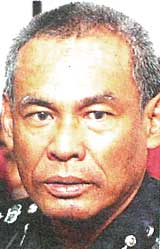
As I write, the IGP has already made a surprise visit to Sarawak, and met his top officers in Kuching and Sibu. At the end of the visit, he has announced, among other things, that a special task force has been set up to probe the possibility that gangs thrive in the peaceful Land of the Hornbill because they enjoy protection from VIPs and top politicians.
 As a chess player would say, the plot is thickening. It would be interesting if the probe reveals that the Bintulu MP (
right
) has also some gang members under his patronage. He is a very wealthy man, and wealthy
towkays
as well as the local MPs are favourite targets for gangs when they are compelled to seek patronage. I should know. I was born and bred in Sarawak, and served as MP for Bandar Kuching for a while.
As a chess player would say, the plot is thickening. It would be interesting if the probe reveals that the Bintulu MP (
right
) has also some gang members under his patronage. He is a very wealthy man, and wealthy
towkays
as well as the local MPs are favourite targets for gangs when they are compelled to seek patronage. I should know. I was born and bred in Sarawak, and served as MP for Bandar Kuching for a while.
Both camps 'use' gangsters
The network of power relation and fear works like this, at least in Sarawak. The ordinary citizens fear the gangsters. The gangsters say they fear nobody, but actually they fear the police. The police look fearless, but they are - or try to be - deferential to top politicians and big businessmen. So naturally, the gangsters will try to seek some kind of protection from leading citizens like prominent politicians and corporate tycoons, as an antidote against pressure from the police. Besides, getting on the good side of politicians and businessmen can also bring income for the gangsters.
There is this politician from the BN whom I fought twice and lost. Even before nomination day, this chap would fete all the major gangs in town with an endless flow of beer and sumptuous dinners. Later on, his director of operation would contract off some of the lucrative campaign work to the gang members, street by street, hanging banners and posters and staff. During the campaign period, these hard hats would be paid thousands, just to protect their turf, and make sure those campaign materials would not be destroyed. Often, these gang members see themselves as security personnel for the candidate of their choice.
Other gangs may also decide to support the opposition. They are voters too, and they have their political sentiments. Some do so because they have not been awarded election contract from the BN. By helping the opposition in the first days of the campaign period, they hope to be redrafted into the BN camp. For them, it is all about money.
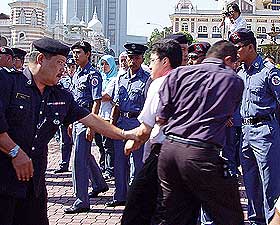 You can imagine the tension whenever gangs are employed for election campaign. Sometimes, the strong arms from both camps in an election contest get into a confrontation, especially over the destruction of campaign materials. Then, in the heat of a propaganda battle, there is the threat of a turf war breaking out.
Once, my campaign team put up a very tall party flag in front of my headquarters to impress members and supporters. A gang from the opposing side was paid RM8000 to chop down the flag pole made of bamboo. The high price was due to the symbolic meaning of the flag itself. After it was chopped down, I gave strict instruction not to retaliate, and we had a relatively peaceful election. Of course, I lost that contest. It gave a completely new meaning to the term "democracy"!
When politicians get elected partly on the strength of direct support from the underworld, he is deemed to be indebted to these shady characters who make their living through illegal means. Serving as an YB, the elected representative is then bound to look after them whenever they get into trouble with the police.
The relationship between the gangs and the business tycoon is slightly different. Like politicians, big businessmen sometimes require the special service of the samsengs . I have known of timber tycoons who hired gangsters to look after security matters in their timber concession areas, including intimidation of villagers who protest against the logging operation.
I also know of one particular case, in Kampong Bali and Kampong Busang, near the Niah area in Miri district, where some gang members were allegedly killed by the villagers. That is a story for another day.
Legitimate businesses also violent
In any case, it is a matter of prestige for a tycoon that the Big Towkay has some gangs under his wings. In the eyes of the samsengs , the big towkays are their boss. They are very proud to declare that a certain prominent Tan Sri was their Towkay , as if the sense of belonging gave them some kind of legitimacy for their existence.
Gangs usually run illegal businesses, like prostitution, operating gambling dens, organising cock fights, serving as bouncers in night clubs and other illegal outlets, loan sharking, prostitution, smuggling, extortion, kidnapping, murder, and drug dealing. Many of their members are drug addicts. Before they go to a gang war, they would take powerful drugs and a great deal of alcohol, to boost their fighting spirit.
In recent decades however, some gang leaders have also begun to invest in legitimate businesses. The very few rare ones would retire from the underworld, though they have often been forced to dip into the murky water of the dark side once in a while.
Even when gangs begin to operate legitimate business, their modus operandi is very much tinged with threats of violence, monopoly, and under-cutting. An example is in their monopoly of car or property auctions.
When the auction room is packed with well-known gang members, who have agreed in advance on who and how to bit for the lowest price, bona fide second hand car deals and property brokers would not have a chance against them. These assets would therefore be sold at a price that fetches much profit later.
It would be a matter of time when gang related businesses would diversify into a myriad array of trades. For instance, Sarawak has a huge beer market. For nearly two decades, the best kept secret in Sarawak is that anyone can buy the three cans of regular beer in any of the legion of coffee shops for RM10 or RM11. The demand for this tax-exempted beer is so strong that it is shipped through the state in containers. One wonders what the Customs Department people are doing except sleeping or collecting their cut.
 The odd gang members who have made it in the world of business through various means have even decided to poise themselves to become community leaders, by taking part in charitable or educational projects. Perhaps they have this secret aspiration to be awarded a datukship one day, thus emerging from the periphery of legitimate society into the limelight of social prominence.
Upon his return to Kuala Lumpur, the IGP has more or less confirmed the allegations of the Bintulu MP. I expect his report would have even rattled the PM, even if Sarawak is such a distant and obscure outback. What is even more unsettling is the report that the Sarawak gangs have been networking with their West Malaysian counter-parts, thereby threatening to become full-blown as a national problem.
Police corruption
The IGP also revealed that there are 16 gangs with 300 members operating in my home state. I fear this figure would be an underestimation of the real extent of gang activities in Sarawak. In my home town of Kuching alone, there are at least that many gangs and gangsters. In recent decades, however, the Sibu gangsters have gained themselves notoriety for being particularly fearsome, as they start to invade other people's turf in other towns.
As in West Malaysia and Sabah, the history of gangsterism in Sarawak is as old as the history of Chinese migration to Malaysia itself. In urban centres in Sarawak, this problem is unique to the Chinese community. This I hope will be a theme for future treatment.
The question remains as to whether police corruption is not one of the root causes of gangs "running riots" in Sibu and other towns in Sarawak.
The relationship between the police and the gangs has always been an ambiguous one. Gangs operate a huge alternative economy probably worth in the region of many millions. They do have the means to offer tremendous temptation to senior and junior police officers. The IGP has issued an order through the media warning police officers not to get too close with the underworld. That kind of public statement is heavy with implications. He knows the problem.
Next week, I shall try to unveil some of the well hidden aspects of this strange relationship between the law and the underworld.
The Sarawak godfathers (Pt 2) next Saturday


Are you sure you want to delete this comment?
This action cannot be undone.