




Motherhood, the institution of selfless love
Sometime around this time of the year, a day is designated as Mother's Day to pay homage to mothers of the world. Who designated it, or how it came to be so designated, is not known widely, and neither is it important.
Whether by design nor not, the biggest beneficiary of Mother's Day seems to be the world of commerce and industry. Gift shops, restaurants and businesses of all sorts will prey upon children's profoundest love for their mother with the suggestion that this love is best expressed by a purchase - and an expensive one preferably. I even read an incredible article in the NST that suggests giving an expensive car for Mother's Day.
Sometime around this time of the year, a day is designated as Mother's Day to pay homage to mothers of the world. Who designated it, or how it came to be so designated, is not known widely, and neither is it important.
Whether by design nor not, the biggest beneficiary of Mother's Day seems to be the world of commerce and industry. Gift shops, restaurants and businesses of all sorts will prey upon children's profoundest love for their mother with the suggestion that this love is best expressed by a purchase - and an expensive one preferably. I even read an incredible article in the NST that suggests giving an expensive car for Mother's Day.
The cynical observer of human affairs will sigh at this commercialisation of all things sacred. He may even opine aloud that we can do justice to the sanctity of motherhood only by making every single day a Mother's day in our lives.
In any case, do all mothers want expensive gifts as a token of their children's love for them? My mother, if she is still alive, would certainly not want to trouble her children that way. You can give her an ang pow of course. She would then store the money between the pages of a book, to be given to her grandchildren upon her death. Upon her death, we did discover a small fortune in cash stashed away between pages of many thick books on her shelf.
Motherhood is a distinctive human institution that has stood for eons as the bedrock of human civilisation. In ancient times at least, the men had to go out hunting, and the women had to stay back, to tend to the crops, do the laundry, feed the chickens, keep the household in order, and - above all - nurse and nurture the young.
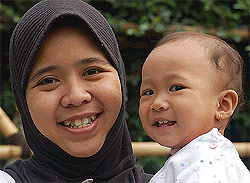 The father may be the master in his own house, according to traditional values, but without the all-encompassing tender loving care from the mother, his castle will soon be in ruins!
The mother's central place in every home is cemented by her special relationship to her children. This intimate relationship probably starts long before a child is born. There, the yet unborn child grows for nine months or so, feeding off from the mother's body, its heart beating audibly in the mother's womb. Whatever the mother eats, drinks, and feels, affects the foetus directly in some primordial way. Only the mother can claim with justification that her child is her own flesh and blood, literally.
From birth to puberty
We are also told that the pain of labour and child birth by a mother is the greatest pain that can be experienced by human beings. Man can only imagine that kind of pain, and never experience it. It is said that because of this ability to bear great pain, women are more resilient physically and emotionally than men. I will not go into that kind of comparison so common in the meaningless battle of the sexes.
Invariably, the mother will have to shoulder almost single-handedly the gruesome task of nurturing her children from birth to puberty, and then to adulthood.
The early weeks and months must be particularly taxing. The baby is essentially a milk sucking and peeing-excreting machine that requires close attention on a 24/7 basis. It is also a completely self-absorbed blob of protoplasm oblivious to the regular hours of adult life. Very few men would be gifted with the sort of patience, physical stamina, and minute attention to details required for the job of handling a baby full-time.
This is a stressful time for the tired mother, who has to recover from the traumatic ordeal of child-birth herself. The severe stress can give rise to post-natal depression, from which some mothers can never recover for life.
Nowadays, educated ladies generally abhor the idea of having more than two or three children. In my mother's generation, it was common for mothers in my neighbourhood to have many children, some bearing enough offspring to form a whole football team. The toll of many child-births on their body must be great, and so anaemia and hardening of the bones often return to torture them in their old age.
With the father working away from home most of the day, returning only to eat, rest, read the newspaper or watch TV, the growing child learns about the world from the mother entirely. With infinite patience, the mother teaches the little tot about getting away from any fire, taking the first step upright, using the toilet, and finally talking the language of the parents.
No sacrifice is too great
She has to agonise over the faintest sign of disease that might threaten the fragile little thing, and arrange for all the medical checks and vaccinations. Any mild fever or such irregularity as loose stool or a cough will send her into a traumatic panic. A chuckle from the toddler's toothless gum, on the other hand, will give her such delight as to make her feel that all her sufferings have been worth it.
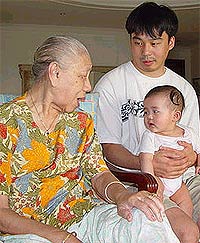 A mother's devotion to her children is total. It is especially noble, because of all forms of human love, a mother's love is the most selfless of all. No sacrifice is too great for her as long as the well-being of her children is ensured. If the house is on fire, she will plunge into the inferno to save her children long before the firemen arrive.
Many mothers are far from perfect. We still read about young mothers abandoning their new-born baby at the door of an orphanage, or just flush it down the toilet bowl. Some abuse their children physically or emotionally. Some love their children to a fault, and spoil them rotten, until they grow up ill-adjusted for social adult life. Others will turn out to be complete control freaks, manipulating their children in all aspects of their lives well into old age.
We are horrified when we hear or read about the folly of some mothers. We feel pity for their children. Fortunately, we are an Asian society, and the sanctity of motherhood is preserved by the virtue of most mothers, mine included.
In most families that I know personally, mothers are honoured, cherished, and looked after very well, when the children have grown up and on track to a stable family of their own. The tension between a mother and her daughter-in-law is always there, and again the cynical observer of human affair will merely conclude that women are their own worst enemies anyway.
But the smart daughter-in-law would do well to learn from the mother, because of the latter's experience and wisdom in her old age. More than anything else, she understands better the problem of a married woman, and the trials and tribulations of marriage itself. Her advice may be more effective than any marriage councillor.
With the idea of the extended family on the wane, young recently married couples do not like to live with their parents, preferring instead to build their little paradise of a nest away from prying eyes and interfering tongues.
Heavy burden
But the presence of a mother in the house may be the greatest blessing for the young couple. Nowadays, many women also like to work and build a career of their own. An old lady in the house can look after young children, far better than any hired help can, because she loves grandchildren to distraction. There, in the privacy and security of the home, the old lady provides continuity for the very young, teaching them their mother tongue, and imparting their family and communal traditions.
Now, with so many young and not-so-young mothers in the work force, the function and meaning of motherhood is evolving. The laws of the land in looking after the welfare of working mothers are not bad at all, though in actual benefits, we are far behind such enlightened nations as Sweden.
In this new age of women's emancipation, mothers too can pursue a career and seek self-actualisation in the work place. The second income in the household is also welcome, in these days of rising prices, and expensive education for the children.
In a sense, the burden of modern working women is even heavier, and the fine balance between work and the home is truly a thin red line full of perils. How working mothers cope with this dilemma requires a great deal of wisdom and love.
At the end of the day, in middle and old age, all that a mother wants is perhaps good health for all in the family, prosperity and happy family life for her children, and deep appreciation from her entire family for the sacrifice she has made in the course of her life. Above all, she needs constant and loving companionship.
What would this world be without mothers indeed!


Are you sure you want to delete this comment?
This action cannot be undone.