




Windfall for civil servants
The civil service, the police, and the armed forces have finally received a substantial windfall in pay hike, after much speculation in the press recently.
Naturally, there would be quite a great deal of grumbling on the ground. Some eternal critics of the government would attack whatever the BN government does, especially in a measure that is likely to increase the financial burden of the nation, which could only be off-set by all kinds of taxes. Others are already long unhappy with the yoke of an inefficient and corrupt bureaucracy that enmeshes their private life with layers and layers of rules and regulations from the cradle to the grave.
The government machinery is also a political instrument for implementing the ideology of the ruling party. Without it, the BN government cannot coerce and implement the numerous policies of nation-building under the loose and large umbrella of the NEP.
The civil service, the police, and the armed forces have finally received a substantial windfall in pay hike, after much speculation in the press recently.
Naturally, there would be quite a great deal of grumbling on the ground. Some eternal critics of the government would attack whatever the BN government does, especially in a measure that is likely to increase the financial burden of the nation, which could only be off-set by all kinds of taxes. Others are already long unhappy with the yoke of an inefficient and corrupt bureaucracy that enmeshes their private life with layers and layers of rules and regulations from the cradle to the grave.
The government machinery is also a political instrument for implementing the ideology of the ruling party. Without it, the BN government cannot coerce and implement the numerous policies of nation-building under the loose and large umbrella of the NEP.
People who are opposed to the NEP in both its concept and its implementation will naturally see the pay hike through race-tinted lenses. After all, the great majority of the civil service and the security personnel are Malays. The pay hike can be seen as just another out-pouring of largesse from a Malay-dominated government to a large chunk of the Malay electorate amidst speculation of an impending general election.
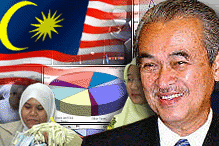 In Malaysia, it is extremely difficult to comment on public issues without paying heed to the question of race that underlies all political discussions. In the mind of the Malaysian citizens, their examination of political issues will be premised by this hidden but primordial thrust in their mind: how will this government decision affect me, as an individual member of my ethnic community? It is hard to define any criterion of objectivity in public discourses, especially when politicians themselves seldom make any pretence at objectivity in their public utterances.
I have always tried to employ this concept of "veil of ignorance" as proposed by John Rawls, the great American philosopher of jurisprudence, in his ground breaking book, A theory of Justice . In an "original position" a theoretical construct not unlike Rousseau's moment of making the equally theoretical social contract citizens ought to make decisions on the basis of ignorance about how those decisions will affect them personally.
First significant pay rise
Unfortunately, in "real" life, and in any functioning democracy, citizens almost always pass judgement on public affair on how things will affect their self-interest. Jeremy Bentham will triumph over John Rawls any time.
I digress. I can hear some readers snoring already. But theoretical contemplation is sometimes unavoidable; it is a useful exercise in the re-examination of one's own prejudicial assumptions about life.
In the more mundane world of living a life in Malaysia, I do agree for once with this decision to raise the pay of our civil servants - especially that of the police force.
After all, this is the first significant pay rise for them in 15 years. The costs of living in Malaysia, especially in the Klang valley, have been shooting through the roof. The pay for low ranking public servants has lingered near poverty level. The pay package for a new police constable is even lower than the wages paid out to foreign workers employed in many industries.
Already, there are press reports that tell many tales of junior civil servants moonlighting as taxi-drivers and petrol pump attendants after their work in government offices has ended late in the afternoon. Many of them must be indebted through no fault of their own, and even small loans owed to furniture vendors have to be defaulted. Even with both spouses working, their combined income can hardly keep up with the spiralling cost of education for their growing children.
Then, the countless voiceless pensioners who receive half of their last pay must find it hard to enjoy any comfort in their sunset years. All that glimmers is not gold necessarily. The image of the "iron rice bowl" associated with a life-long job in government service may not be so iron-clad.
The dim prospect of promotion based on merit not withstanding, this is perhaps why Chinese youths shun the civil service and the security services. They can make much more money selling chicken rice by the road side. If they are really desperate, they can always sell pirated discs. The private sector may be more perilous, but the promise of reasonable reward is always there.
 In any case, the current pay-hike proposal seems to have been well thought out. Those civil servants at the lowest rungs of the ladder will get the largest percentage increases. The percentage of the hike tapers towards the top. Sadly though, the top man in the department still gets paid 15 times more than his underlings at the bottom of the pile.
Based on needs, the civil servants do deserve the raise as has been offered. But do they deserve the pay hike on merit?
Here, I am quite certain the number of people who are not satisfied with the level of service provided by government servants will be legion. Everybody has a horror story to tell about how he or she has suffered the run-around routine at the hands of a junior Napoleon. To say that there is room for improvement in our public service is a gargantuan understated understatement.
But the government bureaucracy is a mammoth labyrinth, consisting of many ministries and many departments, scattered over many parts of the same town, throughout many regions of the whole nation. The standards of performance must vary a great deal within the civil service as a whole. Naturally, the task of motivating, co-ordinating, supervising, and disciplining this nine-headed Hydra must be more challenging than any that Hercules had to undertake.
Personal experiences
Be that as it may, my personal experience in recent times has indicated that some departments and agencies have shown dramatic improvement. The first that comes to mind is the EPF.
Just last week, I could not endure the explosive wave of techno music booming from a neighbour's house at all hours of the day. I called up the police station at 9th Mile, Jalan Cheras. The lady officer answering my call did not even ask for my IC number and my address. Within 10 minutes, two policemen arrived at the door step of the offensive household and put an instant stop to the whole ungodly pollution of public space.
Like all citizens, I had to apply for the Mykad recently. I went to the KL National Registration Department at Jalan Tunku Abdul Rahman early in the morning, trying to beat the long queue. Unfortunately, it was during the school holidays, and I was given a number, and told to return in the late afternoon.
When I did return at 3 pm, the queue was still relatively long. The waiting was quite painful for a senior citizen like me. All of us applicants were staring at the clock anxiously, in case they close their door at 5 pm, and we had to make another trip to their door the next day.
Some members of the staff were leaving at 5 pm. I was served shortly after 5, by the director himself. The whole process took 10 minutes to complete, and I did not even have to fill in any form. I had a short chat with the director. He told me they were not paid over time, but they had to work late during school holidays to clear the back log. He was silent when I suggested they were under-staffed. Had there been no such a long wait, the experience would have been utterly pleasurable.
 Nowadays, I have much less paranoia about going to the counter of a government office.
With our public service getting such a hefty pay hike, unionised and no-unionised employees in the private sector would have much more ground to jostle for a revision of their pay scale as well. Private employers may not accede to their employees' request for a pay rise as generously as the government. Unlike the government, they have to look at their profit and loss at the end of any day. There could be uneasiness and tension between employers and employees. Perhaps, there would be a higher rate of job hopping and staff turnover.
Then again, higher wages almost always lead to inflation. To blame rising prices of daily necessities on the profit hungry traders is not entirely fair. That is how a relatively free economy works.
In the end, this is the nightmare of the wage in Malaysia, forever caught in the vicious cycle of their wage increase chasing after higher costs of living. The joy of the one million civil servants now in anticipation for their higher pay may be short-lived.


Are you sure you want to delete this comment?
This action cannot be undone.