




Changing faces of marriage
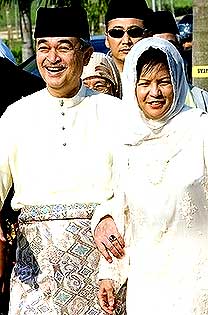
The marriage again of our recently widowed prime minister has made headlines across the nation. Cynical political pundits would see this as another sign of an early general election, since a wedding like that is bound to create a great deal of political capital in the form of general good will.
The PM's second marriage is likely to be proven a success. At his age, he would have accumulated through years of experience sufficient wisdom to negotiate through the stormy sea of a married life.
The PM has his reasons for tying the knot again. It is his personal business, and we may do well to keep our nose out of his private life. The national trend though tells a different story.
The marriage again of our recently widowed prime minister has made headlines across the nation. Cynical political pundits would see this as another sign of an early general election, since a wedding like that is bound to create a great deal of political capital in the form of general good will.
The PM's second marriage is likely to be proven a success. At his age, he would have accumulated through years of experience sufficient wisdom to negotiate through the stormy sea of a married life.
The PM has his reasons for tying the knot again. It is his personal business, and we may do well to keep our nose out of his private life. The national trend though tells a different story.
It has been reported that in recent years, there has been a sharp drop in marriages, especially among non-Muslims, from 57,882 in 2004, to 50,335 in 2005, dipping further to 23,880 in 2006.
 There are also indications that young people in the urban centres tend to get married much later than their forbears. Instead of getting married in their late teens, or early 20s, these young Malaysians would not think of getting hitched until they are around 30. Many men and women of marriageable age seem content with living together rather than plunging into the full commitment of a full-blown marriage.
Many children
It has never been so in Malaysia. Barely half a century ago, when life was slow and simple, people tended to get married very early in life, often in their late teens. They tended also to have many children, particularly among the farming community. The extended family living under one roof, or in close proximity among one another, was the norm.
In the agrarian way of life, many children meant a large workforce in the fields, and a sizeable pool of resource for mutual assistance in times of crisis. Naturally, bearing more children also provided a certain degree of social security. Parents could always depend on one or more of their offspring to look after them in their sunset years.
Naturally, half a century of rapid social and economic development has changed the nature of the marriage and family institutions.
Dramatic industrialisation and urbanisation has succeeded in creating a massive middle class Malaysians of all races. These are the upward mobile and well educated new Malaysians, with a vastly different view on life in general. Certainly, they harbour higher expectations of what life has to offer.
With better education and more employment opportunities, young women no longer have to depend on a husband for survival. The pursuit of a life-long career and self-actualisation must at times seem more urgent than walking in the shoes of their housewife mother.
Perhaps young men and women have more choices to-day. Certainly, they are more aware of the complexity of living in the modern world in a pragmatic sense. Getting married and raising family in Malaysia is an increasingly expensive business. The fulfilment of romantic love is fine and dandy, but one needs bread or nasi lemak as much as one needs air and water to live as well.
Naturally, young people to-day will never dream of marrying without love, or the modern romantic version of love, after the fashion of Romeo and Juliet, or as love is portrayed in pop music, films, and novels.
 This pop culture version of romance is actually a pretty recent invention. It began to be a mass aspiration probably after the Industrial Revolution, when the newly emergent middle class had more money and leisure, and started to look for a higher level of happiness beyond mere daily survival. Before then, romantic tales about men and women falling in love were limited to the idle rich and the nobility, as is the case with Romeo and Juliet.
The institution of marriage is far more ancient. It is as old as human civilisation itself. It is also universal, existing in different cultures at different historical periods, in a myriad array of forms and structures.
Two strongest instincts
Structurally, the marriage institution occupies the centre of organised living for collective survival. It serves to establish social order by regulating the sexual union between the two sexes. If human beings were created or had evolved into a hermaphrodite like the earthworm equipped with both sex organs on one body, there would have been no need for the marriage institution.
Disciples of Charles Darwin would tell us that food and sex are the two strongest instincts among all life forms. Nowhere is this more evident than in the case of human beings. As the anthropologist Desmond Morris puts it, we are "naked apes" with voracious sexual appetite and the equipment to mate and reproduce throughout the year, unlike other animals.
Such strong instinct as the libidinal drive tends to run amok, and runs the risk of disrupting harmonious social relations. The written and unwritten rules of marriage in all cultures are the powerful instrument of social control, and they stipulate the conditions of morally and legally legitimate sexual unions.
In pre-industrial societies, marriages were also motivated by social and economic reasons. They had nothing to do with the personal romantic inclination of the young man and woman concerned, and they in fact never met before the wedding night in many cases.
Back then, marriages were often arranged by parents, often with the assistance of a match-maker. Their ethos then was this: a marriage was the pooling of resources between two families and two clans. Care had to be taken to match the social status of the two families and personal virtues of the eligible men and women, and soothsayers as well as the astrologists had to be consulted.
Naturally, the purpose for the wedding was to produce children, to inherit and continue the bloodline, and to build on the heirloom, if any. When Adam and Eve were kicked out from the Garden of Eden after the fall, they were told by God to "go forth and multiply". According to the Catholic Church, sex in marriage is entirely for the purpose of child-bearing, and birth control is prohibited. This has since become a contentious issue in the global debate on population control.
Nowadays, thanks to the globalised entertainment industry, there is a universal epidemic of obsession with falling in love among the youths of the world, with overcooked clichs about loving till the sea runs dry and that sort of nonsense. They pursue their romantic adventure like moths to the flame.
As Shakespeare noted in Romeo and Juliet, young man has a tendency to fall in love with the idea of love, rather than the lover. Few people who fall in love with that romantic tragedy realise that Juliet was only 14 at the time of her untimely death.
Long married people have since grown out of that sort of puppy love. You have to, if your marriage is going to survive the harsh reality of two strangers living closely together 24/7 for life.
Not luck but hard work
Soon after the wedding for instance, the lady may discover that her prince on a white horse may turn into a frog. The young man may see his demure new bride turning into a nagging, manipulative, possessive, nit-picking, self-absorbed and querulous spendthrift/miser. The fights increase in frequency and violence, over money, friends, in-laws, children, and the most innocuous details in life. The power struggle may turn very ugly.
Eventually, like all developing nations, Malaysia must suffer all kinds of adverse consequences of modernisation, including the breakdown of the family. The divorce rates are on the rise, especially among the Malays. All in all though, our problem with divorce is still not as serious as in most Western countries.
 They may not mean more happy couples in Malaysia. It does mean that some people prefer to keep the marriage intact, no matter how unsatisfactory it is, and often for the sake of the children. By the time the children are all grown up, they would be too old to divorce anyway. So they stay on together out of habit and convenience. Some old couples stop talking to one another for years or decades.
Fortunate indeed are those who are happily married and grow old together. We are told by experts that happily married people tend to be healthier, happier, and live longer lives. These happily married people will tell you that luck has no place in a happy marriage. Marriages are never made in heaven. It takes tremendously hard work, and a great deal of personal growth. Inevitably, the greatest nemesis of a good marriage is selfishness by one or both of the partners.
In case you are young, eligible, and thinking of getting married, or if your marriage is on shaky ground, I strongly recommend the book The Art of Loving written by Eric Frome. Then think again!


Are you sure you want to delete this comment?
This action cannot be undone.