




Bit by bit, let's build a better Malaysia
A nation is a journey and the paths to its future are made by walking. That kind of walking, someone once said, changes both the destination and the person walking.
How this country, and its people, have changed.
A nation is a journey and the paths to its future are made by walking. That kind of walking, someone once said, changes both the destination and the person walking.
How this country, and its people, have changed.
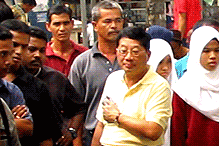 Malaya grew into Malaysia. The complexity of multiplicity and federalism, many people thought, will certainly damn the nation to the downward path of failed states and the May 13 tragedy got us close to it. But instead it surprised many that Malaysia emerged a global political leader and a model of a balance between economics, ecology and equity of a kind that is often baffling and clumsy and yet working.
Today the nation faces new challenges and new opportunities. Once again, many thinking people worry if we have reached one of those tipping points of gloom and doom.
I was born in 1941 ,when Malaya was invaded and bloodied by the so-called World War Two. My most vivid memory of the war was the kind Japanese soldier, who, thrust into a role I am sure he did not chose, was always keen to show me a picture of his small children and never failed to bring a sweet or a biscuit. Soon the war ended and I never saw his smiling kindness again. I hope he was reunited with his family and found happiness.
The 'Emergency'
I grew up in the town of Taiping, which means 'everlasting peace' in the Chinese language. The town was founded to mark peace between warring groups over tin mining rights. A bitter and long drawn war with the so called 'terrorists' - a war the British euphemistically called the 'Emergency' - had begun. The town was one of Malaysia's biggest military cantonments and the soldiers helping to 'normalise' the country came from all parts of the British Empire.
The Fijians were the most memorable. They were awesome athletes and rugby players. My father did the occasional 'home guard' duty with a mixed community group, all with wooden sticks as their only weapon against an 'enemy' none of us ever saw except in caricatures in propaganda leaflets.
The greatness of the place was the joy of living with such diversity and culture. Taiping was a global village, so multi-racial, so multi-cultural, so multi-religious that it gave me the best global education in universal living. I would go to a school named after an English King, my sisters to a 'Methodist' school and my cousin to a 'Catholic' school named after a saint. Our neighbours went to various Chinese, Malay and Tamil schools. At the mosques, the Malay, the 'Mamak' and me, the 'Bengali', experienced the universality of spirituality.
The greatest happiness was after school - it was the joy of a community of youths from the richness of our cultural diversity exploring the lake gardens, climbing the hills, getting lost in the world famous mangroves, organising street games, and parking in the home of three families, one Chinese the other rarities - Punjabi Hindus and a distinguished Parsee, all of whom had magnificent collections of all the great comics of those time, including the magnificent
'illustrated classics'.
It was a truly wonderful childhood, one i could relive a thousand times!
Merdeka comes
When Merdeka came in 1957, to us in Taiping it somehow was just another celebration and then life went on. The school now sang a new song 'Negara Ku". No more 'God save the Queen', but the British headmaster and those dedicated nuns and brothers remained, as did the foreign soldiers.
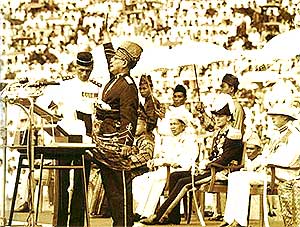 We seemed never to end our contradictions and even seemed to turn them into profitable advantages.
Of course, gripes and groans continued and worrisome trends of racialism and bigotism never failed to rear their ugly heads. Corruption, a worrying gap between the rich and poor, money politics and the challenge of free and fair elections have often taken centre stage.
And now 50 years later, one of my friends, who always worries about where this country is headed, said to me, should we not be singing "God Save this Country?"
Fortunately, I am the incorrigible optimist and I counter this kind of negativity by just giving my best, and by just doing as much good as possible. History has shown that it is little people, doing little things in little places that have changed the world. If you want to change the world, do your little bit and and remember that every little bit counts. Every energy devoted to groans and gripes can be harnessed and converted into positive, proactive and practical action.
A few of us over the years have done just that and will continue doing so.
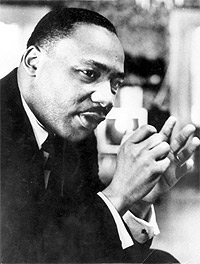 The late Martin Luther King once said: "Nothing in this world is more dangerous than sincere ignorance and conscientious stupidity!" Our country has its fair share of that too, unfortunately.
So what can we do?
Let us work together to overcome such ignorance and stupidity. Let Malaysia in the next 50 years be a commonwealth of learning about peace, compassion and justice. Let us work to be at peace with ourselves, at peace with other people and at peace with the environment, Mother Earth.
Let us learn to listen not just with our ears, but also our eyes and our hearts. Let us walk that path together actively as brothers and sisters in humanity. Lets just do our best and make every little bit count.
If we walk those paths we can have a sustainable future, and hopefully, even a better, fairer, and more just future for all.
I am optimistic we can.
ANWAR FAZAL is the recipient of the Right Livelihood Award, popularly known as the Alternative Nobel Prize. He lives in Penang.


