




Badminton, anyone?
Unlike Lee Chong Wei, Koo Kien Keat, and Tan Boon Heong, Amir bin Ibrahim is hardly a household name in Malaysians sports.
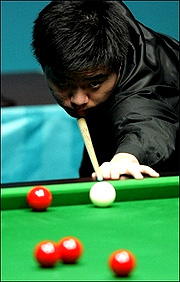
Two weeks ago, Ibrahim bin Amir finished as the runner-up in the Singapore leg of the Guinness 9-ball pool Asian Tour, after having scalped the former world pool champion Alex Pangulayan in the semi-final match-up. This is no mean feat, if you know anything about pool.
I learned the game of pool in an American university in the early 1970s, from a Thai student no less. Then I picked it up again a few years ago, since it is the least strenuous exercise for a senior citizen like me. It is also a very cerebral game of war, and certainly involves much more than shooting a silly ball into a pocket with a cue stick.
Ibrahim bin Amir probably will not receive any motivational cash prizes from the Malaysian Sports Council. Pool is not a mainstream sport in our country. Most Malaysians probably cannot distinguish between snooker and pool. They tend to associate pool and snooker as being played in dim smoky halls run by shady characters for shady players betting big and small sums of money on the outcome of their games.
Unlike Lee Chong Wei, Koo Kien Keat, and Tan Boon Heong, Amir bin Ibrahim is hardly a household name in Malaysians sports.
Two weeks ago, Ibrahim bin Amir finished as the runner-up in the Singapore leg of the Guinness 9-ball pool Asian Tour, after having scalped the former world pool champion Alex Pangulayan in the semi-final match-up. This is no mean feat, if you know anything about pool.
I learned the game of pool in an American university in the early 1970s, from a Thai student no less. Then I picked it up again a few years ago, since it is the least strenuous exercise for a senior citizen like me. It is also a very cerebral game of war, and certainly involves much more than shooting a silly ball into a pocket with a cue stick.
Ibrahim bin Amir probably will not receive any motivational cash prizes from the Malaysian Sports Council. Pool is not a mainstream sport in our country. Most Malaysians probably cannot distinguish between snooker and pool. They tend to associate pool and snooker as being played in dim smoky halls run by shady characters for shady players betting big and small sums of money on the outcome of their games.
 My abiding interest in sports has its origin in my secondary education in a distinguished Kuching mission school, where the teachers placed equal stress on both academic and curricular activities. I was a star sprinter, a star basketball player, and learned to play rugby, ping-pong, football, and badminton.
Those were the days when the teachers (the "house-masters") would drum into your head that the most important thing in sport is participation, and challenging yourself in testing your limit towards excellence. Winning was fine, but it was not everything. It was a strange message, because we did win everything in sight in inter-school competitions.
Those were the good old days of amateurism in sports, and even the Olympic Games forbade professional athletes and sportsmen from taking part.
Big service industry
 Nowadays, everything in sports is measured with the mighty dollar, and it has become one of the biggest service industries there is. In fact, spectator sports have grown into a multi-national entertainment industry worth probably tens and hundreds of billions of USD per year. The exploits of former Thai PM Thaksin Shinawatra in trying to buy over Manchester United, and the entry of David Beckam into California and Hollywood are just instances of how sports are now commercialised beyond recognition.
With corporate sponsors, broadcasting rights and ads in the region of millions for 30 seconds of air time, life television coverage of sporting events to a global audience has generated tremendous wealth for clubs and sportsmen alike.
Michael Jordan of the Chicago Bulls in the American National Basketball Association made a combined annual salary of US$70 million at the height of his playing career. The total asset of any professional sporting league in games like ice hockey, basketball, baseball, or football in the US must be many times the GNP of any poor African country!
The most stunning sporting phenomenon must be the American professional wrestling mania. You could hardly call professional wrestling a sport; it is more like a combination of theatrical farce and a freak show. I am told that those unusually large men make more money than basketball superstars.
At one time, I had to travel through many remote regions of Sarawak, far away from "civilisation". Nevertheless, whenever there was a television, even one that ran on a car battery deep in the jungle, you were bound to see eager faces fixed on the screen showing a wrestling match in progress. Members of the audience would not be able to name more than three cabinet ministers. But they could cite you the entire career history of any wrestling star like Stone Cold Austin, The Undertaker, or Bret "the-hit-man" Hart.
Such ostentatious stench of wealth in sport professionalism repels me. I have never followed the progress of any professional sporting league, except on those rare occasions when I would watch NBA action.
National pride
Call me anti-social if you like. I find this hysterical obsession with soccer matches going on half a world away mildly amusing. Unfortunately, spectator sports can also be corrupting. Fans are not lured into participation; instead of taking up the game, they become overweight and sedate couch potatoes munching on chips and sloshing beer. Worse still, they get addicted to betting on the games, thereby ensuring an ever-present and ever-growing black market for loan-sharks in Malaysia.
But there is no running away from sport spectacles. Victory in an international contest can bring much national pride and swelling of patriotism. It is good for politics. Naturally, our very nationalistic government must have a Ministry of Youth and Sports. The minister just recently proposed building some kind of training facilities at a cost of RM500 million in the UK.
Judging from the results over the past decades, the Ministry of Youth and Sports seems to have done a miserable job in preparing our talented youths for international competitions. In spite of the money spent, the fanfare, and all that media hype, we do not have many gold medals to show off to the rest of the world. Our last distinguished athlete on the track is Jegathesan who flourished in the 60s.
 It is not as if we Malaysians are Asians, and therefore do not have the power and the physical strength to rule the track. The reigning world and Olympic champion in the 110 metre hurdle event is a Chinese from mainland China!
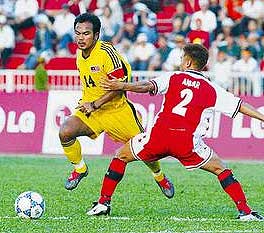
I see Malaysia described often as a soccer mad nation. We seem to be mad about betting on soccer results only, judging from the fact that our soccer team now rates at 154 (or something ridiculous like that) at the moment. Recently, in the Asian Championship, our team was so humiliated that a distinguished personage had to resign, though the most distinguished personage in Malaysian football still refused to step down. You cannot say much against him, since he is a person of exalted royalty. Perhaps that is the problem with Malaysian football.
In contrast, the team from ravaged and war-torn Iraq made it all the way to the final!
Like any patriotic citizen, I have always supported my national team in any sport. But I have been so disappointed so many times, that after a while, I lost interest, and skip the thick pages in the sporting section of our national dailies.
No matter what the political and sporting leaders say, I am doomed with the heavy thought that our national athletes and sportspersons are all kampong champions. When it comes to the crunch on the international arena, they wilt away.
Lack of consistency
Recently though, there seems to be a renaissance of sort among our badminton fraternity.
 In the 50s and 60s, and again in the 80s, Malaysia was a superpower in international badminton. But for some strange reasons, our national team has languished, going through ups and downs, until I lost interest again.
Then one day, I discovered to my great surprise that a Malaysian singles player was the number one seed in the world in the person of Lee Chong Wei! Then this year, the crack pair of Koo Kien Keat and Tan Boon Heong burst on the scene as the hottest doubles pair. Then there is a batch of fresh young players who have hitherto remained unknown, but who have defeated established stars. Then again, the recently concluded Asian championship for the under-19s has seen Malaysian youngsters taking centre stage.
Their obstacle to greatness is the lack of consistency. You must aspire to greatness, the sort of greatness exhibited by Rudy Hartono and Liem Swee King of Indonesia, winning world titles as a matter of course for seven or eight years in a row.
 The coach of the current national doubles players, Rexy Manaiky was such a great player, having swept every title in his path in his hey days. He is an Indonesian, but we will not hold that against him. Judging from his public statement alone, I have great admiration for the man. He knows that winning takes more than just superhuman skills; it requires strength of character, intelligence certainly, and above all, humility.
You can see the strength of character being tested, again and again, in young players like Lee Chong Wei, Koo Kien Keat, and Tan Boon Heong. They have the skills to beat world champions on any good day, but they fall victims to their inner demons, their self-doubt under the tremendous pressure of national spotlight and public expectation.
In a country hungry for heroes, they also fall victim to "official nationalism", and could be spoiled by all the pampering of a political-sporting elite who knows next to nothing about sporting greatness and care even less.
These young men can earn hard fought victories in the World Badminton Championship in August in KL. They can bring home the precious Olympic gold medals from Beijing next year. They simply have to overcome themselves, and the officialdom that is corrupting everything that is good in Malaysia. I support them with my whole heart.
Then I realise why this is so. Malaysia is a country built upon a belief in positive discrimination. I would just like to see our Malaysian youths excel in international sports, where the playing field is really quite level.
As long as they try their best, I would support them even if they lose eventually.


Are you sure you want to delete this comment?
This action cannot be undone.