


/file/publisher-c1a3f893382d2b2f8a9aa22a654d9c97/2024/07/7dbb30b07b7be40840cba191295d2946.jpg)

BOOK REVIEW | Elegant work in its own class
COMMENT | The 19th century was marked by the consequences of the Peace of Westphalia, the rise of nationalism and ethnocentrism in Europe, and the emergence of Communism.
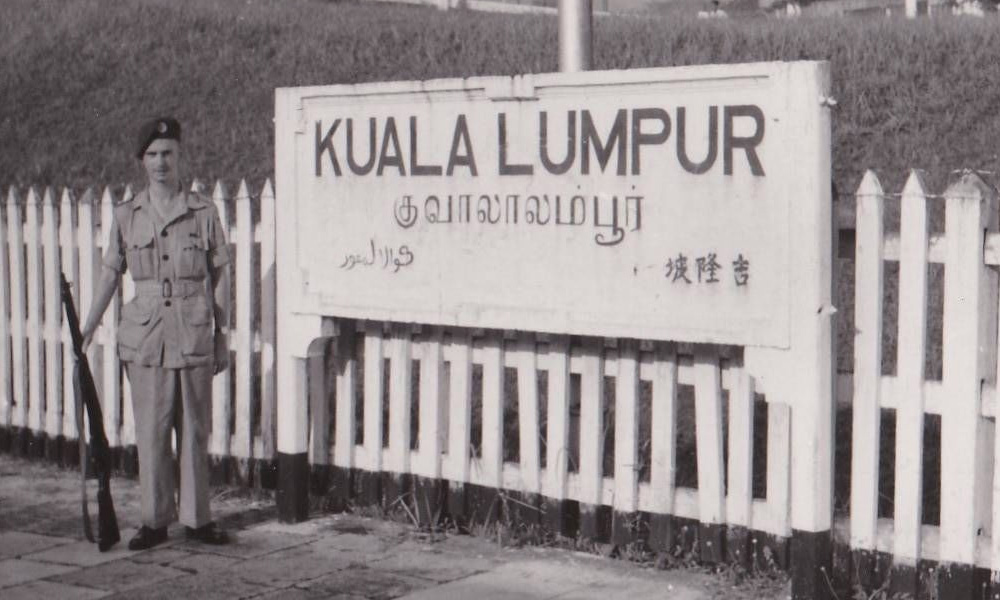
It also saw British imperialism in Malaya and Singapore, where Philosophy served to guide colonial management.
The Straits Philosophical Society hosted discussions on race, identity, and colonialism, against the backdrop of Structuralism and Social Darwinism of this epoch in modern world history.
Almost a decade ago, I was made aware of this work on Colonial History by one of Asia’s most prolific social scientists Lim Teck Ghee, who conceived it as a commentary of essays.
Today, after almost 50 years, the much-awaited collection of the writings of the colonial elites of the Straits Philosophical Society has come to elegant fruition.
The volume is an admirable academic labour of love that began with...
COMMENT | The 19th century was marked by the consequences of the Peace of Westphalia, the rise of nationalism and ethnocentrism in Europe, and the emergence of Communism.
It also saw British imperialism in Malaya and Singapore, where Philosophy served to guide colonial management.
The Straits Philosophical Society hosted discussions on race, identity, and colonialism, against the backdrop of Structuralism and Social Darwinism of this epoch in modern world history.
Almost a decade ago, I was made aware of this work on Colonial History by one of Asia’s most prolific social scientists Lim Teck Ghee, who conceived it as a commentary of essays.
Today, after almost 50 years, the much-awaited collection of the writings of the colonial elites of the Straits Philosophical Society has come to elegant fruition.
The volume is an admirable academic labour of love that began with Lim’s 1976 discovery of a set of “about to be-discarded” unpublished philosophical papers in the Penang State Library and how this prominent Malaysian historian salvaged the valuable set of 17 papers.
The result is a collaborative effort with a British-based prolific editor and scholar in Colonial History, Charles Brophy to produce this volume of work on the commentary of primary sources of the work of the Straits Society.
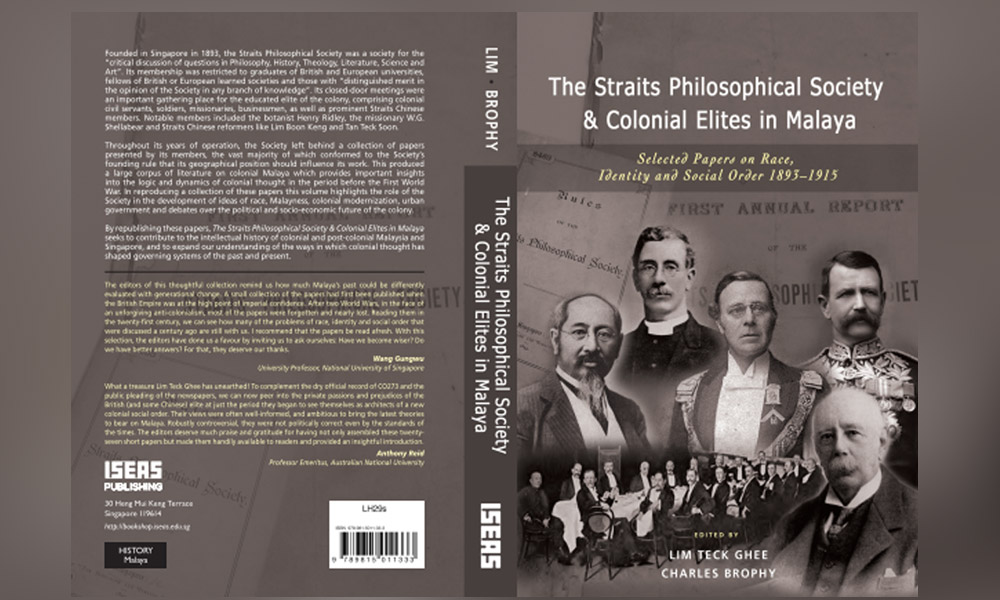
The Institute of Southeast Asian Studies publication of Lim’s and Charles Brophy’s “The Straits Philosophical Society and Colonial Elites in Malaya: Selected Papers on Race, Identity, and Social Order 1893-1915” is timely.
This is especially true for academics and students of Southeast Asian History interested in understanding the philosophical debates that were happening in late 19th-century Singapore and Malaya.
This 462-page book consisting of thirty essays should be a delight to those interested in political philosophy as it pertains to British colonial history.
As an educational contribution to the field, this book offers a glimpse of the value of philosophical thinking in developing perspectives on the inner workings of colonialism.
It includes a range of critical themes, from the basis of colonial ideology, the psychology and political economy of the Straits Chinese, and the impact of the Opium War on the Chinese in Malaya, to the extensive narratives on the colonial construction of Malayness.
Core idea
This brief review essay discusses the educational value of society's work and debates on governing colonies with regard to race, religion, and ethnicity. The core argument is that the transcultural flow of ideas played a significant role in decolonisation.
The book embodied this flow of ideas, contributing to the development of an independent intellectual culture in colonial Malaya.
Critiques of ideology reveal tensions within the society and its contributions to nationalist thought. Revolutionary leaders learned from their experiences in former colonies, challenging the foundational ideas of colonialism and empires.
The work of shaping human nature and exercising power is discussed in the ongoing debates among those in positions of power. These debates, influenced by thinkers such as Jean-Jacques Rousseau and Mahatma Gandhi, inspired independence movements.
The Straits Society, similar to French salon culture, discusses how to colonise and control natives while promoting colonial divide-and-conquer tactics.
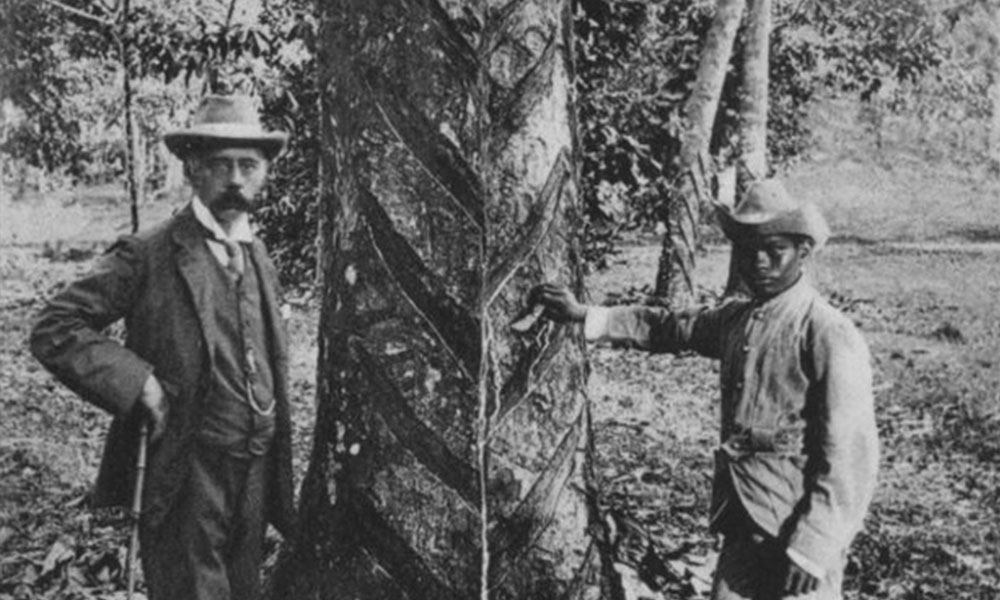
Notable contributors include H N Ridley, who brought rubber seeds to Malaya for British economic gain, and W W Shellabear, who studied Hindu-Buddhist-influenced Malay literature.
The society also engages in debates about governing the colony and subjugating the Malays, including discussions on their religion and psyche. Lim and Brophy provide insightful analysis of race, religion, and royalty in Malaysia within this valuable volume of scholarly work.
This collection delves into debates surrounding the governance of various colonies, including the Chinese Straits community in Singapore during the Opium War. It also explores how the Malays responded to British colonisation and examines concepts like "amuk" and "latah".
The authors analyse the interplay between Chinese immigrants, Malays, sultans, and colonisers, shedding light on race, religion, and royalty in Malaysia today. However, one question remains: Why were there no Malay scholars or royals involved in these discussions?
The hypothesis is that Malay rulers lacked the intellectual tools to debate against colonialism and protect their kingdoms. This is evident in the fall of Malacca in 1511.
In terms of poverty, Western philosophy and technology outmatched the Malay rulers. They lacked a culture of critical thinking and innovation which hindered their ability to resist colonialism. They were preoccupied with maintaining their kingdoms and did not experience the intellectual advancements of Europe.
The concept of “daulat” and “kerajaan” was used as a means of social control. The Malay rulers were more concerned with survival in global politics than philosophical reflection.
Academia has long lamented the lack of academic freedom in Malaysian universities. Policies such as the UUCA and Academic's Pledge of Loyalty have discouraged critical thinking.
The rise of Malay-Muslim influence has further limited the exploration of Western ideas while de-emphasising English language education has hindered the development of philosophical thinking in society.
These observations reflect the death of philosophising in modern Malaysia, as seen through the lens of this book.
How to read this book
“The Straits Philosophical Society and Colonial Elites in Malaya” is essentially a book on philosophical ideas about colonial rule in British Malaya, a fascinating read if one is interested in philosophy in general and political philosophy in particular.
The book established at the end of the 1800s was a forum to intellectualise the directions and inner workings of the empire, especially on issues of race, identity, and the economy. Pedagogically, how do we read this collection of essays and commentaries if we are to use it to teach Colonial History?
In my decades of teaching, courses such as United States History. Ancient and Modern World History, Colonialism, and Imperialism, and even currently in Human Geography and Sociology of the Future I would use primary sources as the main texts to analyse phenomena and patterns in History.
I’d asked students to read first-hand accounts, treatises, letters, and journal entries, and analyse visual text such as photos and other similar forms of representations.
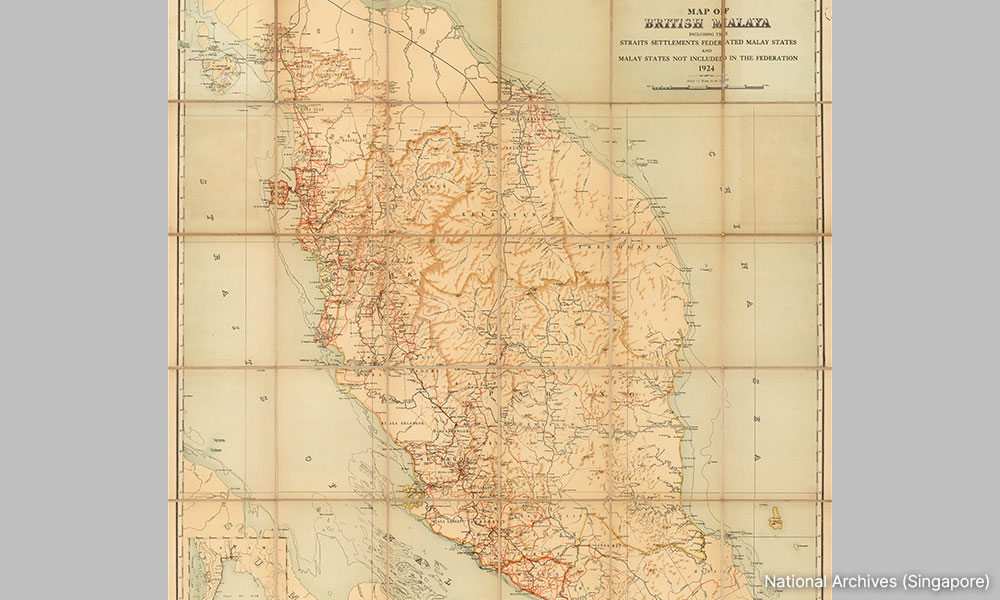
Although students might have a difficult time reading works such as those written in “archaic English” they will be encouraged to persevere. I’d guide them through the language usage and most importantly the content.
Thus, reading Henry David Thoreau’s “Walden”, Plato’s “Dialogues, Symposium, Meno”, or translated texts of the Enlightenment Period such as Voltaire’s “Candide”, Rousseau’s “Emile” and essays and discourses on equality and human nature, or even “reading paintings” such those by the French master Jacques Louis-David and his visual commentaries on the French Revolution (housed primarily in the Louvre in Paris,) may be challenging but necessary.
The essays in this collection on the philosophical discourse concerning the Straits Settlement and, on the economy, the “civilising mission of the British Empire, the Straits Chinese, and the Malays I suggest must be read in the following sequence:
First, read the primary essays. Next, read the counterarguments. Lastly, read what the authors/compilers have to say.
I value original thinking in my students. The key question is “What do you think? How do you support your claim?” after ensuring that they understand what they have read, have them summarise the contents and explain the author’s idea, in the student’s own words.
This is the process of reading I have been using since I started teaching. It is a metacognitive process of close reading, contextualising text, and context and hypertext so that there is a sense of “heteroglossic” understanding of what one is reading.
Complex is the idea or reader-response to the text since our reading will always be subjective and culturally bound and governed by a multiverse of experiences we bring, in the process of interpreting.
I want to create philosophers out of my students. I have no answers for them. This has been an aspect of my philosophy of teaching that has kept me passionate as an educator, academic, and student of humanist praxis and complex systems in general. Hence, the suggestion on how to use the book as an enrichment material on Colonial Malaya.
Essential read
Lim and Brophy’s must-read work in commenting on the primary sources of political philosophical ideas pertaining to race, identity, and governing the Malay colony is both valuable as an analysis and a classroom text to teach about colonialism and the construction of colonial identity.
“The Straits Philosophical Society and Colonial Elites in Malaya” is an elegant work in its own class of originality given the fact that these papers were about to be discarded.
The value of the collection of excellent essays, written circa 1895 to 1915 lies in its nature as the primary source, which historians and teachers of Colonial History especially would appreciate using in class. Even more valuable is the nature of philosophical arguments crafted and debated in the style of Marxist dialectics concerning how the colonies, especially Malaya and Java are to be governed.
The British and Dutch ideologues at times illustrated in the essays have differing conceptions of human nature, the interpretation of worldviews, on race and identity, of Malayness, and how human labour in the colonies is to be managed. One must give credit and even show admiration for the members of the Straits Philosophical Society for bringing philosophical perspectives to the study of colonising.
Aside from the idea that colonialism is evil and that for example, the British Empire siphoned trillions of dollars from the continent and made millions suffer, one must get to the root of the analysis of the anatomy and chemistry of colonising strategy itself.
What role do philosophy and anthropology play in structuring the intellectual strength and rationale for subjugating and enslaving “the little brown brothers”, to advance the civilising mission of the empires?
To capture and control resources in the name of the Cross and the context of the Crusade, and finally to hold on tight to the often quoted (or misunderstood) line from Rudyard Kipling’s poem “Mandalay”.
“East is East, West is West and the twain shall never meet?”
The world of Western intellectual progress circa the late 1800s to mid-1900s produced a systematic and universalising view of human nature and social order vis-a-viz colonialism, of raw Structuralism, I’d say, founded upon race superiority and the advancement of empires as the highest stage of “colonial and mercantile” capitalism, as Vladimir Lenin analysed in his famous essay.
Lim and Brophy’s work is an elegant invitation to the foundational debates of colonialism of the day circa World War I. As elegant as the Nobel Prize novel by Kazuo Ishiguro on a World War II theme, “The Remains of the Day”.
AZLY RAHMAN, the author of 10 books and more than 500 essays on politics, philosophy, education, the arts, and history, is an academic and international columnist for two major opinion portals in the United States. He writes here.
The views expressed here are those of the author/contributor and do not necessarily represent the views of Malaysiakini.
/file/1160/c9b2e1036b860314c9a3f9902db1c12f.jpeg)
/file/1306/6acc80f77d48ac6b78f8a9b29d4f769d.jpeg)
/file/publisher-c1a3f893382d2b2f8a9aa22a654d9c97/2024/05/2af1ba88d07f8b2b361295e43cb8f3fb.jpg)
/file/publisher-c1a3f893382d2b2f8a9aa22a654d9c97/2024/02/808a570ecfd6bf83ec2ed35c8004b3a7.jpg)
/file/publisher-c1a3f893382d2b2f8a9aa22a654d9c97/2023/08/1c750887add0c0bf87103135c7b357dc.jpg)


Report this comment
Are you sure you want to delete this comment?
This action cannot be undone.