


/file/publisher-c1a3f893382d2b2f8a9aa22a654d9c97/2026/07/0f227212fdafd9569c8559e286351073.jpg)

ADUN SPEAKS | Beyond the post-mortem: What Tiram taught me
ADUN SPEAKS | When I joined politics in 2016, I was a “banana”, a Chinese who can’t speak Chinese. Consequently, I was assigned to Chinese-minority areas during elections: Kapit, Pengkalan Batu, Keningau, Simpang Jeram.
In the 2019 Cameron Highlands by-election, I was based in the 100 percent-Malay area of Felda Sungai Koyan 3. Malay voters are, of course, not a monolith; these assignments gave me a different political upbringing within DAP.
Recently in the Johor election, I campaigned in Tiram, a BN stronghold except in the 14th general election of 2018, when it was won by PKR's S Gopalakrishnan.
Pakatan Harapan fielded Nor Zulaila Abdul Ghani, or better known as Lily, a Chinese-Malay mother of two, fluent in Mandarin and Hokkien, with 12 years of public service experience. We decided to run a modest, positive campaign to suit Lily’s personality.
Tiram's 117,496 voters comprise 57.2 percent Malays, 24.5 percent Chinese, 11.6 percent Indians, and 6.7 percent others. The non-Malay populations reside in Ulu Tiram, and the Malays largely in Kota Masai.

Through the local grapevine, we heard that some Umno grassroots disagreed with their candidate selection. It was hard to tell if they would abstain, switch teams, or consolidate behind BN. In the end, BN won decisively with a majority of 28,255 votes.
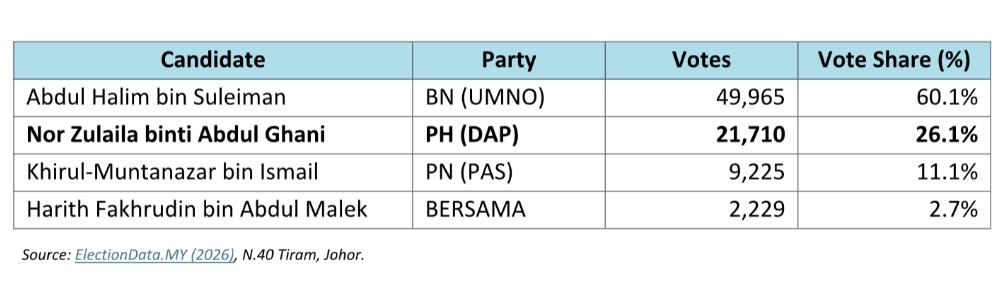
Beyond the headline result, several lessons emerged.
Perikatan Nasional did not top any voting district but consistently finished second in Malay-majority areas. For voters who did not want to support BN but remained wary of Harapan and newly formed Parti Bersama Malaysia, PN emerged as a credible alternative.
Meanwhile, Bersama was not a spoiler. Even if all its votes had gone to Harapan, BN's margin was far too substantial.
A more sobering lesson was that Harapan’s strong performances in Chinese-majority voting districts were insufficient to overcome BN's advantage elsewhere.
Going forward, Harapan must face several trends that have upended previous assumptions.
1. High ceramah and voter turnout numbers ≠ support
Full-swing campaigning is like a 7.7 mega sale: the PA system announces limited-time deals, crowds gather, and shopping carts fill quickly.
But not everyone who shows up makes a purchase. Some browse, some leave empty-handed, and many shop online where you never see them at all.
On July 7, a friend remarked that Chinese voters were starting to feel the “wind”. Ceramahs were full, roads turned red on navigation apps. Maybe Johor, too, would turn red.
We were wrong.

There is strength in numbers. Reformasi and Bersih demonstrate that mass mobilisation over a shared cause can reshape politics in profound ways.
Crowded ceramahs and high voter turnout are more layered: they generate energy and excitement, but they can’t predict how people will vote. Beyond mega ceramahs, concerts, and convoys, what messages are voters taking home and to heart?
2. Ditch the ‘6-7’ for authentic Gen Z engagement
A Kota Masai trader told me, "Anak muda sekarang, dia nak tengok results saja." (The youth only want to look at the results.) There’s truth in that.
Voters deserve performance and results. But they also deserve to understand how decisions are made and why progress can sometimes be slow.
Explaining the process in clear, non-defensive language empowers people to ask better questions and hold us to account.
This year, we started a dialogue series called “Talk3Talk4 with YB” in Kampung Tunku, where residents can bring questions, issues, and suggestions, no filter.
With my three Petaling Jaya City Council (MBPJ) councillors, we answer what we can, note items for action, and arrange follow-up site visits or meetings where needed.
This is also where Gen Z deserves more respect instead of politicians dropping “6-7” or “scuba” memes and giving “Hello, fellow kids” vibes. If we want their trust, we must earn it by treating them as equal participants in our democracy – the very principle underpinning Undi18.
As the Negeri Sembilan polls go on, the real test is not whether we can explain why we lost. It is whether we are willing to change how we win.
LIM YI WEI is assemblyperson for Kampung Tunku.
The views expressed here are those of the author/contributor and do not necessarily represent the views of Malaysiakini.
/file/publisher-c1a3f893382d2b2f8a9aa22a654d9c97/2022/12/0d2eb38dabab6ad30f3d99e211c2b902.jpg)
/file/publisher-c1a3f893382d2b2f8a9aa22a654d9c97/2026/07/7b7768308b073441bd7ecce8b304d9c0.jpg)
/file/publisher-c1a3f893382d2b2f8a9aa22a654d9c97/2026/07/f698c84ca032464345adc41c2913254a.jpg)
/file/1251/aa283709c71bb5b585a0ef5a7b40d0e8.jpeg)


Report this comment
Are you sure you want to delete this comment?
This action cannot be undone.