


/file/publisher-c1a3f893382d2b2f8a9aa22a654d9c97/2026/07/92ddb487c1110932b91db3b97081bd86.jpg)

COMMENT | Don't blame racism for failure to understand voters' needs
Let's look at the facts instead.
Between April and July this year, Institute for Strategic Analysis & Policy Research (Insap) conducted four waves of face-to-face fieldwork across Johor and Negeri Sembilan, undertaken by independent enumerators.
Over 10,000 Malaysians were interviewed in person in the months and weeks before both elections. The composition of respondents reflected the demography of the electoral rolls for each state.
Asked which national issues most influence their...
COMMENT | Following the outcome of the Negeri Sembilan state election, the general political narrative has been claims of Malay voters' consolidation, return of identity politics, and how non-Malays are now somehow exposed.
Let's look at the facts instead.
Between April and July this year, Institute for Strategic Analysis & Policy Research (Insap) conducted four waves of face-to-face fieldwork across Johor and Negeri Sembilan, undertaken by independent enumerators.
Over 10,000 Malaysians were interviewed in person in the months and weeks before both elections. The composition of respondents reflected the demography of the electoral rolls for each state.
Asked which national issues most influence their vote, respondents put the cost of living first at 66 percent, then the economy and jobs, followed by corruption and integrity.
It was followed by political stability, then education. Race-related issues came sixth of eight.
In fact, it came sixth in every community polled. Malay, Chinese and Indian respondents selected it at rates within four points of one another, whereas roughly two-thirds of respondents in each community selected cost of living as their top concerns.
Whatever divides Malaysians, it is not their diagnosis of what has gone wrong in their own communities but rather the pressures of increasing cost of living that the federal government has not responded to.

That finding sits poorly with the political narratives now being told. You cannot claim that voters were consumed by racial anxiety and yet at the same time deny their concerns about the economy.
What voters said about each coalition
In Johor, satisfaction with the BN state government came back higher than the Pakatan Harapan-led federal government - with Chinese, Malay and Indian respondents landing within three points of each other.
In Negeri Sembilan, we asked the equivalent question about the then-incumbent Harapan state government.

In Nilai and Repah, satisfaction sat at around a third. In Chennah, dissatisfaction outweighed satisfaction by a margin.
As we now know, BN went on to defend Johor and succeeded with even greater numbers, while Harapan went on to lose Negeri Sembilan.
What matters most to voters
All three communities rated a track record of service delivery among their highest expectations of candidates and parties to vote for.
Not one campaign messaging tested, such as "Green Wave" fear-mongering or Malay voters’ consolidation, connected with the voters.
This is worth deeper consideration because those complaining hardest now about identity politics actually ran their campaign on such messaging and their post-election narratives reflect the same.
Malaysians are not sitting in ethnic blocs waiting to be collected. There are no fixed deposits left.
READ MORE: BN-PN tsunami could push Harapan to worst GE outcome since 2008, S'gor defeat
Every party in this country is now being asked to earn the votes in front of it, candidate by candidate, term by term, and the parties still counting on inherited loyalty are the ones with the shortest future.
Where the votes actually moved
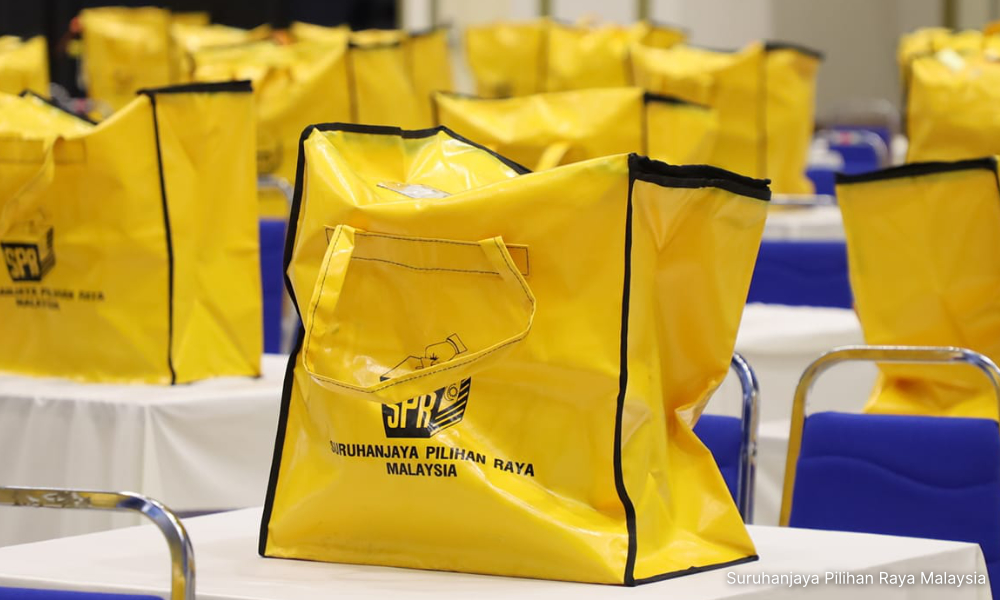
If identity politics was the primary deciding factor, voters of the same community in the same neighbourhood would have voted the same way. In reality, they did not, and the official count shows where the difference came from.

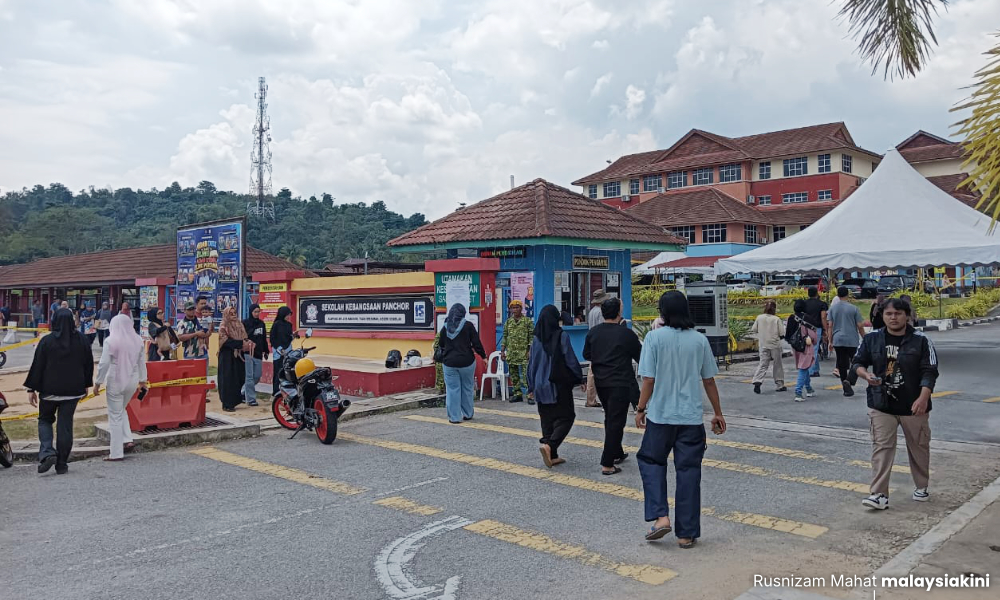
Polling streams are ordered by age, so a single polling centre records how its oldest and youngest voters each voted. At SJK(C) Chun Yin in Pekan Titi, the Chinese-school centre in Chennah, the BN candidate took under 18 percent in the streams for voters in their 60s and 70s, and over 34 percent in the stream for voters aged 18 to 33.
Similarly, at SJK(C) Kampung Baru Tampin, the equivalent polling centre in Repah, the BN candidate took 26 percent in the oldest stream and between 44 and 50 percent in the three youngest.
In both seats, within the Chinese community's own neighbourhoods, the youngest voters gave BN close to double what the oldest voters gave it.
That is a meaningful movement in the Chinese vote, and it is a movement no theory of race-based voting predicts. It is largest among the young, who have the least inherited loyalty to anyone, and it is largest where a candidate had something to show for.
Which brings me to the objection I know is coming, that a race-based political party organised around Chinese community interests has no standing to say any of this.
Relevance of race-based parties
The MCA was founded in 1949 against the backdrop of mass repatriation of Chinese Malayans to defend the interests of those who had nowhere else to go.
It established the Alliance with Umno in 1952, sat at the independence talks in London in 1956, and in the years after Merdeka, drove the same community it helped to citizenship in this country to build the nation together.

That is the founding act of the party that secured the standing and future of Malaysians who might otherwise have had none.
As such, the MCA is a nationalist party with a track record, and it has never asked anyone to pretend that community interests don't matter.
All Malaysians want the same issues fixed as they continue to hold their own communal interests dearly. Both are true, and any politics that insists the second half (communal interests) will continue to be surprised by election results will be.
Race-based politics did not return in 2026 because it never left. Every governing coalition in this country has been assembled communally, without interruption, since 1952.
That was true of the Alliance; it has been true of BN, and it is true of Harapan today, which contests seats and allocates them according to the same formula everybody else uses.
Calling it a “return” implies an interval of absence that nobody can date, and it seemingly projects a view as if they had no role to play in it.
What changed this year was not the presence of race-based politics. It was simply a question of competence.
Same standards apply
The same standard has to run both ways. If it is racial politics when Malay voters are united around a shared interest, it is also racial politics when non-Malay voters do the same. What Malaysian voters reject is racism, not representation.
On the night of the result, Harapan's own election director said the Negeri Sembilan state administration had been marvellous on investment, reform and service to voters, and attributed the defeat to identity politics played by its competitors.
Amanah's communications director said the performance campaign drew no response and that voters gave the state government’s track record no attention at all.
Based on the fieldwork weeks before the campaign began, voters had already assessed that record and a great many were not convinced by it.
A campaign built on performance will not work if the performance itself was never felt on the ground. This was not a failure of the voters to listen, but rather it was a failure to give them something worth listening to.
READ MORE: YOURSAY | Reforms only matter if rakyat feel effects in their daily lives
Prof Sivamurugan Pandian of Universiti Sains Malaysia reached much the same conclusion from outside the party system. Speaking to Scoop after the state election result, he assessed that some Chinese voters had been prepared to reconsider their long-standing support for DAP when a credible BN alternative was placed in front of them.
He put the deeper question to DAP directly, saying that the bigger issue was not the seats it had lost but whether it now faces "voter fatigue, performance dissatisfaction and a disconnect between national leadership and constituency-level concerns".
That is a diagnosis about delivery and about distance from the ground. It is not a diagnosis about race, and it came from a political sociologist with no interest in defending anybody's coalition.
Questions that need answers
Representation inside a government and representation outside it are not the same thing.
A community with their representatives on the same table where decisions are taken has a real channel for recourse, whereas a community represented only in opposition does not, and no amount of arguments from the opposition substitutes for it.
That is not an argument for any particular party but instead is a description of how coalition government has always worked here.
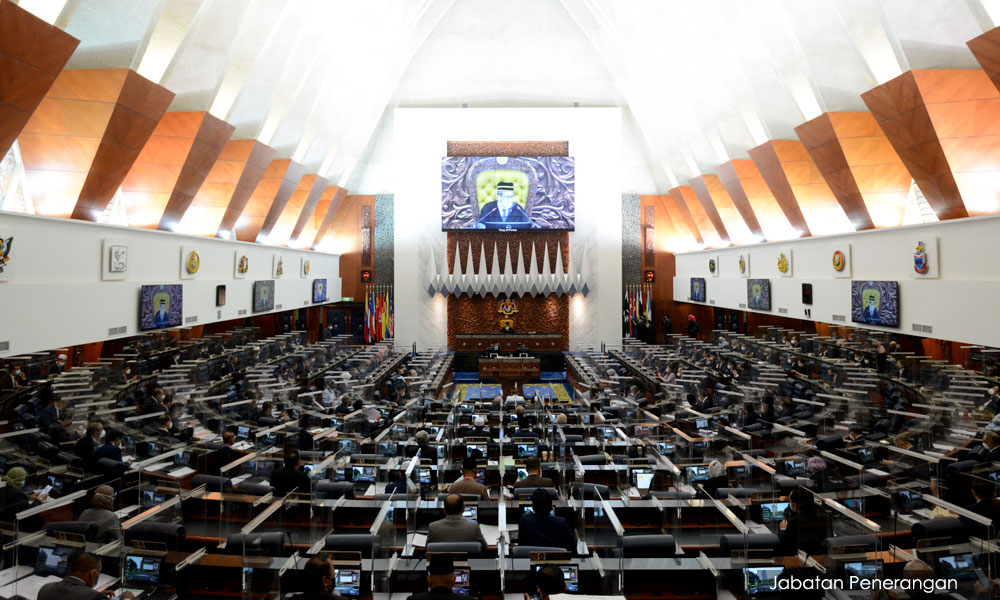
Just look at the current administration dealing with their own dissenting MPs.
READ MORE: PKR MP who attended Rafizi's event now says his access to govt funds portal blocked
Voters are entitled to weigh that and reach their own conclusion. What they should not be told is that the choice is not theirs to make, or that making a decision around communal interest is a lesser form of politics.
Nobody needs to apologise for their own identity. The obligation is to be answerable for what has been done with it.
On July 11 and again on Aug 1, voters in both states showed they are perfectly capable of making choices themselves.
WOON KING CHAI is the director of MCA-linked Institute of Strategic Analysis and Policy Research (Insap). He previously served in senior roles in the federal government and private sector.
The views expressed here are those of the author/contributor and do not necessarily represent the views of Malaysiakini.
/file/publisher-c1a3f893382d2b2f8a9aa22a654d9c97/2026/08/9b7a7a9683d7be2134a630173952ed23.jpg)
/file/publisher-c1a3f893382d2b2f8a9aa22a654d9c97/2026/02/3739443292b70382b87c13377e0c17ea.jpg)
/file/publisher-c1a3f893382d2b2f8a9aa22a654d9c97/2026/07/144faf8a405dc3c050068cdf23031558.png)
/file/publisher-c1a3f893382d2b2f8a9aa22a654d9c97/2026/08/81975cab9814f7e08f94d544b03c5af3.jpg)


Report this comment
Are you sure you want to delete this comment?
This action cannot be undone.