




The thaw and the new sultans
The underground political tectonic plates in Malaysia have shifted.
The resultant tsunami was probably long in the making. But its sudden manifestations on March 8 at the polls caught everybody by surprise. Two weeks later, the main actors from both the protagonist and the antagonist camps look dazed and uncertain as ever on the political stage, like skilled swimmers caught in an uncharted sea.
Much of the body of racial myths that has formed the bedrock of our nation-building experiment for half a century has been debunked overnight. The tactic of divide-and-rule inherited by the governing classes from their former colonial masters has somehow backfired. In a matter of weeks, Machiavellian formulae that have worked so well in cowing an entire population now look sterile and ludicrous even.
One smells the fragrance of spring, a tremor of thawing in the frozen air. The body politics of Malaysia seems to be stirring uneasily from its long moribund state of rigour mortis, struggling in its cocoon to evolve into a beautiful butterfly through its inevitable metamorphosis.
The underground political tectonic plates in Malaysia have shifted.
The resultant tsunami was probably long in the making. But its sudden manifestations on March 8 at the polls caught everybody by surprise. Two weeks later, the main actors from both the protagonist and the antagonist camps look dazed and uncertain as ever on the political stage, like skilled swimmers caught in an uncharted sea.
Much of the body of racial myths that has formed the bedrock of our nation-building experiment for half a century has been debunked overnight. The tactic of divide-and-rule inherited by the governing classes from their former colonial masters has somehow backfired. In a matter of weeks, Machiavellian formulae that have worked so well in cowing an entire population now look sterile and ludicrous even.
One smells the fragrance of spring, a tremor of thawing in the frozen air. The body politics of Malaysia seems to be stirring uneasily from its long moribund state of rigour mortis, struggling in its cocoon to evolve into a beautiful butterfly through its inevitable metamorphosis.
I know we human beings are pretty much creatures of habits. We prefer to dwell exclusively within our comfort zone most of the time. On a world historical scale, you could say man is the prisoner of his own nameless fears. That is why security and stability are the mainstays of national politics in Malaysia and elsewhere.
But as Jean Jacque Rousseau would have told you, the only stability and security that you will find in human affairs is behind the bars of a prison cell. History takes place in time, and time is flux. Therefore, making history means making significant changes, to our physical, cultural and political environments, and to ourselves. Change, and I mean structural paradigmatic change, is the iron logic of history, for better or for worse.
Fresh, interesting interpretations
Therefore, the people of Malaysia, their federal and state governments, their institutions of state, have all been thrust outside their traditional comfort zone. Earth shakers of old now find themselves on uncertain grounds, as they fumble along in this brand new landscape. The old gridlock of laws and regulations are still there. But new horizons have arisen for fresh and interesting interpretations and enforcement of those old laws.
Take the sultans for instance.
The institution of the sultanate has been made sacrosanct at the time of independence as part of the Malay nationalist narrative that spearheaded independence. They were the highest symbol representing Malay sovereignty in a Malay homeland. But unlike the sultans in a bygone age, the rulers are constitutional monarchs, ceremonial head of state with some powers over Islamic affair within their domain.
 In the past, the odd ruler would have forgotten at odd times that they were constitutional monarchs. Enough dirt was dug up in Parliament during those sessions in the 1980s when constitutional amendments were introduced to curb the power of the Sultans.
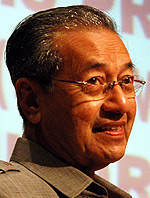
Ironically, it was Dr Mahathir Mohamad - the ultimate champion of Malay dominance in a Malay homeland – who initiated and drove this campaign to diminish the power and the prestige of the royal houses. In retrospect, one has to conclude that only Dr M had the clout and the tenacity in the short history of Malaysia to have taken on the very symbol of Malay sovereignty.
How the rulers took this giant snub in their royal noses we will never know. Since then, the royal houses have behaved with great decorum, and perform their public functions with an obvious sense of devotion and responsibility. They act on the advice of the prime minister and the mentri besars all the time it seems, and behave as constitutional monarchs are supposed to behave.
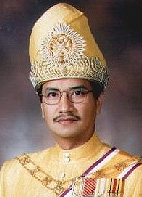 In the matter of appointing a prime minister after a general election, the Yang di Pertuan Agong’s guideline is clearly stated in the federal constitution. He will appoint somebody who in his estimation will command the support of the newly elected Dewan Rakyat to the office of prime minister. The same applies to the sultans and the governors when it comes to the appointment of their mentri besars and chief ministers.
Exactly how the rulers can be confident about someone who can command the support of the legislatures is never clearly spelled out. We know this is not a decision entirely up to the rulers’ subjective discretion. We all know also how we as citizens can do simple arithmetic and by a quick count, arrive at a judgement on who should be a prime minister. It works with a kind of unwritten rules, a convention built up over the past decades by sheer common sense.
Perlis Sultan did the right thing
However, the unexpected results of the 2008 general election have created completely novel situations in matters of appointing chief executives in quite a few states.
 The transfer of power in Penang was a reasonably straight forward affair, thanks in part to the graciousness of the outgoing CM Dr Koh Tsu Koon. In the case of Kedah, PAS also had little problem in forming the state government. But matters were messy in Selangor, Perak, Perlis, and Terengganu.
The case in Perlis was especially illuminating. There, the BN had gained a clear majority, but there was some confusion about who had the command of the whole house of state assembly.
The outgoing MB Shahidan Kassim had a letter from the PM appointing him to be the MB. At the same time, a big group of Umno assemblymen had presented themselves to the Sultan of Perlis and had nominated another candidate to be the new mentri besar.
In this case, the Sultan of Perlis did the right thing, and went on to swear in a new menteri besar, irrespective of whatever letter of appointment that had been issued by the prime minister. Within our system of federation, it is the sole prerogative of the Perlis Sultan to appoint the mentri besar in his state, and it is in fact very bad grace for the prime minister at the federal level to interfere in this whole affair.
The iron grip of the dictatorship of the prime minister’s office by unfolding events, built up by Dr M has finally been pried open.
In the case of Terengganu, it is a quirk in the constitution that caused a small kink in the formation of the new state government. The Sultan of Terengganu is also the Yang Di Pertuan Agong, the federal king, and so he cannot act as a sultan in the appointment of his mentri besar. Unfortunately, his Regent is an infant. This is no big problem because there are provisions for solving this problem in the state constitution, as has been elegantly explained in the Star (20 March 2008) by Dr Shad Saleem Faruqi, the Professor of Law from UITM.
In Selangor, Khalid Ibrahim from the PKR looks as if he is custom-made for the position of the mentri besar, what with his charisma, his corporate stature, and his resume in human and financial management.
Bickering for spoils of war
The problem with forming the Selangor state government stems from within the DAP, as they continue their ugly internal wrangling for the spoil of war in public, fighting for the positions of deputy mentri besar and executive councillors. The solution was therefore to suspend the idea of appointing a deputy MB.
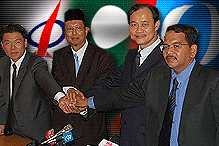 The bickering for the spoils of war in Perak is particularly disturbing to supporters of the alternative coalition of PKR, DAP, and PAS.
The Perak scenario is messy to begin with, since the opposition coalition has only a slim majority of three seats in the state assembly. A few defections and the balance of power would be tipped irreversibly towards the BN.
While the DAP has 18 seats and thus enjoy the advantage of being the largest bloc of opposition seats, they have not gained a simple majority. Worse still, they do not have a single Malay state assemblyman in a Malay state the constitution of which requires a Malay and a Muslim mentri besar. That stipulation probably could not be changed or suspended without the consent of the Conference of Rulers. I simply cannot see how the rulers could have scrapped this requirement without negating their reasons-to-be.
In the subsequent melee, the opposition coalition members learnt a valuable lesson in multiracial and multi-religious coalition politics. They have also learnt a lesson in protocol in their dealing with the Perak Regent. The DAP leaders in particular have to be jolted into their new reality as a component of the state government in waiting. Many of the old guards within this brand name opposition party must still be stuck in the time capsule in which they envisage themselves as an opposition party for 10,000 years!
Eventually, the Regent of Perak came out as the only one smelling like a royal rose. He shows great poise and restraint, giving advice without appearing to be interfering with the formation of his new state government. He knew his duty to his state and his subjects. He must have had a few anxious moments, but it turned out alright in the end, for the moment. As for the DAP, they have a PAS MB who can speak Mandarin and is half-Chinese, and that makes Malaysian politics interesting.
In short, the institution of the Malay ruler has been tested by the new realities brought on by the results of the 2008 general election. Their majesties have met the challenges well, and have evolved into their new roles as effective constitutional monarchs well. This can only show to the nation that they are still very much relevant in national politics in Malaysia.
Already, commentators are wondering aloud about what kind of role the Conference of Rulers can play in providing checks and balance in the improvement of our institutions of state, especially in the reform of the judiciary. The natural question that commands our attention is this: will the election outcome influence the thrust and content of the final report to be presented by the Royal Commission on the Lingam Video?
These are interesting times indeed, and it is an honour to be a witness to history in the making.


