




A season for rebellion
I was surprised when the reporters covering parliament proceedings decided spontaneously to boycott all press conferences a few days ago and the story-tellers became the stories themselves. Although our news hounds are the front-line foot soldiers in our media industry and eye witnesses to many dramatic and sometimes violent events in our public sphere, they are by and large a respectful, compliant and even shy bunch of individuals.
This time they were goaded into open rebellion by a parliament ruling to ban them from the lobby area, following a recent directive that each media organisation would not be allowed to send more than five reporters to cover parliament business. Fortunately for them, they seemed to have received full support from their editors in their headquarters.
The parliament directive has no rhyme or reason of course. The Dewan Rakyat is the highest political forum in the land, and the people have every right to know what goes on inside the House and outside in the lobby. The reporters serve as the bridge between the Parliament and the people. To limit press freedom in Parliament is a blatant act of contempt against the most basic democratic right of the people.
I was surprised when the reporters covering parliament proceedings decided spontaneously to boycott all press conferences a few days ago and the story-tellers became the stories themselves. Although our news hounds are the front-line foot soldiers in our media industry and eye witnesses to many dramatic and sometimes violent events in our public sphere, they are by and large a respectful, compliant and even shy bunch of individuals.
This time they were goaded into open rebellion by a parliament ruling to ban them from the lobby area, following a recent directive that each media organisation would not be allowed to send more than five reporters to cover parliament business. Fortunately for them, they seemed to have received full support from their editors in their headquarters.
 The parliament directive has no rhyme or reason of course. The Dewan Rakyat is the highest political forum in the land, and the people have every right to know what goes on inside the House and outside in the lobby. The reporters serve as the bridge between the Parliament and the people. To limit press freedom in Parliament is a blatant act of contempt against the most basic democratic right of the people.
Obviously, the new Speaker and his two deputies have yet to adjust themselves to the new reality following the emergence of a new political landscape after the March 8 general election.
In the past week, the newspapers have been full of such interesting stories.
What a lone individual can achieve
One of the most sensational acts of rebellion was the explosive affidavit produced by Raja Petra Kamarudin, with the bold allegation that the DPM's wife was present at the scene at the time when Attantuya was murdered. This time around, he was not arrested, detained, and charged with sedition. Instead the police have started what seems to be a serious investigation. How it will affect the outcome of the sensational murder trial remains to be seen.
Has Raja Petra opened a can of worms that will cast a shadow on the political future of a prime-minister-in-waiting, or has he sunk himself into a deep hole where dire consequences await him? The reaction of most ordinary people will be one of wonder: surely he must have some secret evidence in hand, waiting for the right time to divulge and bare all - if he dares to make such an outrageous allegation against the wife of the second most powerful man in the land?
It just goes to show what a lone individual can do to shake the VVIPs from their complacency of great power. We are reminded of the chap who recorded the Lingam tape.
Then, Justice Ian Chin repeated his testimony that the former PM had given him and other independent judges 'veiled threat" if they did not toe the line in the years gone by.
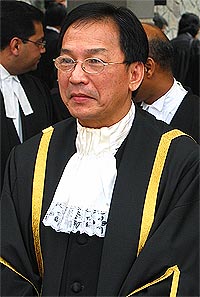 I know of this judge, because of my personal interest in some of the cases that had come before him. In one case, in which some Iban villagers tried to make claim to their land under the Native Customary Rights against a plantation company, Ian Chin ruled in favour of the Ibans, citing precedents from the cases in Australia involving the Aborigines, and from Canada where the American native Indians also faced the same dilemma over their ancestral land. In another case involving an election petition, he ruled against the BN candidate, finding him guilty of vote buying. That is what I call courageous enlightened judicial activism. We need judges like that to further the cause of judicial independence and the blossoming of democracy.
It is no wonder that a prime minister like Dr Mahathir Mohamad will find a judge like Ian Chin a thorn in the flesh. Now Dr M is a private citizen like me, though he will be coming out with his guns blazing against Justice Chin, for a leopard, no matter how old, cannot change its skin.
Between the former PM and the serving judge in Sabah and Sarawak though, my vote of confidence is for Justice Chin. I can assure you readers that this has nothing to do with the fact that he is a Sabahan, and I am a Sarawakian, and we share the brotherhood of both being East Malaysians. It is comforting to think that the chance of setting up a tribunal to remove Ian Chin from his exalted and distinguished office now seems remote. 1988 seems so long ago.
Malaysia under Dr M in those 22 years of rule by a strong man was a pressure cooker. Many public officials and ordinary citizens had to swallow their conscience in public. The conscience sat uneasily in the stomach, and it caused much psychosis in public life.
Fortunately, Malaysia is no Zimbabwe, and we have made significant progress since Dr M retired. His retirement has been the best thing that has happened to Malaysia since our independence.
Malaysians more vocal now
Since the March 8 general election, the Malaysian people have become more vocal. Demonstrations are not always visited upon by water cannons on the street. Policemen are learning how to act like real policemen. The Malaysian people are getting bold, asserting their rights as they should, and not acting like slavish subalterns, mere population serving as objects of administrative powers, rather than citizens enjoying all the rights and powers of sovereignty.
Take the humble petrol station owners for another instance. These are small, usually Bumiputra businessmen, eking out a meagre existence just to meet the needs of the 15 million or so motorists for fuel. The hike in fuel costs benefits them little, and they had threatened to shut down in a big way for a few days.
In the old days under Dr M, this kind of rebellious act would have been treated as a threat to national security and the ISA stick would be bandied about to whip these petrol station owners into shape.
Instead, Shahrir Abdul Samad, the Minister for Domestic Trade came to the rescue of the nation, by working out a higher level of commission for the petrol station owners, as well as promising to fight for a lower credit card charge from the banks. Rebellions do work.
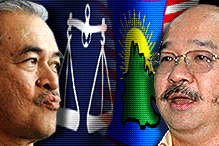 The stormiest act of rebellion in recent weeks though has to be the bold statement from Sapp president Yong Teck Lee that his party MPs will support a motion of no confidence in Parliament against the prime minister.
Among his demands, is that immediate actions be taken to solve the problem of illegal immigrants in Sabah. Sure enough, the prime minister sets up almost immediately a special task force to start tackling this problem of an illegal population estimated to be 1.5 million people - about half the total population in Sabah.
This most recent announcement has been received by Sabah leaders with "cautious optimism", which is a euphemism for "reserved cynicism". After many broken promises from KL, Sabahans will do well to maintain a healthy level of cynicism on the subject. Obviously, the announcement was made without much consultation with the state government, and it seems like a knee jerk reaction to put out the fire started by Yong that threatening to burn down the grand edifice of the Barisan Nasional.
Again it shows that if you want result from the government, you must start a peaceful and non-violent rebellion. I wonder who will start the next fire.
The taxi drivers have more than just cause to go on strike. There, the system of giving out permits stinks sky-high. Spare parts, tyres, garage servicing, and cost of living have all gone up, while the restriction on their meter rate remains. Now with higher fuel cost, how will they survive?
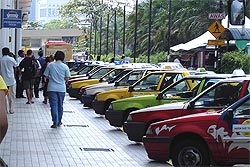 Can you imagine if the 30,000 taxi drivers or so in the Klang valley will all go on strike for one day, and they will all go to the Parliament House to lay traffic siege to that august building on top of the hill a shout away from Bukit Bintang - while the House is in session? Fortunately for the BN government, the taxi drivers are not a very organised lot!
But the biggest threat of rebellion comes from the possible defection of more than 30 Barisan Nasional MPs from Sabah and Sarawak to Pakatan Rakyat in the near future, rendering the PM as the new opposition leader in the process. Whether this sort of mass defection will actually take place is anybody's guess, and there are ethical questions of party hopping to be settled. For the moment though, Anwar Ibrahim has the BN camp entrapped in a quandary with his mind game, and that keeps commentators like me very busy.
My conclusion is this: a little peaceful and non-violent rebellion is a good thing for democracy in Malaysia.


Are you sure you want to delete this comment?
This action cannot be undone.