


/file/publisher-c1a3f893382d2b2f8a9aa22a654d9c97/2024/09/051a26f69fc289398b827737b67d5a58.jpg)

COMMENT | Wake up, Putrajaya: We are in an education crisis
COMMENT | Last week, the Organisation for Economic Co-Operation and Development (OECD) released the 2025 Programme for International Student Assessment (Pisa) scores.
Pisa measures 15-year-olds’ ability to apply their knowledge and skills in science, mathematics and reading to real-world problems. The assessment is held every three years and has become the standard international benchmark for comparing the performances of education systems.
More than 760,000 students across 91 countries and economies, including 7,624 students from 157 schools in Malaysia, participated in 2025.
Malaysia first participated in 2009, and our scores have consistently remained below the OECD average, hovering in the bottom third. Yet, successive education and development plans have continued to set ambitious targets.
The Malaysia Education Blueprint 2013–2025 aspired...
COMMENT | Last week, the Organisation for Economic Co-Operation and Development (OECD) released the 2025 Programme for International Student Assessment (Pisa) scores.
Pisa measures 15-year-olds’ ability to apply their knowledge and skills in science, mathematics and reading to real-world problems. The assessment is held every three years and has become the standard international benchmark for comparing the performances of education systems.
More than 760,000 students across 91 countries and economies, including 7,624 students from 157 schools in Malaysia, participated in 2025.
Malaysia first participated in 2009, and our scores have consistently remained below the OECD average, hovering in the bottom third. Yet, successive education and development plans have continued to set ambitious targets.
The Malaysia Education Blueprint 2013–2025 aspired for Malaysia to reach the top one-third of countries in international assessments, while the 13th Malaysia Plan now targets reaching the international average by 2030.
Moreover, Malaysia is being overtaken by regional economies with lower income per capita. Thailand, which had generally performed below us in recent Pisa cycles, overtook us substantially in mathematics and science, while matching our reading score in 2025. While Cambodia remains behind, it has recorded significant improvements, while Malaysia has declined (Figure 1).
/file/attachments/orphans/p1_932309.png "Wake Up, Putrajaya: We Are in an Education Crisis 150926 Figure 1")
The latest results paint an increasingly grim picture. Malaysia’s mathematics score fell to a historic low at 397, below 400 for the first time. While the scores for science and reading increased by three and five points respectively, neither increase was statistically significant, with the OECD describing Malaysia’s performance in both subjects as “about the same” compared to 2022.
Level of proficiency
More troubling is what lies beneath the headline scores. Almost two-thirds of our students, or 65 percent, failed to attain Level 2 proficiency in mathematics, the OECD’s baseline proficiency level.
At this level, students are expected to apply basic mathematics to simple real-world problems, such as performing currency conversions. The share of Malaysian students below this baseline has risen from 41 percent in 2018 to 65 percent 2025.
/file/attachments/orphans/p2_669326.png "Wake Up, Putrajaya: We Are in an Education Crisis 150926 Figure 2")
Scores did fall across most participating countries in Pisa 2025, but Malaysia’s decline is structural rather than a shared post-pandemic dip. Some may attribute our deteriorating results to insufficient resources or a lack of curiosity among students. Yet, Malaysia already spends more on education than our regional neighbours such as Thailand and Vietnam, who performed better than us (Figure 2).
The Education Ministry consistently receives the largest allocation among all ministries in the federal budget, rising from RM55.2 billion in 2023 to RM66.2 billion in 2026. Meanwhile, the evidence does not point to a simple shortage of teachers as a dominant cause either.
The 2025 PISA survey shows that only 18 percent of Malaysian students attended schools whose principals reported that instruction was hindered by a lack of teaching staff, lower than the OECD average of 39 percent. Neither does the problem appear to be a lack of student motivation.
Eighty percent of Malaysian students reported curiosity about learning many different things, while 79 percent said they put in additional effort when schoolwork became difficult. However, only 37 percent demonstrated a “growth mindset” where they believed intelligence can be cultivated through effort, learning and feedback.
Structural issues
In reality, the issues are more structural, and some start even before children enter school.
First, Malaysia’s child stunting rate rose to 21.2 percent in 2022, up from 17.7 percent in 2015 according to the 2022 National Health and Morbidity survey. More recent estimates put Malaysia's stunting rate at 24 percent in 2024, higher than Indonesia, Cambodia, Vietnam and Thailand. Chronic undernutrition in early childhood can weaken cognitive development and reduce school readiness and concentration, which leads to poor learning outcomes.
Then, children enter primary school with weak foundations. Malaysia’s pre-school gross enrolment rate is relatively high at 93 percent in 2024, but the headline masks the persistent gaps in access and quality.
In rural and remote areas, families may have no public preschool within reasonable proximity. In urban areas, limited public places leave lower-income families reliant on private options they cannot afford. More importantly, access does not necessarily translate into readiness.
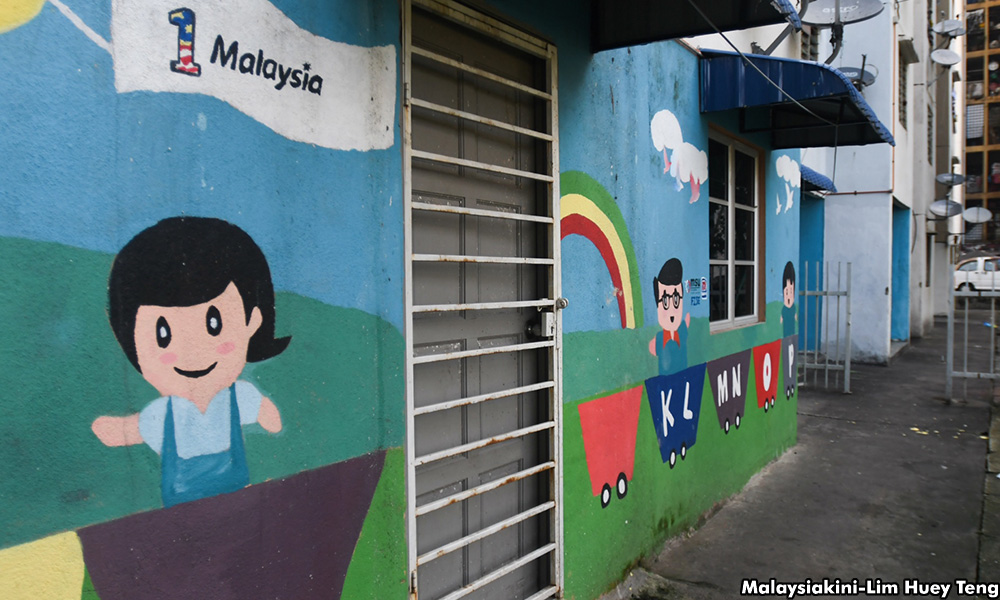
A 2024 World Bank report found that 24 percent of children who attended preschool still lacked the skills needed to be school-ready, while 42 percent of 10-year-olds were unable to read and understand a short, age-appropriate text. If a child cannot read with understanding by age 10, learning in almost every other subject becomes harder.
The quality of early-childhood education is another concern. 57 percent or 32,975 Malaysia’s preschool teachers did not hold the minimum diploma qualification in early childhood education in 2023. The system is also fragmented across different ministries, agencies and private providers (Figure 3). If children begin Primary One already behind, those learning gaps will compound as they progress through school.
/file/attachments/orphans/p3_414988.png "Wake Up, Putrajaya: We Are in an Education Crisis 150926 Figure 3")
Third, there is a broad lack of ownership and understanding among stakeholders responsible for implementation. On paper, the Malaysia Education Blueprint, be it the past (2013-2025) or the latest (2026-2035), has always been aspirational and embedded with reforms ranging from Higher-Order Thinking Skills to interventions in mathematics learning.
The problem, however, has never been a shortage of policy plans, but a struggle to implement them at the district and school level. A study conducted by a group of University of Nottingham experts found that school principals and teachers in Malaysia take limited ownership of the education blueprint because they are insufficiently consulted, and lead to a lack of enthusiasm in implementation, while feedback loops between schools and policymakers remain weak.
Lastly, Malaysian teaching pedagogy must catch up. While the education blueprints have repeatedly advocated for more student-centred teaching and placed greater emphasis on higher-order thinking skills, classroom practice has changed far more slowly.
No silver bullet
An OECD report found that 70 percent of classroom tasks still emphasised factual recall and rote memorisation rather than critical thinking and problem-solving.
Unless continuing professional development for teachers becomes more effective, classroom practice will struggle to change, and students will not grasp the critical thinking skills crucial for the 21st century.
There is no silver bullet to the crisis. However, the first step is to stop pretending that our results are fine when they are at historic lows. The Education Ministry should take a less defensive approach and stop setting aspirational targets that it repeatedly fails to implement or achieve.
Reform must instead focus on aligning incentives and securing buy-in across Putrajaya, district offices, school leaders and teachers, while identifying where learning is failing and fixing implementation at the school level.
We are running out of time. If we continue with business as usual, we are not just falling behind our neighbours. We are failing our children.
SUM DEK JOE is a trained economist and recently joined Bersama as its policy spokesperson.
LAU KEN ERN is an undergraduate student at the University of Cambridge. He is pursuing a bachelor’s degree in Philosophy.
The article first appeared on the Edge.
The views expressed here are those of the author/contributor and do not necessarily represent the views of Malaysiakini.
/file/publisher-c1a3f893382d2b2f8a9aa22a654d9c97/2021/01/7da4b8242ccb8816c15056eeead7cc22.jpg)
/file/attachments/orphans/MaszleeMalik1_681382.jpg)
/file/publisher-c1a3f893382d2b2f8a9aa22a654d9c97/2026/01/5414edf62df82d3f8cba944a4dcf3b14.jpg)
/file/publisher-c1a3f893382d2b2f8a9aa22a654d9c97/2026/08/911dbbceb6e35cee8f5a4b6235aa62ad.jpg)
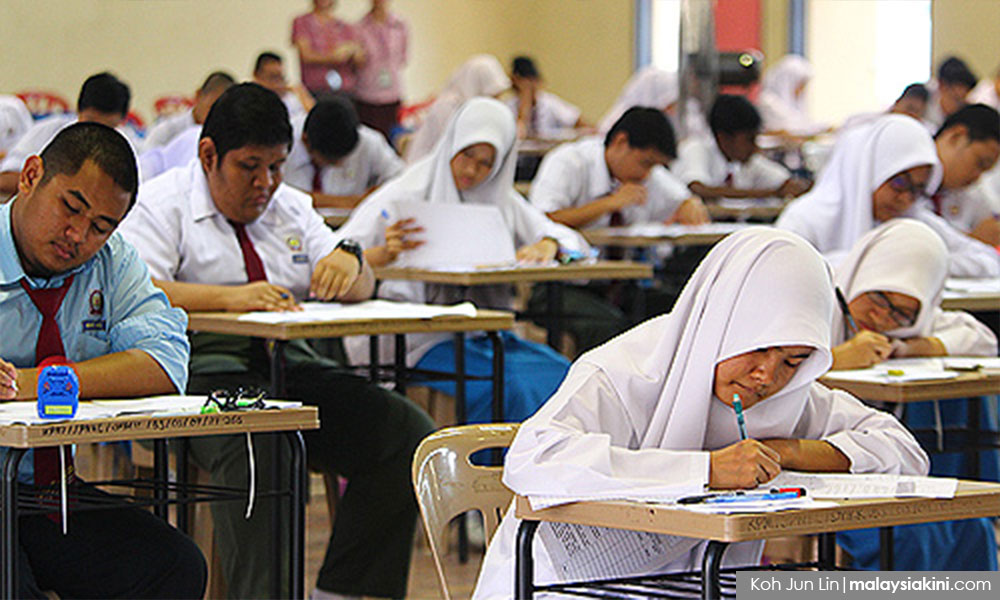
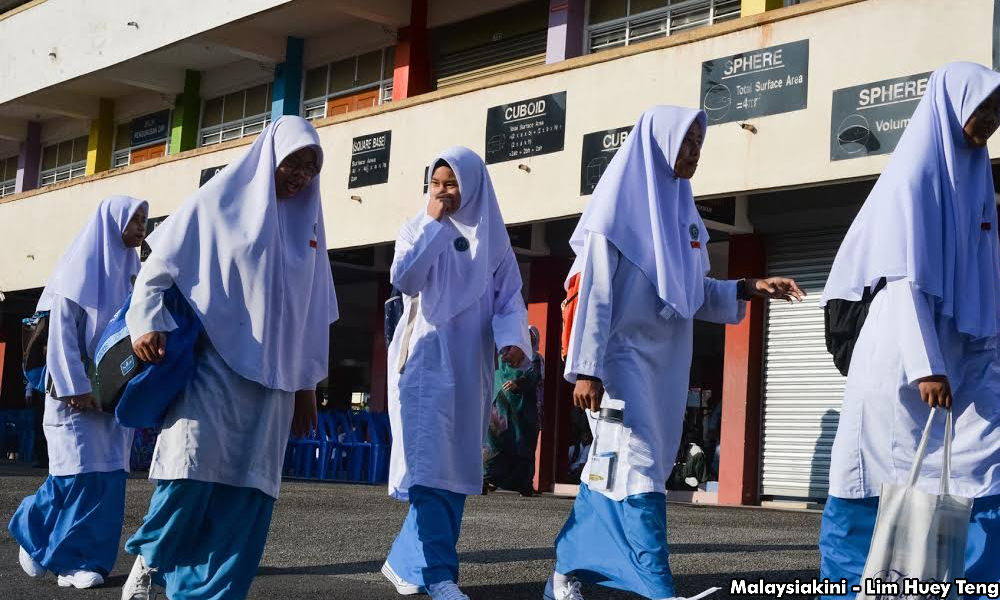


There are a very obvious solutions to improve our education system: 1. Change the Education Minister. Put somebody who who has imagination and creativity on how to reform our education system. 2. Change the medium of instruction to English and focus on mathematics, science, IT, languages (English, Malay and others), history, geography and other useful subject. Less focus on religious and religious based studies which should be take up as extracurricular activities. 3. Completely change the criteria for recruitment of teachers that should be based on their proficiency in English, math and science and such subjects. Existing teachers should be retrained well before they start teaching again. Qualified teachers should also be paid well to motivate them to improve themselves. 4. Remove all racial and religious mindsets and impediments from our education system. Bring back the merit based system we use to have before the 1990's.
By the time 2030 comes everything will be wiped out. Al will take over and we become like robots ?
Dismantle our broken and bias education system and policies which were designed and tailored to suit one community, and embark on a system for all Malaysian base on meritocracy.
Are you sure you want to delete this comment?
This action cannot be undone.