


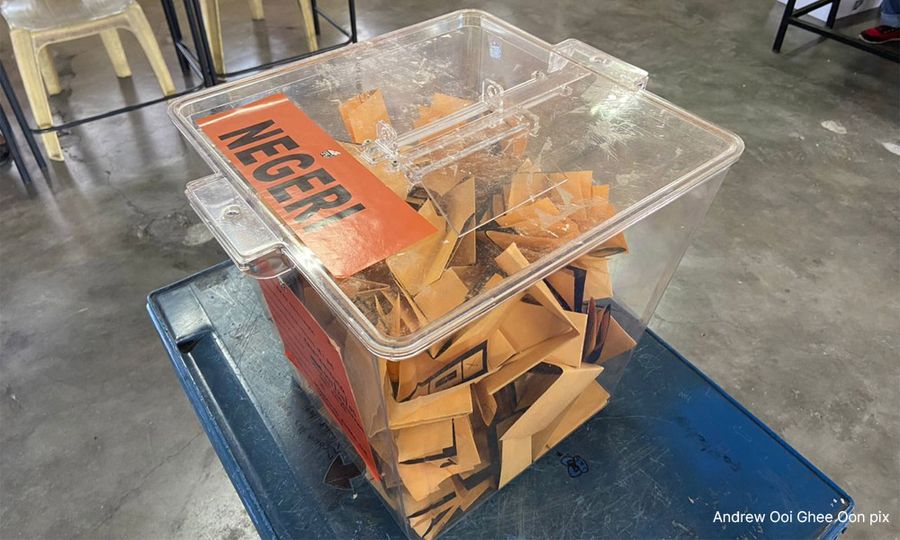

COMMENT | Vote to be seen: Why abstaining gives others the power
COMMENT | Conventionally, the reason to vote is to influence the outcome of an election. Hence, turnout is naturally higher in most marginal constituencies than in party strongholds.
But there is a danger in this argument, particularly now that we are reverting to two-coalition competition, albeit a lopsided one, with the BN-Perikatan Nasional pact.
The danger is this: if voting patterns in the 15th general election persist, with the exception of BN and PN votes converging, there may be little reason to vote in most peninsula constituencies in GE16.
I leave out Borneo constituencies from this analysis because electoral dynamics there are more nuanced and cannot be meaningfully lumped together with those in the peninsula.
In GE15, PN won 71 peninsula seats, and BN won 23. Together, they could potentially have wrested another 28 seats from Pakatan Harapan had their votes converged. That would give BN-PN a potential 122 seats that could effectively be considered won even before nomination day. Only 43 seats would be worth going out to vote for.
The actual number of marginal seats can, of course, be refined by...
COMMENT | Conventionally, the reason to vote is to influence the outcome of an election. Hence, turnout is naturally higher in most marginal constituencies than in party strongholds.
But there is a danger in this argument, particularly now that we are reverting to two-coalition competition, albeit a lopsided one, with the BN-Perikatan Nasional pact.
The danger is this: if voting patterns in the 15th general election persist, with the exception of BN and PN votes converging, there may be little reason to vote in most peninsula constituencies in GE16.
I leave out Borneo constituencies from this analysis because electoral dynamics there are more nuanced and cannot be meaningfully lumped together with those in the peninsula.
In GE15, PN won 71 peninsula seats, and BN won 23. Together, they could potentially have wrested another 28 seats from Pakatan Harapan had their votes converged. That would give BN-PN a potential 122 seats that could effectively be considered won even before nomination day. Only 43 seats would be worth going out to vote for.
The actual number of marginal seats can, of course, be refined by applying additional assumptions.

If we include constituencies where BN-PN's lead over Harapan was less than 10 percent, another 10 seats are added. Conversely, if we exclude Harapan strongholds where it led BN-PN by 20 percent or more, 25 seats are removed. I use a wider margin to define Harapan's strongholds (20 percent) than BN-PN's (10 percent) to account for the expected lower turnout among Harapan supporters.
After both adjustments, the number of contestable seats drops by 15, leaving just 28 marginal seats: two held by Amanah, 10 by DAP, and 16 by PKR.
We would face a similar problem if Harapan and BN could transfer their votes to each other, potentially turning most seats in Selangor, Penang, and Negeri Sembilan into their respective strongholds, as seen in the 2023 state elections.
Electoral pacts may discourage voting
Cartel-like electoral pacts can create many more strongholds and discourage people from voting. This is likely what will happen in Malacca. Unless we, as a society, seek solutions, the same problem will haunt us in GE16.
One possible solution is to introduce Closed List Proportional Representation (CLPR) seats alongside the existing First-Past-The-Post (FPTP) seats.
See my proposal for Penang and Selangor here, and Bersama's manifesto on how this could be pursued through appointed seats at the state level here.
However, before we get a hybrid electoral system with party-list seats, we must first ask ourselves: what benefit does voting bring if our votes do not change the outcome?
Be seen by politicians and govt
For me, the fundamental reason to vote is to be seen.
Whether you vote or not, the positions will be filled or retained after polling day. In Malacca, for instance, there will be 28 state assemblypersons, one chief minister, 10 exco members, and 96 councillors.
The difference is whether you get to be seen and considered by politicians and the government in their subsequent decision-making.
If you are invisible, like thin air or glass, the party or candidate you support carries less weight, whether they win or lose.
If your supported party wins, a bigger share of the vote gives it greater legitimacy to introduce the laws, policies, or changes you want.
When turnout is high, and majority is big, the winner simply has greater legitimacy. In the cases of Hungary, Serbia and the American midterm, the incumbent had to accept defeat. This is pointed out by New York Times’ Katrin Bennhold in her article “Why Winning Big Matters”.
When turnout is high, and the winning majority is large, the victor enjoys greater legitimacy. In Hungary, Serbia, and the US midterms, for instance, incumbents had to accept defeat. This point was highlighted by New York Times columnist Katrin Bennhold in her article, "Why Winning Big Matters".

If your supported party loses, a bigger vote share reminds the winner that it still faces substantial opposition and cannot bulldoze through laws and policies without considering dissenting voices.
In Malacca, if BN-PN wins 24 of the 28 seats, as many predictions suggest, it would command an 86 percent majority. However, with seven appointed seats expected to be filled by PAS, MCA, and others, the new state government would have 31 of 35 seats, or an 89 percent majority.
Now, if BN-PN also secures a two-thirds majority of the popular vote, it could claim a strong mandate to push through almost any laws and policies. Those who do not vote would have little basis to argue that they did not give BN-PN that mandate.
When you abstain, you effectively outsource your decision-making power to those who turn up to vote.
If you genuinely cannot find a party or candidate to support, you can still make yourself seen by spoiling your ballot. However, you should clearly write your grievances on it so that counting agents notice and can convey the message to the parties.
Vote for ideas
Few people vote based on manifestos. Those promises are to inform campaign messaging and give voters a basis for demanding post-election accountability.
But you can also turn manifesto ideas into your weapon.

You can make your choice based on a particular policy idea, regardless of the election outcome. It could be something like a youth quota for government contracts or party-list seats. However, since manifestos contain many ideas, you should publicise your choice on social media if you want it to be noticed. Tell people that you voted for a particular election promise.
If an idea gains popularity, other parties that did not receive your vote may eventually come around to including it in their next manifesto.
When others abstain, they pass their power to you
If your neighbours or colleagues tell you they will not vote, they are effectively outsourcing their power to those who do, which may include you. The more people abstain, the greater the influence of every ballot cast.
So, go against the tide. You never know: you might change the outcome precisely because nobody expects it.
Consider the numbers. In the last Malacca state election in 2021, BN won 75 percent of the seats with just 38.39 percent of the votes, helped by a low turnout of 65.85 percent.
Of the 28 seats, 13 were won with margins of fewer than 1,000 votes. BN won 10 of these seats and PN the remaining three. Had enough abstaining voters turned out to support the first runner-up, the seat distribution could have been Harapan eight, PN three and BN two.
So, if people around you choose to abstain and become politically invisible, they pass their power to you and everyone else who votes. Take that gift and vote to be seen.
Many will tell us that the Malacca election and GE16 are foregone conclusions. They are not, at least not when it comes to one thing only you can decide: whether you choose to be seen or remain invisible.
WONG CHIN HUAT is a political scientist at Sunway University and a member of Project Stability and Accountability for Malaysia (Projek Sama).
The views expressed here are those of the author/contributor and do not necessarily represent the views of Malaysiakini.



Report this comment
Are you sure you want to delete this comment?
This action cannot be undone.