




Cheap labour cheapskates - thats us
It need not have come to this - another high-profile crackdown on illegal migrant workers which is bound to draw the ire of the neighbouring countries from where we source most of our cheap labour.
It need not have come to this - another high-profile crackdown on illegal migrant workers which is bound to draw the ire of the neighbouring countries from where we source most of our cheap labour.
The government has decided - after two embarrassing flip-flops - that there would not be another extension to the six-month long amnesty .
 But as always, we have failed to ask ourselves this very important question: why are there so many illegal migrant workers - according to some estimates, close to a million - in our midst?
Porous borders are one reason. And much has been said about the lack of personnel in our 680-member immigration department to police our borders. But if we can't stop the supply, surely we can stop the demand?
Over the years, we have turned a blind eye to employers who hired illegal workers. Records indicate that only seven have so far been charged, with none since fined or jailed.
Indeed, the government should be commended for - at long last! - amending the law so that the book can be thrown at errant employers. Still, there are loopholes.
To get a court hearing, illegal workers must remain in the country to act as witnesses although court cases can last anything from six months to four years.
Some witnesses, however, are not issued visas to enable them to stay on and for those who do get them, they are not allowed to work. How are they going to feed themselves for months, if not years, without any source of income? Go figure.
Money-making machine
There's another reason for the high number illegal workers in the country. For one thing, many of them entered the country legally. Here's how it works.
Before employers can hire a foreign worker, they must first obtain an approval from the Home Ministry. This approval - known as 'demand' in the labour recruiting business - has turned out to be a nifty money-making machine for the well-connected.
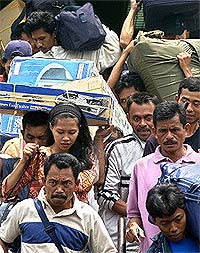 Some set up bogus companies and work with crooked officials to get the 'licence' to import labour. This closed industry was so lucrative that even a former deputy minister was known to be involved once.
'Demands' are sold to labour recruiting agents - 50 'demands' (for 50 workers) can fetch an easy RM100,000. It's no exaggeration to say that 'demands' are a currency unto their own with hundreds of thousands being traded over the years.
Labour recruiting agents use these 'demands' to legally bring in workers who are required to foot the agents' outlays on top of hefty fees.
However, according to the law, foreign workers can only work for the employer stipulated in their work permit - which in this case does not exist as they are bogus. Thus, these workers are deemed illegal despite having found work elsewhere after their arrival.
'Go soft' approach
Apparently our 'go soft' approach on illegal workers applies to errant employers as well. Take, for example, the case of 90 illegal workers at a construction site in Damansara Damai, a suburb near Sungai Buloh, northwest of Kuala Lumpur.
Their story is not new - illegal workers cheated of their hard-earned wages. There have also been previous cases of employers sneakily calling in the police to round up their illegal workers come pay day. Employers get off scot-free and save a bundle while the workers are deported.
This time, however, the Damansara Damai illegals, protected by the amnesty, are staying put until they get their money. The are going after the developer of Damansara Damai, MK Land Berhad, whose boss is one of the country's richest men, Mustapha Kamal Abu Bakar.
 Under the law, those found employing illegal workers can be slapped with a maximum fine of RM10,000 for each worker employed or sentenced to a minimum of six months' jail and whipping.
But Mustapha need not worry. The workers were hired by a sub-contractor who in the eyes of the law is fully responsible for the misdeed. This despite the fact that MK Land might have known of the illegal status of the workers. Put simply, not only can the main contractor outsource the work, it can also outsource the risk too.
With Malaysia being flogged by the media in Jakarta, Human Resources Minister Fong Chan Onn was quick to 'end' the Damansara Damai controversy.
The minister said he was informed by Sri Mega Jaya - the sub-contractor concerned - that the workers' salaries had been given to an intermediary who had absconded with the money. But there's more - this 'sub-sub contractor' was himself an illegal migrant worker!
But why did Fong let Sri Mega Jaya off the hook so easily? After all, Mega Jaya should have been charged for hiring illegal workers.
Who're the traitors?
Indeed, we would not have to carry out another highly publicised crackdown had the government listened to those who have campaigned for a better deal for the migrant workers.
 For over a decade, they have called for action be taken against errant employers. The government, too, had been told that corruption in its bureaucracy has spawned a great number of illegals, and that key government officials were involved in the scam.
But these activists have been dismissed as traitors while errant employers who mistreat migrant workers and tarnish the name of the country are vehemently defended.
Ironical? Tell that to the migrant worker who has five mouths to feed and hasn't been paid for a year.


