




Thais prevail where we failed
Newsweek called him the 'new Mahathir'. He has a penchant for big-ticket projects. His economic prescription is simple - spend your way out of trouble. Nothing new in that, except in Thailand they called it Thaksinomics.
He delivers his own brand of populism - a healthcare scheme where Thais pay Bt30, about RM3, per hospital visit. Throw in a Bt1 million handout for every village and easy credit for just about everybody, you have a sure election winner. And like Mahathir who had ruled Malaysia with an iron fist, he too brooked no dissent.
But that's where the similarities end.
Newsweek called him the 'new Mahathir'. He has a penchant for big-ticket projects. His economic prescription is simple - spend your way out of trouble. Nothing new in that, except in Thailand they called it Thaksinomics.
He delivers his own brand of populism - a healthcare scheme where Thais pay Bt30, about RM3, per hospital visit. Throw in a Bt1 million handout for every village and easy credit for just about everybody, you have a sure election winner. And like Mahathir who had ruled Malaysia with an iron fist, he too brooked no dissent.
But that's where the similarities end.
Malaysia's ex-premier Dr Mahathir Mohamad was a 22-year veteran in crushing nay-sayers. Thailand's Thaksin Shinawatra - who has been in power for four years - is, however, still very much an apprentice.
But like his 'mentor', he is a man in a hurry. And for men in a hurry, 'press freedom' does not figure in their vocabulary.
Thailand's broadcast media, thanks to years of military dictatorship, is mostly government controlled. But there was one pesky independent TV station, iTV. Thaksin, through a business crony, quickly took care of that by buying it over while campaigning for power.
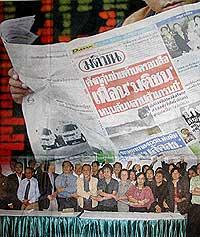 Harder to control, however, is the print media, which has a long history of protecting its independence.
So when another Thaksin crony, copywriter turned entertainment tycoon Paiboon Damrongchaitham, attempted the takeover of top newspaper group Matichon - the publisher of two influential Thai language newspapers, Matichon Daily and Khao Sod - two weeks ago, everyone was up in arms.
Paiboon had quietly bought up 32 percent of the group's shares before announcing that he wanted a controlling 75 percent stake.
Thaksin's hidden assets
Thaksin has crossed swords with Matichon before. He was particularly irked by its journalists who exposed his clumsy attempt to hide his wealth when declaring his assets while running for office four years ago.
Matichon's senior editor Prasong Lertratanawisute and his team of hard-boiled journalists found Thaksin had diverted shares worth RM200 million to a gaggle of unlikely proxies - his maid, driver, gardener, security guard and friends, including, yes, a dead one.
As a result, Thaksin, a telecommunications tycoon and one of Thailand's richest man, was hauled to court on charges of making false statements in his assets declaration forms.
 Thaksin (
photo, right
) claimed that he had no intention of concealing his assets, which only represent a fraction of his wealth. He blamed his wife - believed to be the family's real power broker - for making the arrangements.
Thaksin (
photo, right
) claimed that he had no intention of concealing his assets, which only represent a fraction of his wealth. He blamed his wife - believed to be the family's real power broker - for making the arrangements.
And like Mahathir, he, too, cried in public, tearfully pleading to the court to allow him to serve as PM. Enough judges were moved. They voted 8-7 to acquit him.
So it is now payback time for Thaksin.
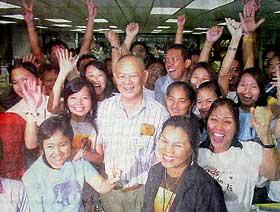 However, the Matichon takeover plan by 'close friend' Paiboon began to unravel days after his bid. He didn't count on the fighting spirit of the newspaper group's founder, 61-year-old Khanchai Boonpan (
photo, centre
), who command about one-quarter of the company's shares.
However, the Matichon takeover plan by 'close friend' Paiboon began to unravel days after his bid. He didn't count on the fighting spirit of the newspaper group's founder, 61-year-old Khanchai Boonpan (
photo, centre
), who command about one-quarter of the company's shares.
Khanchai, a journalist who launched Matichon during the democracy movement against the army generals in the 70s, was a reclusive yet well-respected man.
The hostile takeover bid sparked a rare public outrage.
A consumer group's called for a boycott of music CDs sold by Paiboon's main business vehicle, GMM Grammy company. It even planned to hold protests at concerts by Grammy's pop artists, targeting their young fans. A student group, formed to oppose the takeover, named themselves - tongue-in-cheek - the Target Group.
Even the bank which gave the loan to Grammy for the takeover bid came under intense criticism.
Spooked by the protests, Grammy eventually sold 12 percent of its shares to the Matichon founder, who had to borrow about RM100 million to top up his stake to remain the biggest shareholder.
MCA's Nanyang takeover
Thai journalists have a gallant record of staring down the men and women in uniforms. Indeed, decades of revolving-door military dictatorships has failed to intimidate them.
But battling the men and women in business suits proved to be more difficult. Still, they didn't take it lying down.
Now compare that to MCA's takeover of Nanyang Press Holdings four years ago.
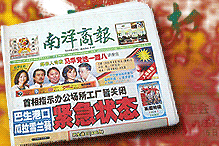 The takeover of Nanyang - the publisher of two key Chinese-language newspapers,
Nanyang Siang Pau
and
China Press
- was part of an elaborate plan by Mahathir to strike back at the fledgling 'reformasi' movement.
The takeover of Nanyang - the publisher of two key Chinese-language newspapers,
Nanyang Siang Pau
and
China Press
- was part of an elaborate plan by Mahathir to strike back at the fledgling 'reformasi' movement.
It came hot in the heels of the ruling coalition's shocking and humiliating defeat in the 2000 Lunas by-election.
Mahathir's fightback was well-engineered - 10 reformasi leaders were jailed, public rallies banned, student activists cowed into submission. These measures, plus many others, have successfully stopped reformasi dead in its tracks.
And like the takeover of Matichon, MCA's bid for Nanyang drew a lot of flak - both from the journalistic fraternity and the Chinese community. Even the political party itself was split down the middle when it voted on the issue at an emergency general meeting.
However, we failed to stop the MCA takeover. Why?
There were many reasons but one stood out. Clearly the missing ingredient in that fight - and perhaps the key one - is that the Nanyang case was not a hostile takeover. Owner Quek Leng Chan, despite being a reluctant seller of his Nanyang stake, did not fight the bid.
After all, Quek - who ranks 10 notches higher than Thaksin in Forbes ' latest list of Southeast Asian billionaires - had other business interests to protect. Needless to say, he owed favours to Mahathir when building his vast business empire and could hardly snub the then PM's request for him to do 'national service'.
Khanchai, on the other hand, is a journalist at heart. He understands well the importance of press freedom to his company and to his country. Which is why he was willing to make the necessary sacrifice - borrowing heavily from the banks to keep Thaksin at bay - when called upon to do 'national service', Thai-style.
Mahathir and Thaksin may share the same contempt for press freedom, but the Thais can proudly claim that at least one of their own has refused to be either Mahathirised or Thaksinified.
And against strongmen like Mahathir and Thaksin, that is no mean feat indeed.


