



LETTER | Sakyamuni monastery blockade: Firm using procedure talk to evade real issue
LETTER | This report by Malaysiakini puts both sides' public statements on the table.
Associated Pan Malaysia Cement Sdn Bhd’s (APMC - a YTL Cement subsidiary) logic precisely confirms your earlier judgment: this is not a question of money, but a question of "who gets to decide”.
APMC's public reasoning - it sounds very "procedurally just". What the company told Malaysiakini was:
The blockade was not to drive out the monks, but to stop unapproved building materials and heavy machinery from entering and to prevent the temple from continuing "illegal expansion”.
The blockade did not completely cut off access, because "there are still two pedestrian walkways available”.
They are the "landowner”, the court has confirmed their rights, so "the court's judgment must be respected”.
They "do not want to worsen the situation”, they just want to "maintain the status quo”.
The funny part of this rhetoric is this: it packages a survival crisis for a religious site as "a property owner's compliance management of illegal construction”.
It sounds like enforcing building regulations, rather than besieging a century-old Buddhist temple.
READ MORE: Tambun monastery urges probe over blockade, cement manufacturer defends action
But there are several key issues as follows:
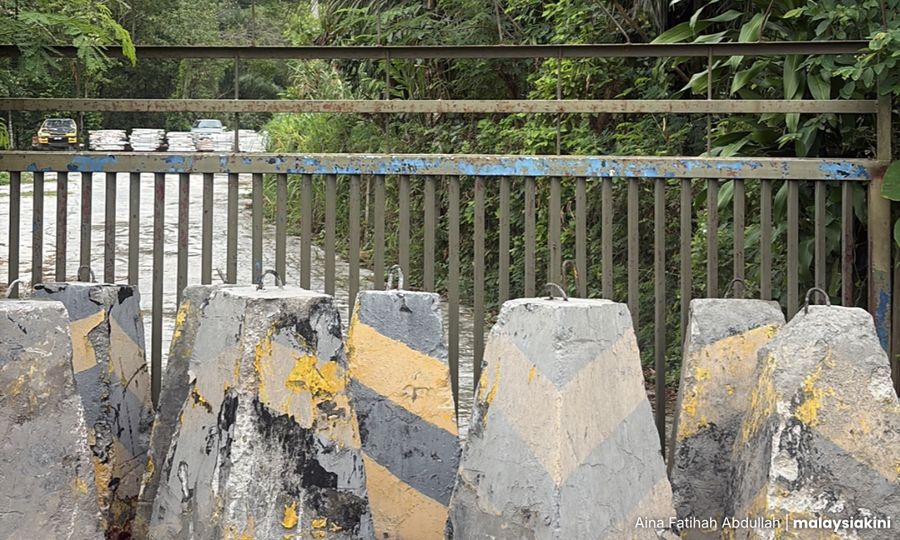
First, "two pedestrian walkways" and "the main entrance sealed with boulders and iron bars" are two different things.
The report clearly states: the main entrance has been blocked by boulders since June 23, iron bars were welded on Sept 29, and a guard post was added on Oct 13.
Being able to walk on pedestrian paths does not mean ambulances, fire engines, construction vehicles, and devotees' vehicles can pass.
READ MORE: 'Not just a monastery', says head monk of Tambun spiritual site facing demolition
APMC used the "there are still ways to walk" remark to evade the core fact that "the main passage has been physically blocked”.
Distraction from main issue
Second, the reason of "stopping illegal expansion" is a distraction. The engineering geologist hired by the temple concluded that the cave is safe and suitable for continued residence.
APMC makes an issue of "illegal building materials”, but who gets to judge what is "illegal"?
When the court has not yet made a final ruling, the temple has already filed an appeal, and the stay of execution application has not yet been heard, APMC is enforcing the law on its own as "landowner”.
This itself is using a fait accompli (accomplished fact) to pressure the judiciary.
Third, the sentence "the court's judgment must be respected" is something APMC itself has not done.
The temple side clearly points out: the stay of execution application was originally scheduled for hearing on Sept 9, but it was cancelled, and no new date has been set.
While the stay application remains unheard, APMC continues to reinforce the blockade, add guard posts, and fly drones at low altitude - this is not "respecting the court”, this is "finishing the job before the court speaks”.
What this represents
It was said earlier that "the point is not money, but a religiously exclusionary sense of mission”, and this report provides public-level confirmation:
APMC's defence completely avoids the question of "why escalate precisely during Vassa (a three-month annual rains retreat observed by Theravada Buddhist monastics)”.
It does not discuss timing, the sensitive religious period, or the history of the century-old temple.
It only talks about "property rights”, "compliance”, and "court judgments”.It describes the temple as the side "expanding without approval" and itself as the side "maintaining the status quo”. But the one actually changing the status quo is itself - placing boulders in June, welding iron bars in September, building a guard post in October.
Every step is an escalation, and every step says "this is my land”.It uses the identity of "landowner" to upgrade itself from "tenant" to "owner”.
But the land ownership belongs to the Perak state government, and what APMC holds is a quarry lease. The "pemilik tanah" (landowner) it speaks of is, in legal terms, a concept that needs to be strictly limited.
The issue at hand
It exposes APMC's public logic: using the language of property rights to conceal the substance of religious exclusion; using compliance procedures to package the creation of a fait accompli.
And the temple side's seven demands - investigate the legality of the blockade, protect the monks' safety and freedom, investigate the drones, safeguard Vassa practice, respect pending judicial proceedings, promote dialogue, and comply with the Ipoh 2035 Local Plan - each one pulls the issue back into the public sphere, rather than letting it remain in the private domain of a "property rights dispute”.
Time will prove: when "court judgments" are used to justify a siege during Vassa, and when "landowner" is used to conceal a tenant's overreach, what is recorded in the ledger of karma is not legal terminology, but those monks blocked outside the gate by iron bars, and those nights when quiet practice is impossible amid the low hum of drones.
YAP SEONG YEE is a devotee and volunteer at the Sakyamuni Caves Monastery.
The views expressed here are those of the author/contributor and do not necessarily represent the views of Malaysiakini.


Report this comment
Are you sure you want to delete this comment?
This action cannot be undone.