




BN must learn fast to stay relevant
Pakatan Rakyat, 2 and Barisan Nasional, 1 - that was the score chart from yesterday’s simultaneous by-elections held in Bukit Selambau (Kedah), Bukit Gantang (Perak) and Batang Ai (Sarawak).
Pakatan Rakyat, 2 and Barisan Nasional, 1 - that was the score chart from yesterday’s simultaneous by-elections held in Bukit Selambau (Kedah), Bukit Gantang (Perak) and Batang Ai (Sarawak).
It was a score board indicating perhaps the future direction of Malaysian politics.
 Since March 2008 general election, BN has lost four successive by-elections in the peninsula. Permatang Pauh and Kuala Terengganu parliamentary seats were the earlier by-elections.
BN’s victory in Batang Ai was expected given that it was a underdeveloped constituency in which the electorates do not have much access to basic facilities, amenities and information.
 "It shows that BN can now win only with money politics and promises of development in remote rural areas where people were more occupied with the daily struggle to meet their needs," said Anil Netto, a blogger and political analyst from reformist group Aliran.
He said Pakatan’s victories in both “bukits” showed that Malaysian voters in general were casting their ballots based on issues, personalities, politics and virtues, and not along communal lines.
He referred to Pakatan’s substantial gains across all communities in Bukit Selambau state and Bukit Gantang parliamentary seats to substantiate his claims.
BN and Umno seem to still have the edge among Malays in rural areas and the older generation, a discouraging sign for the future of the ruling party which has dominated Malaysian politics since Merdeka.
The more informed and young voters among all races are rooting for Pakatan.
The by-elections also revealed that BN has lost vast grounds among non-Malay electorates, which has raised serious questions on the relevance of the coalition’s non-Malay-based component parties such as MCA, MIC, Gerakan and PPP.
BN lost non-Malay votes in both seats
 "It’s increasingly becoming Pakatan versus Umno, no longer BN. The other component parties need to rethink their future and political relevance now," Anil said.
BN has lost the non-Malay votes in both seats where MCA, MIC and Gerakan were considered to have strong presence.
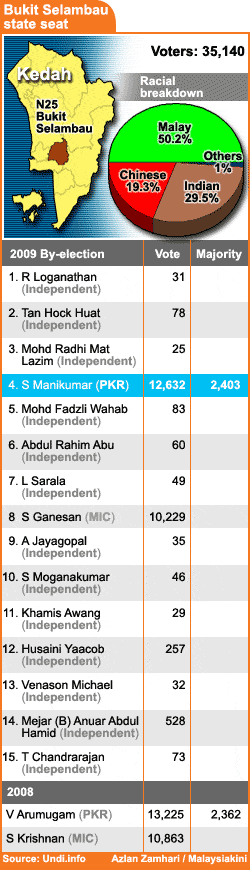
PKR’s Manikumar defeated nearest challenger S Ganesan from MIC by a 2,403-vote margin. He polled 12,632 votes against Ganesan’s 10,229.
In the last general election, independent candidate V Arumugam won the seat by 2,362-vote majority.
Manikumar’s increased majority win of 41 votes was significant given that he was entangled in a contest that boasts a record 15 candidates, including an unprecedented 13 independent candidates.
The independents collectively garnered 1,326 votes. All of them lost their RM5,000 deposit.
Voting data also disclosed that Manikumar had won the majority of votes in predominantly Indian areas.
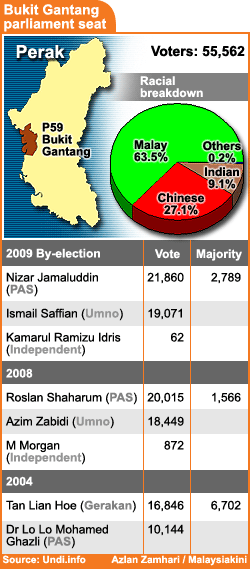
In Bukit Gantang, the non-Malays especially Chinese and younger Malay voters backed PAS candidate Mohd Nizar Jamaluddin, who won by a majority of 2,789 votes, polling 21,860 over his Umno rival Ismail Saffian (19,071) and independent Kamarul Ramizu Idris (62).
Nizar's victory a slap in the face for Umno
In 2008 elections, PAS’ Roslan Shaharum polled 20,015 votes to score a 1,566 majority win over BN’s Azim Zabidi, who polled 18,449 and Independent M Morgan bagged 872.
Nizar’s victory was the biggest slap in the face for the Umno new leadership. It was new premier Najib Abdul Razak who engineered the infamous coup d’etat in Perak which saw Nizar being ousted as the menteri besar.
 "Bukit Gantang has clearly sent the message that the people were unhappy with the coup and are demanding a fresh state election to install a legitimate state government in Ipoh," said Anil.
The change of leadership in Umno and appearance of former Umno president Dr Mahathir Mohamad did little to boost the party’s chances.
Dr Siva Murugan Pandian, an analyst from Universiti Sains Malaysia, said Umno and BN must overhaul from top to bottom, find out the changes yearned by the people and strategise correctly on the changes that the coalition wanted and needed to bring.
"The BN federal government has to carry out drastic changes and reforms in its governance and policies. Otherwise, BN would bite the dust in the next general election," he said.
He pointed out that BN had to realise that electorates, especially the younger ones and urban residents, were now matured and politically vibrant.
"They based their electoral judgment more and more on issues and political virtues, rather than sentiments and communal politics," said the academician, a view concurred by Anil.
Anil said the days where BN could win a seat simply by playing racial and development cards were gone.
BN still dominant in East M'sia
"Voters were now asking more questions than before. They demand answers on all issues including on corrupt practices, good governance and democracy. Politicians are constantly being kept on their toes," he said.
 The coalition’s victory in Batang Ai nonetheless showed that the coalition remains a dominant political force in Sabah and Sarawak.
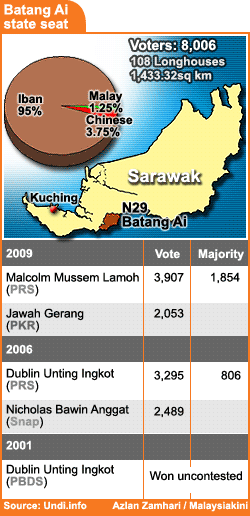
BN's Malcolm Mussem Lamoh (3,907 votes) has beaten PKR's Jawah Gerang (2,053). The majority is 1,854, an increase from BN’s majority from the 806-vote margin at the 2006 state election.
Anil said Pakatan must restrategise itself to win over voters in Sabah and Sarawak if it were serious to realise its ambition to helm Putrajaya in the next general election.
"Pakatan can’t rule Malaysia without becoming a potent force in both states," he said.
Newly-elected Umno deputy president Muhyiddin Yassin said that the “bukit” defeats indicated that BN needed time to convince the people that they should back the new Putrajaya leadership.
But the return of Mahathir into active Umno politics indicates that the BN federal government was lacking ideas on how to convince the public.
Otherwise, a government need not bring back an oldie, known to be a hardliner, to revitalise and rejuvenate its flagging fortune. One need not revive Mahathirism to survive and stay relevant.
Umno and BN can't afford to be always in a state of denial. People demand drastic changes in thinking, ideas, policies and governance in accordance with rapidly developing global changes.
Perhaps the writing is on the wall that the Najib-Mathahir combination to rule the roost in Putrajaya is the beginning of the demise of the Umno-led BN government.
History has shown that a dynasty will not last forever. After all, whether it’s good, bad or ugly, all things must come to an end one day.


Are you sure you want to delete this comment?
This action cannot be undone.