




Shadow cabinet - a fulcrum for a two-party system
Last week, Opposition Leader Anwar Ibrahim announced that the Pakatan Rakyat coalition would form a shadow cabinet in Parliament. The move is one year overdue, but it is better late than never.
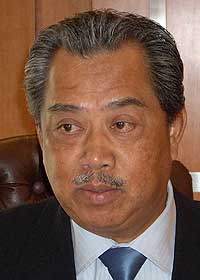
The immediate reaction of the newly installed Deputy Prime Minister Muhyiddin Yassin was that this was a “power grab”, and “designed to topple the government”.
The DPM’s knee jerk reaction is a left-over of the old political narrative in our country. Its implied ramification is that the opposition parties and their shadow cabinet are like terrorist entities trying to topple the legitimate government of the day.
Last week, Opposition Leader Anwar Ibrahim announced that the Pakatan Rakyat coalition would form a shadow cabinet in Parliament. The move is one year overdue, but it is better late than never.
The immediate reaction of the newly installed Deputy Prime Minister Muhyiddin Yassin was that this was a “power grab”, and “designed to topple the government”.
 The DPM’s knee jerk reaction is a left-over of the old political narrative in our country.
Its implied ramification is that the opposition parties and their shadow cabinet are like terrorist entities trying to topple the legitimate government
of the day.
The DPM’s knee jerk reaction is a left-over of the old political narrative in our country.
Its implied ramification is that the opposition parties and their shadow cabinet are like terrorist entities trying to topple the legitimate government
of the day.
He again has subconsciously or deliberately equated the ruling BN coalition with the Malaysian federal government. This is the antiquated language that is on the way out in the evolving political reality of our nation.
The DPM has also laid bare to the world his ignorance of parliamentary practices. In many countries in the Commonwealth that practise the Westminster model of parliamentary democracy, it is a norm for the opposition party to form a shadow cabinet, partly to show their serious intent of forming the alternative government after the next general election.
Her Majesty's Loyal Opposition
Wikipedia has the following to say about the shadow cabinet:
“In British parliamentary practice, the Official Loyal Opposition Shadow Cabinet (usually known simply as 'The Shadow Cabinet') is a group of members from Her Majesty’s Loyal Opposition to srutinise their corresponding office holders in government, and develops alternative policies. Since 1997, the Conservative Party has been Her Majesty's Loyal Opposition, and its leadership therefore forms the current shadow cabinet.”
“Not every Conservative front bench spokesman is a member of the Shadow Cabinet, which is composed of the most senior spokesmen only (usually around 20).”
Therefore, the installation of a Pakatan Rakyat shadow cabinet in the Malaysian Parliament is a declaration of intent of the opposition parties to topple the BN government, and to form an alternative PR government.
The Pakatan Rakyat, just like their counterpart in the House of Commons in the UK, is His Majesty’s Loyal Opposition. To accuse the PR of toppling the government is the height of political sophistry.
In fact, this latest measure taken by Malaysia’s opposition coalition is an indication that they have more or less finally given up the wild idea of grabbing power by enticing defection from the BN MPs. It is a sign that they have finally decided to dig in deep in their parliamentary trenches to do honest work in the Dewan Rakyat in the next three or four years! They would be an irresponsible opposition indeed if they do not present their shadow cabinet.
Most ordinary Malaysian will give scant attention to this spat over the opposition shadow cabinet. That is because in the past fifty years, the idea of an opposition forming the next government has always been a vacuous dream. Opposition members of Parliament were elected to oppose the government, and nothing more.
Now that the opposition coalition is within striking distance of coming to power at the all-important federal level, the introduction of this shadow cabinet business is another positive step in our institution-building for our democratic progress.
Naturally, there is no law or precedent in Commonwealth parliamentary conventions to say that any shadow cabinet minister will automatically be appointed as a government minister upon the opposition electoral victory at the next poll. Nevertheless, the PR shadow cabinet line up would reveal very interesting development.
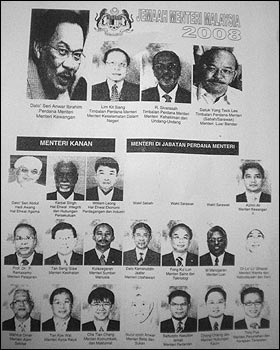 For instance, from the distribution of ministerial portfolios among the three component p
arties of the Pakatan Rakyat, we will know how they intend to share power in the alternative government.
For instance, from the distribution of ministerial portfolios among the three component p
arties of the Pakatan Rakyat, we will know how they intend to share power in the alternative government.
(Photo: A 'shadow cabinet' created for the kick of it online.)
Will any one party dominate all the important ministries like finance, home, education, foreign affairs, transport, agriculture, defense, trade and industry, energy, telecommunication, public works, and those that get huge budget allocation and has a lot of political largesse to dispense to the intere st groups and the rakyat?
Will they be dominated by one single party like the newly hatched BN cabinet, or will they reflect a more balanced sharing of power between the three PR components? How will the importance of Sabah and Sarawak be reflected, or will they be given token ministries like national unity or n ational integration? This is particularly vexing because there are so few PR MPs from those two eastern states!
Do they have the talent ?
The PR shadow cabinet line-up will also allow us to assess whether this opposition coalition has the necessary talent to govern a complex nation like Malaysia, now struggling with all the negative impacts of a global recession.
The shadow cabinet is often drawn from the opposition front bench members who are there because of their seniority or their position in their party hierarchy. I should imagine quite a chunk of the PR front bench members in the Dewan Rakyat are first term members. They would have trouble understanding the Budget documents, let alone how the public administration of a federal government works!
Even old timers w ho have been MPs for many terms may not make a good government minister. It is one thing to go around looking at blocked drains and getting arrested in public demonstrations. It is quite another matter trying to run a ministry and govern a country. It does not mean that a politician who can get votes can automatically be a good minister.
 One exception is Karpal Singh.
He is an expert at throwing tantrums in Parliament to get himself on the front page for four decades.
But I think he would make a good alternative minister of home affairs or law, if only he can temper his ego.
You know what I mean.
One exception is Karpal Singh.
He is an expert at throwing tantrums in Parliament to get himself on the front page for four decades.
But I think he would make a good alternative minister of home affairs or law, if only he can temper his ego.
You know what I mean.
Frankly, I cannot think of anyone from the PR crop of MP who can handle the environmen t portfolio. If they do take power, they will have to appoint somebody outside through the Senate backdoor.
The appearance for the first time on our Malaysian stage of an opposition shadow ca binet also points to another progressive dimension in the evolution of a healthy democratic culture.
A shadow cabinet minister is supposed to “mark” his corresponding minister on the government bench. Unlike an opposition back bencher, he cannot just criticise his BN counterpart for criticism’s sake.
The shadow cabinet minister has to understand thoroughly the purpose, jurisdiction and operation of his ministry. He must also be armed with an alternative policy for the ministry, a programmer that the opposition will implement if and when the opposition coalition comes to power.
 This will compel the opposition to come up with a complete blue-print for running the country if they win the next general election.
What will their policy in education, foreign affair, or finance be like?
How will they tax the people and spend that money?
This will compel the opposition to come up with a complete blue-print for running the country if they win the next general election.
What will their policy in education, foreign affair, or finance be like?
How will they tax the people and spend that money?
How will they reform the many declining institutions of state like the judiciary and the police? How do they intend to eradicate poverty in Sarawak and Sabah, irrespective of race? How would they improve human rights? How will they solve the many socio-economic problems confronted by the Indians?
In short, opposition politicians cannot survive on heart-stirring slogans and empty polemics alone. They will have to climb their steep learning curve of governing our country very quickly. The performance of the minister-in-waiting during parliamentary debate will then give the rakyat a chance to assess whether the opposition does indeed possess the talents needed for government.
The emergence of the shadow cabinet and their alternative policies will then allow voters and commentators to compare them with the cabinet minister ruling coalition. It provides them with a clear cut basis to make their electoral decision during the next poll.
At this stage in our nation’s history, the debut of an opposition shadow cabinet is a pre-condition for the nurturing of a healthy two coalition system of party politics.
Those who cannot understand this simple principle should go back to school.
SIM KWANG YANG was MP for Bandar Kuching in Sarawak from 1982 to 1995. He can be reached at kenyalang578@hotmail.com .


Are you sure you want to delete this comment?
This action cannot be undone.