




Chinese watch BN crab-walk with cold eyes
Two members of my Cheras neighbourhood committee in their late 30s or early 40s dropped by my house for a visit the other day. They had discovered the big advertisement in the Chinese news portal Fung Yin Times that I was a three-term MP once. So they invited me to their next gathering, for some food and chat.
Since my neighbourhood committee had set up their own security system, the frequent break-ins that used to terrorise the residents have disappeared. For that, we are more than ready to part with the RM50 per month. The social capital that they have accumulated through organising themselves has created a community spirit that never existed before.
One of my visitors was a new DAP member with Cliff Tan Kok Wai’s Cheras branch. He informed me that Cliff was going to move into our neighbourhood soon. The other was an independent voter, who obviously had no love for BN. He said he seldom read the Chinese newspapers, and relied on the Internet for news and opinions.
Two members of my Cheras neighbourhood committee in their late 30s or early 40s dropped by my house for a visit the other day. They had discovered the big advertisement in the Chinese news portal Fung Yin Times that I was a three-term MP once. So they invited me to their next gathering, for some food and chat.
Since my neighbourhood committee had set up their own security system, the frequent break-ins that used to terrorise the residents have disappeared. For that, we are more than ready to part with the RM50 per month. The social capital that they have accumulated through organising themselves has created a community spirit that never existed before.
One of my visitors was a new DAP member with Cliff Tan Kok Wai’s Cheras branch. He informed me that Cliff was going to move into our neighbourhood soon. The other was an independent voter, who obviously had no love for BN. He said he seldom read the Chinese newspapers, and relied on the Internet for news and opinions.
Our conversation turned from problems in our community to national politics. Not once did they mention the new PM’s new catch phrase “One Malaysia”.
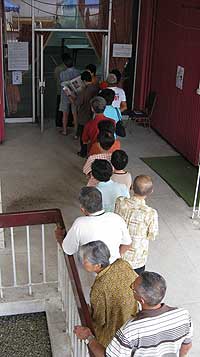 My neighbours are typical of the New Chinese that are emerging in Malaysia. They are self-reliant, both in their personal business and in community organisation. They are realistic, cynical, engaged, street savvy, and well-informed. They are the reason why the ground is shifting under the wobbly feet of Barisan Nasional in Peninsular Malaysia.
Even the semi-illiterate 64-year-old lady running my neighbourhood watering hole had departed from her Datuk father who helped found MCA in Johor in the early days. One evening, she sauntered over to my table and, without mentioning names, grumbled with some emotion how sinful it was to bomb a lady’s body into bits after murdering her. According to her religion, bad Karma awaits the real culprit!
As commentators, we are so engrossed with the grand narrative and the bird’s-eye view that sometimes we miss the small stories that contribute to the silent change in Malaysian politics. This is particularly true with the Chinese Malaysians, who seem adverse to discussing politics in public places.
No longer spooked by May 13
They are practitioners of the old Chinese proverb extolling the virtue of watching the crab with cold eyes to see how long the crab can “walk sideway”. “Walking sideway” in Mandarin also means acting unreasonably, like a bullying hooligan.
During these turbulent times, especially in Perak, the Chinese Malaysians are watching the BN crab intently.
Looking back, the expose of so many public scandals in the police, the judiciary, and the administration before the 2008 general election must have aroused the collective anger. The rising prices of daily commodities added fuel to the flame.
They were going to punish BN, hoping perhaps to reduce the BN majority in Parliament, as DAP had campaigned. They voted across racial and religious lines, and on March 8, 2008, to their great surprise, five states fell to the opposition coalition and the BN lost its two-third majority in Parliament.
To their delight also, such a great surge of opposition gains at the polls did not bring any racial riot. Since 1969 until 2008, that fear for the repeat of the May 13 incident had been the single-most powerful weapon in the hands of Umno in subduing unwilling support of the Chinese for BN candidates at the polls, election after election.
There was also no Islamic state even after they had voted overwhelmingly for a DAP that had formed coalition governments in many states with PAS. In fact, the new PAS menteri besar in Perak turned out to be much friendlier to the Chinese than any Umno menteri besar anywhere in Malaysia.
In one fell swoop, the Chinese voters liberated themselves from that irrational and unfounded fear for race riot and for PAS – hopefully forever!
Mainstream media’s manufactured truth
The unexpected results of the 2008 general election also showed that they no longer believe in the manufactured truths in the Chinese mainstream print and electronic media, which are all owned by BN parties directly or through ownership of their corporate cronies.
In the past, the BN election juggernaut was able to monopolise the public space for the national conversation. That monopoly has been broken by the growing popularity of the Internet.
 In his latest posting on
Malaysia Today
entitled
‘Sun Tze and the Art of War’
, Raja Petra Kamarudin (
left in photo
) wrote this about the power of the Internet:
In his latest posting on
Malaysia Today
entitled
‘Sun Tze and the Art of War’
, Raja Petra Kamarudin (
left in photo
) wrote this about the power of the Internet:
“Yes, in 1998, when we first started using the Internet to fight Barisan Nasional, there were only 280,000 Internet subscribers against eight million registered voters. Today, 10 years on, there are almost 16 million Internet subscribers against 12 million registered voters.
“Over the last 10 years, the number of registered voters increased only 50%. However, in that same period, the number of Internet subscribers increased 328.9% (according to the official statistics). Today, the Internet reaches 62.8% of the Malaysian population. Malaysia has more Internet subscribers than it has voters.
“Yes, that was our plan back in 2004 when we launched Malaysia Today. No, Malaysia Today is not a newspaper. And it is not in the same league as Malaysiakini and Malaysian Insider . Malaysia Today is a guerrilla outfit. We are cyber terrorists. Our job is to hit the government whenever and wherever we can. And if hit and run is what it takes, then hit and run is what it will have to be.”
In the Chinese net portals, in the Chinese section of Malaysiakini , in Merdeka Review , and now in the newly-launched Fung Yin Times , there exists an alternative no-holds-barred vibrant conversation feeding the new frenzy for change in the Chinese community.
There, reporters, journalists, and opinion writers exiled by the mainstream Chinese media have found a fertile garden to plant and grow their seeds of radical change in political worldview of the Chinese in Malaysia.
Community leaders given a black eye
Almost overnight, the traditional role and the legitimacy of the leaders of Chinese guilds and associations have been subverted irreversibly.
Ever since independence, these leaders from the guilds and associations have always acted like the Kapitans during colonial days, as the bridge between the Chinese community and the government. Naturally, they were mostly pro-BN. The mainstream Chinese media would also create the myth of their mythical power to represent the Chinese community as a whole. At one time, they were more influential in opinion making than the DAP!
The prestige of these self-appointed leaders of the Chinese community has declined sharply in recent decades, following the decline in membership of many of these associations. Their traditional activities and their inability to adapt to changing social reality have contributed to their loss of relevance.
In the five (or four) states where the Pakatan Rakyat coalition is in power, these leaders of guilds and associations actually find themselves of having to work with and sometimes kowtow to the opposition politicians. That must be a very educational experience for them.
With the alternative media, the words and deeds of these traditional Chinese leaders are now under the cyber knife, with merciless analysis and irreverent comments.
When Dr Kua Kia Soong was not re-engaged in his job as the New Era College principle, the way he was dismissed caused an outrage both in print and on the Internet.
 When that student punched the Dong Jiao Zong president on the nose, the image was the most dramatic symbol of the decline of the prestige and the legitimacy of the traditional Chinese leaders. An era that was started by Yap Ah Loi has ended.
I dare say that the Chinese voters in Malaysia have been emboldened. This can be seen in their continued support for the Pakatan coalition in four by-elections in the Peninsular in the past one year. They will probably do the same at the Penanti by-election.
This is uncharted water for the Chinese voters in Malaysia. They now find themselves in the powerful position of kingmakers, even in Umno-held Malay majority constituencies. They are no longer the small helpless minority community in a country where Umno preaches the doctrine of Ketuanan Melayu. Now they have the power to determine who is going to be the next prime minister of Malaysia.
I have no doubt this ethnic community known for their pragmatic skills at survival steeped in the Confucian teaching of the Middle Way will exercise their new power coolly, rationally, and pragmatically.
As I said, they watch the crab walk with cold eyes!
SIM KWANG YANG was MP for Bandar Kuching from 1982 to 1995. He can be reached at kenyalang578@hotmail.com.


Are you sure you want to delete this comment?
This action cannot be undone.