




Remembering the June 4 tragedy
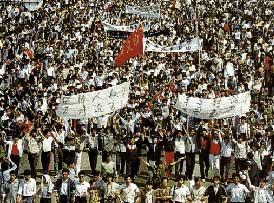
Today marks the 20th anniversary of that tragic event when thousands of university students and lecturers were massacred on Tiananmen Square in Beijing.
 I can still remember my shock and pain when learning of the news 20 years ago.
In China, as in any other country, the use of tanks and machine guns to mow down peaceful demonstrations demanding more democracy by unarmed citizens is a crime against humanity.
I also remember the many debates with my Chinese friends in Malaysia 20 years ago. They said what China needed was the kind of economic liberalisation that Deng Xiaoping was pushing, and not democracy demanded by the demonstrators.
People had to eat first, and people cannot eat democracy, they said. We agreed to disagree.
Today marks the 20th anniversary of that tragic event when thousands of university students and lecturers were massacred on Tiananmen Square in Beijing.
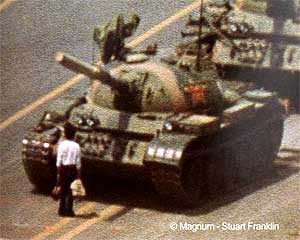 I can still remember my shock and pain when learning of the news 20 years ago.
In China, as in any other country, the use of tanks and machine guns to mow down peaceful demonstrations demanding more democracy by unarmed citizens is a crime against humanity.
I also remember the many debates with my Chinese friends in Malaysia 20 years ago. They said what China needed was the kind of economic liberalisation that Deng Xiaoping was pushing, and not democracy demanded by the demonstrators.
People had to eat first, and people cannot eat democracy, they said. We agreed to disagree.
That was the time shortly after the ‘Operasi Lalang' in Malaysia. The Malaysian Chinese voters were intimidated, fearful, and looked to China with pride as the rising power in the region.
Twenty years after the event, young Chinese in the People's Republic of China knows next to nothing about the Tiananmen Square massacre.
Despite their rapid progress in economic development, China remains a very oppressive closed and conservative society. The government has quite successfully erased the event from the collective memory of their nation.
I had followed the debate on the massacre quite closely, reading up as much as I could of the controversy in the global Chinese media at that time.
A June 4 tragedy
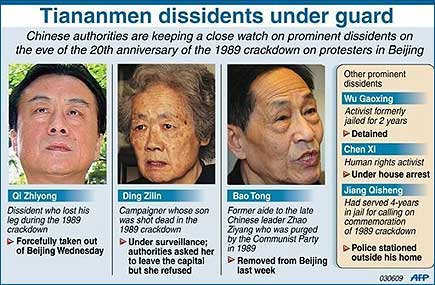
The event also marked the beginning of the end of the rising star of the Chinese Communist Party at the time, secretary-general Zhao Ziyang. He sympathised with the demonstrators.
When he went to Tiananmen to talk to the students, a youngish Wen Jia Bao was by his side. Unfortunately, the party was controlled by Deng operating from behind the scene.
Although Deng is generally credited with his epoch-making move to liberalise China's economy, he was a political conservative nevertheless. There are speculations today that Deng was the one who ordered the military crackdown on the demonstrators in Tiananmen Square on June 4, 1989.
Zhao was then put under house arrest until his death in 2005.
 In a
Reuters
story entitled 'China's Zhao decries June 4 'tragedy' from the grave' (May 15, 2009), it is revealed that Zhao's memoir of the event was going to be published in the book ‘Prisoner of the State' by Simon & Schuster around May this year ahead of the 20th anniversary of the June 4 tragedy.
In a
Reuters
story entitled 'China's Zhao decries June 4 'tragedy' from the grave' (May 15, 2009), it is revealed that Zhao's memoir of the event was going to be published in the book ‘Prisoner of the State' by Simon & Schuster around May this year ahead of the 20th anniversary of the June 4 tragedy.
The memoir consists of 30 hours tape made while Zhao was in house-detention and smuggled out of China by three separate confidants.
Reuters had obtained a copy of the manuscript and quoted Zhao as saying:
"I had said at the time that most people were only asking us to correct our flaws, not attempting to overthrow our political system.
"I told myself that no matter what, I refused to become the (party) general secretary who mobilised the military to crack down on students.
"In fact, it is the Western parliamentary democratic system that has demonstrated the most vitality.
"If we don't move toward this goal, it will be impossible to resolve the abnormal conditions in China's market economy."
A national blackout
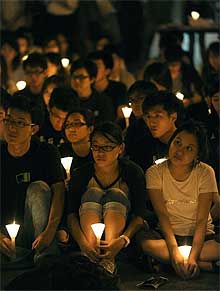 There will be a national blackout of any discussion of the event in China today.
But those protest leaders and participants who escaped overseas would make sure that the world does not forget the atrocity of twenty years ago.
One of them is the banned novelist Ma Jian.
In an article entitled ‘The Great Tiananmen Taboo' published by the Guardian UK Online on June 2, he revisited the tragedy and met some of the participants in a powerfully moving account. I have taken the liberty of reproducing some excerpts below:
"My mobile phone rang. I had arranged a meeting at the bookshop with Liu Hua, a Tiananmen survivor and son of a Beijing University professor. I glanced outside the window and knew at once that it was him. He was the only person in the crowd to have only one arm.
"We walked together down Changan Avenue. A cold wind was blowing and the snow on the pavements had been shoveled towards a line of holly trees. The ancient red walls of the Zhongnanhai compound were glimmering in the evening sun.
"We reached the Liubukou intersection. A few years ago, I'd stood here and taken photographs as part of my research for Beijing Coma. At that time, the gap between the eyewitness accounts I'd heard of the carnage that took place at this intersection in 1989 and the mundane reality before my eyes could not be closed without an effort of the imagination.
"Now, with Liu Hua right beside me, the present scene was instantly merged with the past. He had come on the dawn of June 4 with two young students.
 "It happened right here," he told me, "just by these white railings.
"A tank charged down Changan Avenue, and sprayed tear gas into the air. There was a big crowd of us. We were coughing and choking.
"We rushed on to the pavement, and I was squashed back against these railings. A girl dropped to her knees. I was grasping the railings with one hand to stop myself falling and with the other I offered her a handkerchief and told her to use it as a mask.
"Just as I was leaning over to hand it to her, another tank roared up and careered into us. Thirteen people were crushed to death but I only lost my arm. The tank commander knew exactly what he was doing."
He stared down at the patch of asphalt at his feet and then glanced nervously at the police vans parked on the other side of the road. It was rush hour; cars and taxis were streaming past us.
"What a terrifying experience, I said, gripping the white railings.
 "Yes, it was," he replied quite calmly.
"But I wasn't truly afraid until I saw Deng Xiaoping on television, telling the martial law troops: 'Foreigners say that we opened fire, and that I admit, but to claim that army tanks drove over unarmed citizens, that is a disgraceful slur.'
"My scalp tightened. I was a living witness to the truth. What if one day they came to get me? ... For two years I never dared go out at night, I never spoke about what happened. Policemen came to interrogate me almost every day, but none of us ever mentioned the tanks.
"Every anniversary on June 4, the police would come to my house with pillows and mattresses and sleep on my bedroom floor. Just to stop me speaking to foreign journalists!"
There you have it, a first-hand eyewitness account of the violence dished out to China's national soul by the People's Liberation Army in the People's Republic of China. The army is hardly the people's army, and China is still hardly the people's China, even and especially today.
SIM KWANG YANG was MP for Bandar Kuching between 1982 and 1995. He can be reached at kenyalang578@hotmail.com


Are you sure you want to delete this comment?
This action cannot be undone.