




PAS faces critical transition
As the nation turns its attention to the sound and fury of the PAS Muktamar this weekend, I suddenly thought of Nik Aziz Nik Mat, the spiritual leader of this Islamist party.
I sat beside him for four years in the Dewan Rakyat in the 1980s. He was the lone PAS MP, in a Parliament with a very small opposition presence, unlike today.
As the nation turns its attention to the sound and fury of the PAS muktamar this weekend, I suddenly thought of Nik Aziz Nik Mat, the spiritual leader of this Islamist party.
I sat beside him for four years in the Dewan Rakyat in the 1980s. He was the lone PAS MP, in a Parliament with a very small opposition presence, unlike today.
He wore his turban, his long white flowing robe, and his sandals. He was soft spoken, and always had a smile on his face. I found him courteous, mild, and a disarming man.
But when he stood up to make a speech, he commanded the full attention of the Umno stable, who obviously listened to every word of his without the usual rowdy interruption. He really had their respect.
 His successor for the Pengkalan Chepa parliamentary seat, Mohamed Amar Nik Abdullah
,
also sat next to me for four years, and we became good friends.
He drove a rickety old Mercedes that could not have cost more than RM30,000. He too was not a firebrand by any means. He taught me a little of that quaint Kelantanese version of the Malay language.
Much later on, I got to meet many more PAS luminaries as their number in the Dewan increased. Mohamad Sabu was gregarious and sociable. Abdul Hadi Awang walked as if on clouds. Dr Hatta Ramli was urbane and sophisticated. They were a motley collection of individual politicians.
You have to remember that during those long gone years, PAS was demonised as a monolithic extreme fanatical Islamist political party.
Non-Muslims lived in terror of PAS, because they would turn Malaysia into an Islamic state if they make the slightest gain at the polls. They would implement the hudud laws, and chop off people’s hands for a minor crime of stealing. Even the way the PAS people dressed became a source of mass alienation for non-Muslims.
At that time, PAS leaders were also seen to be aloof to the non-Muslim community, though they made several attempts to woo Chinese supporters, without much success.
'Easier to sleep with the devil you know'
Eventually, this one of the oldest, and possibly the best organised political parties in Malaysia was limited to the two poor east coast states of Terengganu and Kelantan.
The urban Malay, Chinese, and Indian voters seemed to have this nameless visceral fear for PAS.
Even during those brief years when DAP had an indirect liaison with PAS with Tengku Razaleigh Hamzah’s Semangat 46 as the intermediary, DAP would lose badly because, in the words of MCA, “A vote for DAP is a vote for PAS and the Islamic state.”
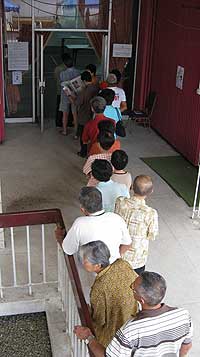 No matter how angry the non-Muslim voters were with the corruption, racial discrimination, and abuse of power of the Barisan Nasional, they would still vote for BN candidates in the end.
As some commentators in the Chinese press put it then: “It is easier to sleep with the devil you know than with an unknown angel.”
I would shout myself hoarse telling my Chinese friends about how Malaysia would never realise their dream of an Islamic state, because they simply did not, and would not, have the numbers. But their nameless fear was more powerful.
According to the street talk, the prejudice among many Chinese was that if PAS takes power, the Chinese could no longer sell and eat pork, or drink alcohol.
So I made a trip alone to Kota Baru and Kuala Terengganu in 2000. There, in the town centres, there were a few shops selling pork more openly than in KL, and I could always have my bubblies in a Chinese coffee shop.
The Chinese businessmen told me the PAS government was better than BN because they were clean, and business could be better done without corruption.
But the Chinese elsewhere would not be convinced.
The March 8 mental revolution
Then, in the last decade or so, PAS visibly began to evolve, as the party had done many times in their over half-century history. New people such as highly qualified professionals, technocrats, academics, social activists and intellectuals, began to emerge to the forefront.
The voices emitting from the vast body of this old party became much more diversified and relevant than before. They could participate in the national conversation with savvy, fluency, and eloquence.
Partly thanks to the advance of the Internet, Malaysians began to see the many faces of PAS, and not all those faces are fanatical, extremist, or conservative.
Then on March 8, 2008, some kind of invisible mental revolution occurred in Malaysia during the general election. The old nameless visceral fear for PAS had partly been overcome, as non-Muslim voters voted across religious and racial barrier for PAS in droves.
I still cannot explain the how or the why, but this silent revolution did happen.
 Writing in the
Malaysian Insider
on June 5, 2009 in a story entitled '
BN versus Pakatan: Chinese reaction to PAS is the key
', Fui K Soong has this say: “In the 1990 general election, PAS' support base stood at 375,867 votes.
"Last year, it reached 1.14 million, an almost three-fold increase in 18 years. The huge increase in PAS support in last year's general election came mainly from its new supporters — the non-Malays.”
PAS leaders and members may be very devout Muslims with a common belief in the establishment of an Islamic state in Malaysia. But whatever their ideology, they are also seasoned pragmatic politicians very involved in the electoral process of a parliamentary democracy.
Are they ready to commit political suicide by placing more emphasis on their ideology over their political survival now?
By now, the national electorate would realise also that PAS is an essential element in the new politics in Malaysia. You cannot wish them away just because you disagree with their ideology.
No need to fear but fear itself
On the other hand, for non-Muslim voters in Malaysia at least, PAS is also a very useful historical instrument at hand to bring meaningful change to Malaysia.
Whatever the fear for their ideology, the vote in hand remains as a powerful tool for containing PAS and their political ambition. The voters just have to be more astute, critical, and vigilant in their support for PAS. They have no need to fear but fear itself.
Meanwhile, the inner tension and the internal dynamic within PAS are playing out before a national audience.
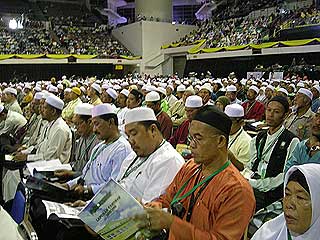 You can see them fumbling collectively forward, with the factions jostling for the power to narrate their political story.
Their political drama is played before a record number of 350 media organisations; at least you cannot fault them for lack of transparency.
Their readiness to face the world squarely no matter what signifies a kind of political maturity that is absent from many other political parties.
From the persistent voice of the ulama asserting their influential position in leading the party, you get the feeling that they do feel insecure in the face of the challenge from the professional group.
But PAS is a huge and complex political organisation.
It would perhaps be a mite too simplistic to see their internal power struggle as divided into the religious teachers and the professionals.
PAS has come a long way
As some religious scholars pointed out, a number of ulamas are professionals too. Then, as Farish A Noor interprets it, the professionals can be considered as ulamas as well!
In his article entitled ' PAS finding its way still ', Farish sums up his views as follows:
 “All in all, it is clear that PAS has come a long way and credit is due to this party that was built over half a century of hard work and selfless dedication by its members.
"Once again, I was impressed by the professionalism of those present and the efficient performance of the organisers.
“But we sincerely hope and pray that PAS will throw its lot with its comrades in the Pakatan, and remember that PAS’ gains in March 2008 were the result of it being in the Pakatan.
"For that reason, PAS leaders need to recognise the needs and demands of the Malaysian public, and be sensitive to the new political realities on the ground in Malaysia.”
I concur. In this current muktamar, PAS is obviously involved in a collective inward-looking reflective deliberation on their future identity.
That is a good thing, because without deep reflection, a political movement cannot evolve and grow. What is wanting though, is how they must now take their place as a national party that is also beholden to their non-Muslim electorate and the voters of Sarawak and Sabah.
SIM KWANG YANG was MP for Bandar Kuching from 1982 to 1995. He can be reached at kenyalang578@hotmail.com.


Report this comment
Are you sure you want to delete this comment?
This action cannot be undone.