




Ruling class out of sync with changing times
As the world watches with a great deal of anxiety the battle of wills on the streets of Teheran, I keep asking this question: When will the big crackdown come?
Thus far, both the government and the opposition protesters have shown great restraint, but who will blink first, in the daily confrontation for dominant space in Iran?
As the world watches with a great deal of anxiety the battle of will on the streets of Teheran, I keep asking this question: When will the big crackdown come?
Thus far, both the government and the opposition protesters have shown great restraint, but who will blink first, in the daily confrontation for dominant space in Iran?
What we witness everyday in that unfortunate country is a deep fissure driven into the heart of the Iranian national soul. Born from a revolution, the Iranian Republic is now torn asunder by another invisible peaceful revolution.
Already, old Iranians compare the present day spontaneous protests to those memorable protests in 1979 that brought down the Shah regime, forcing the American supported dictator to flee the country, and paving the way for the triumphant return of the Ayatollah from his exile.
 But the current crop of the ruling class, the clerics, the guardsmen and the militiamen, as well as the political elite, are unlikely to flee the country any time soon. They still have the means and the motivation to launch a massive crackdown on the opposition forces, with or without massive bloodshed.
By now, whether the presidential result was indeed rigged is no longer an issue. In public perception across a large swathe of the Iranian population, the rigging is a fact carved in stone.
In the hearts of many Iranians, the rigged election is the symbol of all that has gone wrong with an intolerant, irrelevant, and insensitive regime that has grown tired and old over 30 years.
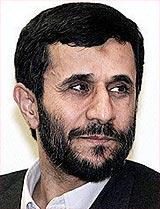
For the first time in the short history of the republic, even the moral authority of the highest spiritual leader Ayatollah Ali Khamenei has become shaky. Despite his many pleas, the opposition camps simply refused to accept as Ahmadinejad ( above ) as their duly-elected president.
Even when the Ayatollah instructed a probe to be conducted by the Guardian Council, and even after the said council has announced its willingness to recount some of the votes, the opposition forces still insist on a rerun of the election. They know that the Guardian Council is heavily loaded against the democratic will of the people.
Social contract must be honoured
Like any other nation, the social fabric of Iran is anchored upon a social contract between the ruling class and the people. The ruling class must fulfil the aspiration of the people, and in return the people will reward their rulers with their trust.
The people's trust is what gives legitimacy and stability to the political system, and make people want to obey the government.
 For instance, in Malaysia, many citizens distrust the top politicians in the country, but they still have trust in the political system. If they do not like BN, they still wait patiently for the next general election. This trust allows the Malaysian system the room for democratic improvement.
In sharp contrast, the daily street demonstrations on the streets of Teheran are but expressions of distrust of the entire political system that is seen as corrupted by power to the core. It is a direct expression of mistrust for the top clerics who are seen as failing their constitution.
The constitution of the Islamic Republic of Iran written in 1979 stipulated that Iran was to be a theocracy first and foremost. The clerical class with its power base in the holy city of Qom were to be the spiritual leaders of the Islamic nation, and would hold sway over even the elected government of their country. That was to be the basis of their national ideology.
Now, that basis is challenged by ordinary devout Iranian Muslims on the streets in many cities and towns daily! No matter what the outcome of the current impasse in the end, the national soul of Iran has been cracked in two. Its future is becoming increasingly uncertain.
The present upheaval is the result of rapid political and social evolution in Iran. Seventy percent of the Iranian population to day were born after the 1979 revolution. Eighty percent of the population now live in urban centres.
 Many of these new young Iranians are university educated and internet savvy. This is certainly not the Iran that welcome Ayatollah Khomeini back to Teheran in 1979.
But the ruling class has not evolved with the changing reality of the times. Entrenched in power and enjoying the prestige and benefits of office, they cling to their power with repressive means, When the university students took to the streets in 1999 and 2003, they cracked down hard on the students, imprisoning the dissident leaders and shutting down the newspapers.
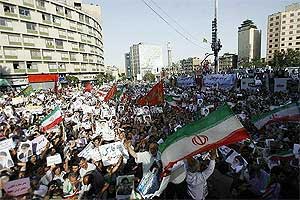
But this time, the massive demonstrations are not limited to the students. There is a spontaneous congruence of forces supported by a cross section of the Iranian society agitating for change and an opening up of the Iranian national life.
Burning desire for change
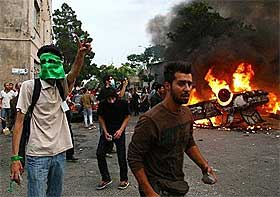
Everyday, they go to the streets and put their body in harm's way to show their burning desire for change, Every night, they shout from the roof top across the city "God is Great", the rallying cry of the 1979 revolution.
I had the privilege of witnessing another scene like this, in Manila in 1986. Three million people were in the streets demonstrating against a rigged election that put Fidel Marcos in power. Unlike in Iran today, they had a citizen polling watch dog that nullified the official election results.
Marcos sent out the tanks and the guns. The demonstrating nuns were putting flowers in the gun- barrels of the soldiers. Finally, even the military joined the revolution of the People Power, and Marcos fled the country with his wife.
 Every country has to traverse its own unique journey in resolving its internal historical contradiction. What happened in 1986 in manila may not happen in Teheran in 2009.
The clerics may concede to the popular demand of the people by ordering a rerun of the presidential election. That would drive a wedge into the loose coalition of the ruling class; it may incur the wrath of the Revolutionary Guards, who see themselves as the true heroes of the 1979 revolution and the eight-year Iran-Iraq War.
What the clerics will probably do is what dictators have done most of the time in the past in history; they will call in the military forces to drive away the demonstrators.
Much blood will be spilt on the streets of Teheran and other cities in Iran. Many will die as martyrs, solidifying the continuing myth of the Green Revolution of 2009.
When that happens, the idea of the Islamic Republic of Iran would probably die a natural death.
SIM KWANG YANG was MP for Bandar Kuching from 1982 to 1995. He can be reached at kenyalang578@hotmail.com


Are you sure you want to delete this comment?
This action cannot be undone.