




Baram village parched, adds to land woes
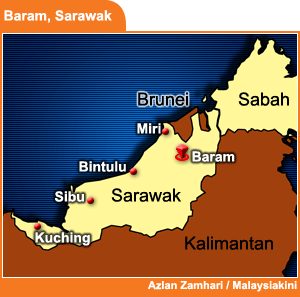
Residents of seven Iban longhouses in Sungai Peking, a tributary of Sungai Tinjar in Baram District, northern Sarawak have been suffering from a long spell of drought in the region since April this year.
Residents of seven Iban longhouses in Sungai Peking, a tributary of Sungai Tinjar in Baram District, northern Sarawak have been suffering from a long spell of drought in the region since April this year.
 The tributary, along which the longhouses stand, is so shallow that a small boat with 5hp engine can move only at a speed of 5 kms per hour, according, Jok Jau , a Baram-based co-ordinator with Sahabat Alam Malaysia (SAM).
"If the drought persists the situation will get worse for the longhouse people unless help comes from the authorities," he told Malaysiakini by telephone from Marudi today.
They are depending solely now on rain water, he said, adding that there has been some rain within the last two days, but the hot dry spell continues, but for how long the weather will be hot, no can tell.
The 800-strong largely Iban community from140 doors or homes in Sungai Peking are well-known for their strong stand against a government-approved oil palm plantation project involving the timber-based conglomerate Rimbunan Hijau (RH) in the Long Lama area.
According to Jok Jau, who knows the history of the Sungai Peking area well, the longhouses are reluctant to approach the authorities for help.
The people here are against the proposal by the company to turn the NCR land into an oil palm plantation.
There is also a primary school in the village.
"For the moment they manage to sustain but worry if the drought should get worst," the SAM co-ordinator said.
Shallow waters
Sungai Peking is about two hours by speedboat from Marudi, the administrative headquarters of the Baram District.
"Only in the past two to three days, because of rain, you can see barges carrying logs and sand from upriver past Marudi Town downriver,' he said.
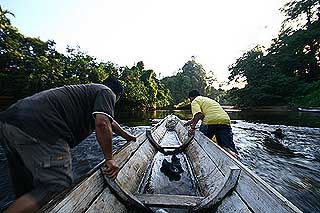 Sand is being extracted from the Baram River between Marudi and Long Lama and is then brought down by barges to Kuala Baram and Miri.
‘Although this helps to deepen the river in some sections, however it is also causing river erosion at the same time,' he added.
Sarawak's timber industry is in the doldrums with decreasing timber for timber-based products , including plywood meant for export.
Logging activities are being sustained to meet only the local demand and the needs of some long-term customers overseas.
Many of the logged areas are being turned over to large companies for reforestation and plnating oil palm trees.
As a result, this has brought back a new form of conflict in Baram with many native land-owners.
According to Jok Jau, the affected areas include Mulu, Long Terawan, Batu Blah,Long Linai and Long Panai which are inhabited by the Orang Ulu.
The latest conflict is in Long Terawan, where native land-owners are against an agreement with a private sector/government agency joint venture company Pusaka KTS Plantation.
To the rescue
Meanwhile, state authorities are reported to be sending clean water to schools and villages hit by the drought in the area.
Longhouses and the SK Puyot near Marudi received the water after an appeal was made to the Baram district office.
The 22,000 sq km district is one of the largest in Sarawak and Malaysia but has a population of less than 100,000.
Transportation is difficult in the remote areas.
Communication is mainly by river but in many places there are road links used mainly logging tracks and plantation roads.
In Kuala Lumpur, Energy, Green Technology and Water Minister Peter Chin Fah Kui was reported as saying that the state government should be looking into the matter as water supply comes within the purview of the state government.
"They should start checking which areas are the most affected from now," he said.


Are you sure you want to delete this comment?
This action cannot be undone.