




Anatomy of change
 As our nation stumbles forward daily, embroiled in raging controversies on many fronts amidst a great deal of political and economic uncertainty, we are all trapped in the cauldron of uncertain change.
As our nation stumbles forward daily, embroiled in raging controversies on many fronts amidst a great deal of political and economic uncertainty, we are all trapped in the cauldron of uncertain change.
Many New Malaysians hanker for some kind of change, as is reflected in the political agitation playing out ferociously on the national stage.
That this desired change cannot be achieved overnight has plunged them into fits of anxiety, and the virtual space on the Internet is filled with cries of despair.
Our nation is in the midst of a transition and the labour pain before the birth of a New Malaysia ravages our national soul.
But change we must, and change we will, because change is the law of nature and the metaphysical essence of our universe.
 The Buddhist teaching proclaims that change is the only permanence in life. The philosopher Heraclitus of ancient Greece did leave us with a fragment that “You never step into the same river twice”.
The river may appear to be the same to you, but the water flowing through it would have been different.
The greatest minds throughout history have always belaboured to understand change.
In natural science, mathematicians have invented calculus, to measure the rate of change. That works well for the natural world, but the intractable human world is much harder to pin down with any formula.
Hegel did try to sum it up with his historical dialectic. The thesis clashes with the antithesis, and through mediation of Time and the Spirit, synthesis is born.
Predicting the future
That works up to a point, but his theory has flaws. For one thing, you cannot predict the future with it. Predicting the future is what people want, mostly.
In business schools, there is no lack of new gurus churning out books on how to manage change, to instil into the minds of future business leaders the innovativeness required to adapt to new market environment and consumer behaviour.
In politics, those in power try to manage change by monopolising all its narratives, to ensure that society will change in the way that they can dictate. All governments do that to various degrees.
The only difference between a developed democracy and a autocratic dictatorship is that the former has regular elections, so that governments can be changed, and so the direction of change itself can also be alternated once in a while.
 In general, the demos – the faceless masses of people living within a geo-political boundary – are uncertain about change. If a radical change is needed, the idea is indeed not accepted widely initially.
The reason is simple: Human beings have this primordial impulse for survival. They have an inborn fear of the unknown future. If the present status quo allows them to live on like before, why change things?
You know the usual dictums. A bird in hand is worth two in the bush. It is better to sleep with the devil you know, then with the unknown angel. If things ain’t broke, don’t fix it.
In the revolutionary theory according to Marx, only the proletariat who own nothing and therefore face extinction will take up arms for change. The bourgeoisie (that means you and me) are not good material for any revolution. Naturally, the debate between evolutionary and revolutionary change still rages on.
People fear change by and large. Prophets of change have always been initially unwelcome. Socrates and Jesus Christ were put to death. (If they reappeared, we would probably kill them all over again).
Then we all know about what happened to Galileo; he was put under house arrest for life for saying that the Earth was round, and not flat.
1Malaysia part of old political order
Here, perhaps Thomas Kuhn has a more realistic perspective on human nature to offer than Hegel. In his book The Structure of Scientific Revolutions , he argued with respect to the Copernican Revolution that people generally are unwilling to discard an old paradigm, despite many evidences that the old paradigm is faulty and unworkable, until a better alternative paradigm is presented.
Kuhn was generally recognised as a philosopher of science, but his observation about how scientific theories change over time was also a study into human nature. That theory can be applied to human behaviours in politics as well.
In Malaysia, we have an ancient political order articulating the old paradigm of religion and race, the politics of patronage and development, the myth of stability and continuity, the façade of social harmony as re-branded in the 1Malaysia slogan.
Those of us who have awakened from our political slumber know that the 1Malaysia slogan is not merely empty; it is so full of internal contradictions that cannot be mediated that no meaningful synthesis can ever emerge from it. It is an unworkable paradigm. It is a dialectic that leads to a dead alley.
 Without a workable alternative paradigm though, Malaysians were still reluctant to discard the old paradigm. When the new paradigm of Reformasi was presented in 1998, it was too vague. Its creator had too much political baggage. It was embraced by many Malays, but it was still watched by the other communities with suspicion.
That is another thing about the dynamics of change. A new paradigm needs time to grow and mature. The idea of Christianity suffered many centuries of persecution until Emperor Constantine was converted and he declared religious tolerance throughout the Roman Empire in 312 AD. Until to-day, monotheistic religions still look askance at Darwin’s Theory of Evolution.
It took 10 long years for the idea of reformasi to mature slowly into a silent concrete agent for change in Malaysia. Finally, it was crystallised in the slogan Ketuanan Rakyat after the 2008 general election.
Here again, we have to reflect upon the essence of political leadership. The true political leader is one who can articulate the content and the future of the new paradigm when the old paradigm has grown tired.
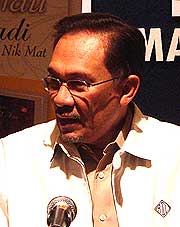
It is not only that he must be smart with slogans. He must understand the crucial contradictions of the time, be able to analyse the root cause of the national problems, and condense his vision in words that strike instant resonance among his followers. Obama is one such leader. Anwar Ibrahim (above) is another such leader in the making.
Much infighting in Sabah and Sarawak
Then again, we note one consistent trend in the history of change.
Whenever a new paradigm agitates to be born, the old order will do all it can to suppress its birth and growth.Those benefited from the old paradigm will gang up to protect the old order that has served them so well. What goes on in Iran everyday is evidence to that dictum. Power not only tends to corrupt; it tends to be addictive too, like cocaine.
When the new paradigm is engaged in a fight to the death with the old paradigm, there are still people to be persuaded that the old paradigm is no longer workable, and the new paradigm is a better workable alternative.The channels for mass persuasion may be blocked by the old order. Again, it takes time and much effort. It is a very hard task.
 In the case of Malaysia at the cross road, the Sarawakians and the Sabahans are particularly in need of this persuasion. This is a great opportunity for a new national dialogue on the road to true national integration.
Unfortunately, the opposition alliance in these two Borneon states is too burdened with remnants of the old paradigm.They are too busy with infighting and too lax with persuading their constituents.
If there is one law in history, it is that there are no historical laws as you would have natural laws governing the natural world. Marx was wrong in thinking that the dictatorship of the proletariat will inevitably triumph at the end of history.
The phrase “end of history” was actually coined by Hegel, and reworked by Francis Fukuyama in 1989 for his own purpose. The history of human affairs will always be open-ended, until the extinction of the human race.
There is no guarantee that the new paradigm in Malaysia will come to fruition.The future of human societies is indeed impossible to predict, because – unlike the natural world – human world is full of too many unknown parameters. Sometimes, luck, chance, and accidents may even make a critical difference in the development of events.
But we know one thing: Change we must, and change Malaysia will. It is not a descriptive sentence, but a normative one.
As the former British Prime Minister once said, “He who rejects change is the architect of decay; the only human institution which rejects progress is the cemetery.”
SIM KWANG YANG was MP for Bandar Kuching from 1982 to 1995. He can be reached at kenyalang578@hotmail.com )


Are you sure you want to delete this comment?
This action cannot be undone.